
A free-standing tower or rolling scaffold in California must have a base dimension of at least one third of its height unless it is securely guyed or tied. (8 CCR §1646(a)) That is a 3-to-1 height-to-base limit. If anyone rides the scaffold while it is moved, the base must be at least half the height, a 2-to-1 limit. (8 CCR §1646(i)(2)) Those two ratios, plus the guardrail, plank and access rules around them, are the core of Cal/OSHA's scaffold requirements for contractors.
The 3-to-1 and 2-to-1 ratios for rolling scaffolds
The rule in 8 CCR 1646(a) is written around the minimum dimension of the base, so use the narrower side. A scaffold with a 4-foot-wide base can stand free to 12 feet of height at 3-to-1. (8 CCR §1646(a)) If workers will ride that scaffold while others push it, the 2-to-1 rule caps it at 8 feet. (8 CCR §1646(i)(2))
Tying or guying the scaffold removes the 3-to-1 ratio requirement but not the other rules. Riding is the situation where the stricter ratio applies, and it comes with a list of conditions:
- The surface is level to within 3 degrees and has no pits, holes or obstructions. (8 CCR §1646(i)(1))
- The wheels have rubber or similar resilient tires, with metal wheels allowed on towers of 50 feet or more. (8 CCR §1646(i)(3))
- The push force is applied as close to the base as practicable and never more than 5 feet above the supporting surface. (8 CCR §1646(i)(4))
- Everyone on the scaffold is told before it moves, and nobody is on a part that extends out beyond the wheels or supports. (8 CCR §1646(i)(5)) (8 CCR §1646(i)(6))
A person riding a self-propelled scaffold has tighter limits: the platform can be no more than 4 feet above the floor, and it must be at least 20 inches wide with no more than a 1-inch gap between planks. (8 CCR §1646(j)) Motor vehicles, add-on motors and battery power cannot be used to propel a rolling scaffold. (8 CCR §1646(j)(5))
Wheels, screw jacks and platform details
Rolling scaffold wheels need an effective lock that stays locked while people climb or work. (8 CCR §1646(c)) At least 2 of the 4 casters must swivel, and every wheel has to carry at least 4 times the maximum intended load. (8 CCR §1646(c)) Ladders and other unstable objects cannot be set on top of a rolling scaffold to gain height. (8 CCR §1646(f))
A screw jack must extend into its leg tube by at least one third of its length, and the exposed thread cannot exceed 12 inches. (8 CCR §1646(b)(2)) Platform planks on rolling or tower scaffolds cannot stick out more than 18 inches past their supports, and the platform must be tightly planked across its full width except for needed entrance openings. (8 CCR §1646(e))
Guardrail heights
Open sides and ends of a work platform need railings once the platform is 7 1/2 feet or higher above grade. (8 CCR §1644(a)(6)) Measured up from the platform, the top rail runs 42 to 45 inches high, and a midrail goes about halfway between the top rail and the platform. (8 CCR §1644(a)(6)) An X-brace can serve as a top rail if the crossing point is 45 inches, give or take 3 inches, above the platform and a horizontal midrail is installed between 19 and 25 inches above it. (8 CCR §1644(a)(6)(A))
Tower and rolling scaffolds point back to this same railing rule. (8 CCR §1646(b)(1)) Toeboards or side screens can also be required. (8 CCR §1646(b)(1))
Planking and platform loads
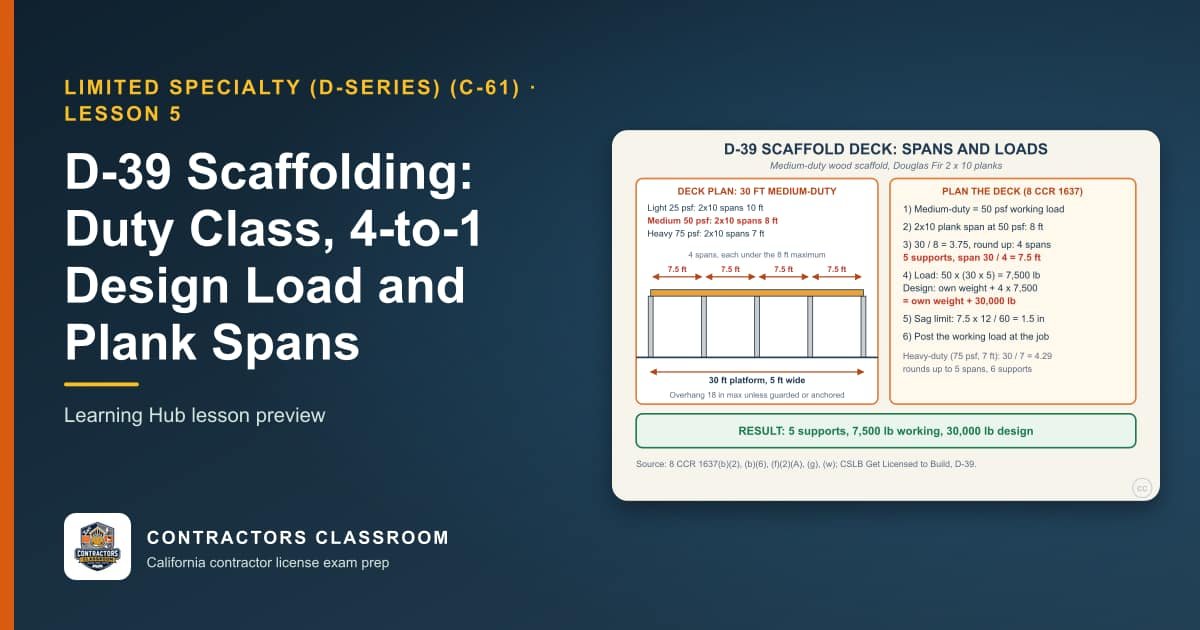
Solid sawn planks must be at least equivalent to 2 by 10 nominal scaffold-grade lumber. (8 CCR §1637(f)(1)) For Douglas fir and Southern pine, the maximum span of a 2 by 10 plank depends on the working load: 10 feet at 25 pounds per square foot, 8 feet at 50, and 7 feet at 75. (8 CCR §1637(f)(2)(A)) Those loads correspond to light-, medium- and heavy-duty scaffolds. (8 CCR §1637(b)(2))
A scaffold is designed to carry its own weight plus 4 times the maximum intended working load. (8 CCR §1637(b)(2)) Each plank must extend at least 6 inches past the ledger at both ends. (8 CCR §1644(a)(7)) A plank may hang no more than 18 inches past its support, unless a guardrail or other barrier keeps people off the overhang or the far end is anchored. (8 CCR §1637(g)) All planks are inspected before use each day, and damaged ones come out of service. (8 CCR §1637(f)(6)) (8 CCR §1637(f)(7))
Putting planks on guardrails to get extra height is not allowed. (8 CCR §1644(a)(4))
Worked example: a 22-foot platform at heavy duty
Suppose a heavy-duty platform (75 pounds per square foot) is 22 feet long. At that load a 2 by 10 plank spans no more than 7 feet. (8 CCR §1637(f)(2)(A))
- Divide the length by the maximum span: 22 / 7 = 3.14. Round up to 4 spans.
- Four spans need 5 supports. Each span is 22 / 4 = 5.5 feet, comfortably under 7.
- Check the design load. If the platform is 5 feet wide, its area is 22 x 5 = 110 square feet. At 75 pounds per square foot the working load is 8,250 pounds, and the scaffold is designed for its own weight plus 4 x 8,250 = 33,000 pounds. (8 CCR §1637(b)(2))
Ties, bases, access and wind
Metal scaffolds rest on manufacturer base plates and, on earth or soft ground, the plate must bear on a wooden pad equal to a 2 by 10 piece cut 10 inches square. (8 CCR §1644(a)(3)) Tie-ins use wire at intervals of no more than 30 feet horizontally, and ties are required at the free ends once the platform height passes 3 times the least base dimension. (8 CCR §1644(a)(5))
For access, a safe and unobstructed route, such as a walkway, stair or ladder, has to reach every platform. (8 CCR §1637(n)(1)) A hook-on ladder is limited to a bottom rung no more than 24 inches above the supporting level and rungs spaced no wider than 16 3/4 inches. (8 CCR §1637(n)(2)) On a supported scaffold more than 35 feet high, such ladders need rest platforms at 35-foot intervals. (8 CCR §1637(n)(2))
Work on scaffolds during storms or high winds is prohibited unless a qualified person has decided it is safe and the workers are protected by personal fall arrest or wind screens. (8 CCR §1637(u)) A qualified person must also supervise erection and dismantling. (8 CCR §1637(k)(1))
Study tip
The most common mix-up is between the 3-to-1 free-standing limit and the 2-to-1 riding limit, so write both on a card. Finish trades such as painting and drywall often work from rolling scaffolds, so the painting contractor exam prep page and the drywall page are good places to apply these rules. Painting contractor license exam prep Drywall contractor license exam prep A separate lesson works through scaffold duty classes and plank spans in more depth. D-39 scaffold duty class and plank spans
Sources
Code sections and publications this article relies on, as printed in the editions we reviewed. Codes and CSLB procedures change: check the current text before you rely on a detail.
- California Code of Regulations, Title 8 (Cal/OSHA Construction Safety Orders), section 1646(a)
- California Code of Regulations, Title 8 (Cal/OSHA Construction Safety Orders), section 1646(i)(2)
- California Code of Regulations, Title 8 (Cal/OSHA Construction Safety Orders), section 1646(i)(1)
- California Code of Regulations, Title 8 (Cal/OSHA Construction Safety Orders), section 1646(i)(3)
- California Code of Regulations, Title 8 (Cal/OSHA Construction Safety Orders), section 1646(i)(4)
- California Code of Regulations, Title 8 (Cal/OSHA Construction Safety Orders), section 1646(i)(5)
- California Code of Regulations, Title 8 (Cal/OSHA Construction Safety Orders), section 1646(i)(6)
- California Code of Regulations, Title 8 (Cal/OSHA Construction Safety Orders), section 1646(j)
- California Code of Regulations, Title 8 (Cal/OSHA Construction Safety Orders), section 1646(j)(5)
- California Code of Regulations, Title 8 (Cal/OSHA Construction Safety Orders), section 1646(c)
- California Code of Regulations, Title 8 (Cal/OSHA Construction Safety Orders), section 1646(f)
- California Code of Regulations, Title 8 (Cal/OSHA Construction Safety Orders), section 1646(b)(2)
- California Code of Regulations, Title 8 (Cal/OSHA Construction Safety Orders), section 1646(e)
- California Code of Regulations, Title 8 (Cal/OSHA Construction Safety Orders), section 1644(a)(6)
- California Code of Regulations, Title 8 (Cal/OSHA Construction Safety Orders), section 1644(a)(6)(A)
- California Code of Regulations, Title 8 (Cal/OSHA Construction Safety Orders), section 1646(b)(1)
- California Code of Regulations, Title 8 (Cal/OSHA Construction Safety Orders), section 1637(f)(1)
- California Code of Regulations, Title 8 (Cal/OSHA Construction Safety Orders), section 1637(f)(2)(A)
- California Code of Regulations, Title 8 (Cal/OSHA Construction Safety Orders), section 1637(b)(2)
- California Code of Regulations, Title 8 (Cal/OSHA Construction Safety Orders), section 1644(a)(7)
- California Code of Regulations, Title 8 (Cal/OSHA Construction Safety Orders), section 1637(g)
- California Code of Regulations, Title 8 (Cal/OSHA Construction Safety Orders), section 1637(f)(6)
- California Code of Regulations, Title 8 (Cal/OSHA Construction Safety Orders), section 1637(f)(7)
- California Code of Regulations, Title 8 (Cal/OSHA Construction Safety Orders), section 1644(a)(4)
- California Code of Regulations, Title 8 (Cal/OSHA Construction Safety Orders), section 1644(a)(3)
- California Code of Regulations, Title 8 (Cal/OSHA Construction Safety Orders), section 1644(a)(5)
- California Code of Regulations, Title 8 (Cal/OSHA Construction Safety Orders), section 1637(n)(1)
- California Code of Regulations, Title 8 (Cal/OSHA Construction Safety Orders), section 1637(n)(2)
- California Code of Regulations, Title 8 (Cal/OSHA Construction Safety Orders), section 1637(u)
- California Code of Regulations, Title 8 (Cal/OSHA Construction Safety Orders), section 1637(k)(1)
Every lesson and question we write is grounded in California code books and CSLB materials. How we build our lessons


