
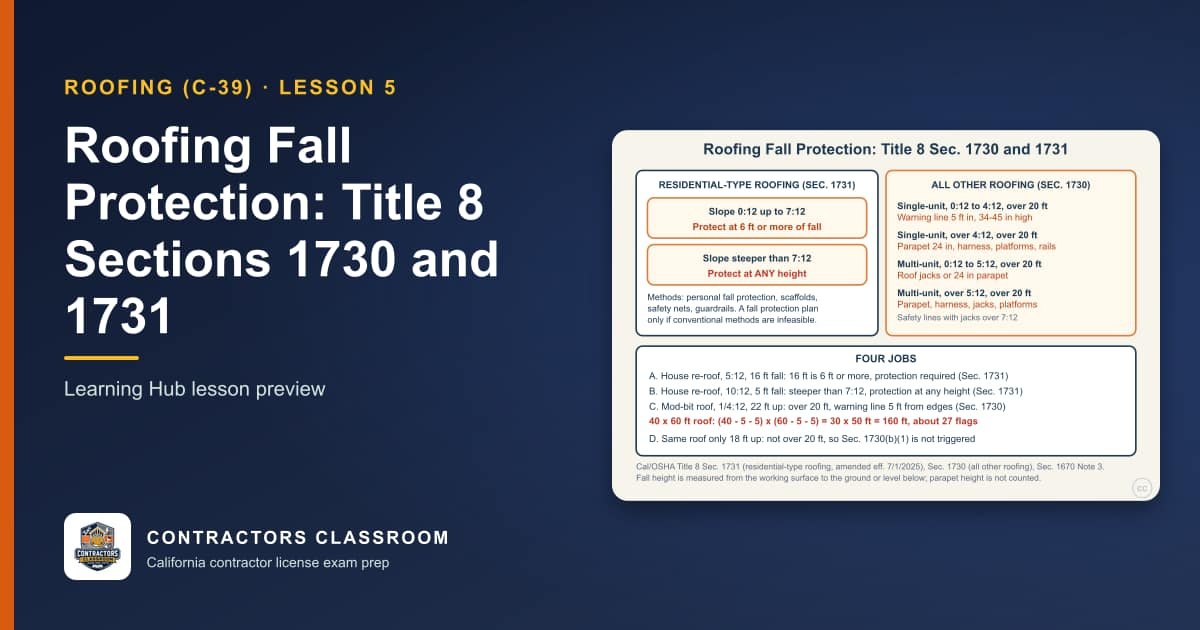
Which Cal/OSHA roof fall rule applies to you depends first on what kind of roofing job it is, and only then on height and slope. Residential-type roofing falls under 8 CCR 1731, where protection starts at a fall distance of 6 feet. (8 CCR §1731(c)(1)) Other roofing falls under 8 CCR 1730, where the main trigger is a roof height of more than 20 feet. (8 CCR §1730(b)(1)) Mixing the two up is one of the easiest ways to miss a question or a citation.
Which section covers your roof
Section 1731 defines residential-type roofing as roofing, re-roofing and tear-off work on single-family houses, townhouses, duplexes and similar structures that Section 1716.2 covers. (8 CCR §1731(b)) The definition takes in loading and laying roofing materials, the insulation that goes with them, sheet metal built into the roof system, and vapor barrier work. It leaves out construction of the roof deck. (8 CCR §1731(b))
Section 1730 says outright that it does not apply to residential-type roofing activities. (8 CCR §1730(a)) So a tract-home re-roof follows 1731, while a commercial flat roof follows 1730.
Residential-type roofing under 8 CCR 1731
The rule splits at a 7 in 12 slope.
- Slopes from 0 in 12 up to and including 7 in 12: protection is required once a worker could fall 6 feet or more to the grade or level below. (8 CCR §1731(c)(1))
- Slopes steeper than 7 in 12: the same protection applies regardless of height. (8 CCR §1731(c)(2))
The methods allowed are personal fall protection systems, scaffolding, safety nets and guardrails. (8 CCR §1731(c)(1)) The fallback is a written fall protection plan using safety monitors and controlled access zones, and it is available only if the employer can show conventional methods are infeasible. It must meet Sections 1671.1 and 1671.2. (8 CCR §1731(c)(1)) Notice that a warning line by itself is not on the 1731 list.
Roof slope here means the ratio of vertical rise to horizontal run, so a 4 in 12 roof rises 4 feet for each 12 feet of run. (8 CCR §1731(b))
Workers on these jobs also need specific training in the fall hazards of roofing work. The list includes gable ends, slipping, roof holes and openings, skylights, ladders and scaffolds, access to the roof, where materials are placed, impalement hazards, and care and use of fall protection systems. (8 CCR §1731(d)(1)) The employer has to keep documentation of that training. (8 CCR §1731(d)(2))
Other roofing under 8 CCR 1730
Section 1730 sorts roofs by covering type as well as slope. Section 1723 describes the two groups: single-unit (monolithic) coverings, such as built-up roofing and flat-seam metal, and multiple-unit coverings, such as asphalt shingles, standing-seam panels, tile and slate. (8 CCR §1723(a)) In every case below, the trigger is a roof height of more than 20 feet, except that the low-slope single-unit rule applies at any height when felt-laying machines or similar walk-behind equipment are in use. (8 CCR §1730(b)(1))
- Single-unit, slopes 0 in 12 to 4 in 12: use one or a combination of the methods in the section, which centers on warning lines and headers. (8 CCR §1730(b)(1))
- Single-unit, slopes steeper than 4 in 12: choose from parapets 24 inches or higher, personal fall protection, catch platforms, scaffold platforms, eave barriers, or standard railings and toeboards. (8 CCR §1730(c))
- Multiple-unit, slopes 0 in 12 through 5 in 12: use a roof jack system, a parapet at least 24 inches high, or another method that gives equivalent protection. (8 CCR §1730(e))
- Multiple-unit, slopes steeper than 5 in 12: pick from a 24-inch parapet, personal fall protection, catch platforms, scaffold platforms, eave barriers or roof jack systems. Safety lines are required with roof jacks on roofs steeper than 7 in 12. (8 CCR §1730(f))
Height is measured as the vertical distance from the employee's walking or working surface to the ground or level below, and a parapet does not add to the measurement. (8 CCR §1730(g))
Warning lines: height, strength and distance
On low-slope single-unit roofs, warning lines are one of the allowed methods, and the details are specific.
- The line is rope, wire or something similar, with bright flagging hung roughly every 6 feet. (8 CCR §1730(b)(2))
- It is set 34 to 45 inches over the roof surface. (8 CCR §1730(b)(2))
- It must be able to take at least 500 pounds of tension. (8 CCR §1730(b)(2)(B))
- Stanchions are designed and installed to resist tipping and displacement, and the line is attached so that pulling one section does not take up slack in the sections beside it. (8 CCR §1730(b)(2))
- Both the lines and the headers stay at least 5 feet back from the roof edge. (8 CCR §1730(b)(4))
Where felt-laying machines or other equipment operated by an operator walking backward (walk-behind) are used, the distances increase. On the edges that run perpendicular to the direction of travel, headers must stay 10 feet back, while warning lines still need only 5, or 10 when conditions prevent the use of headers. (8 CCR §1730(b)(5)) The operator stays at least 3 feet from edges parallel to the direction of travel. (8 CCR §1730(b)(10))
Employees are told to stay inside the lines except when work must be done at the roof edge, and any work outside the lines is closely supervised by a qualified person. (8 CCR §1730(b)(7)) (8 CCR §1730(b)(8))
Worked examples
Job A: house re-roof, 5 in 12, eave 16 feet above grade. This is residential-type roofing under 1731. The slope is not steeper than 7 in 12, and 16 feet is more than 6 feet, so protection is required. (8 CCR §1731(c)(1))
Job B: house re-roof, 10 in 12, eave 5 feet above grade. The slope is steeper than 7 in 12, so the 5-foot height does not matter. Protection is required. (8 CCR §1731(c)(2))
Job C: built-up roof, nearly flat, 22 feet above grade, 40 by 60 feet. This falls under 1730 and 22 feet exceeds 20. A warning line 5 feet in from each edge makes a rectangle of 30 by 50 feet, so the line is 2 x (30 + 50) = 160 feet long. (8 CCR §1730(b)(4)) With flags about every 6 feet, plan for roughly 27 flags. (8 CCR §1730(b)(2))
Job D: the same flat roof, but 18 feet up. The roof is not more than 20 feet high, so the 1730(b)(1) trigger is not reached. (8 CCR §1730(b)(1)) The general safety program and training requirements in Sections 1509 and 1510 still apply. (8 CCR §1730(a))
Where to practice
Fall protection questions are easiest when you work them as a sequence: identify the type of roofing job, find the slope, measure the height, then pick a permitted method. The roofing contractor exam prep page covers this subject area for the C-39 license. Roofing contractor license exam prep A full lesson walks through the same four jobs. Roofing fall protection under Title 8 sections 1730 and 1731 Section 1731 points to the residential framing section, 1716.2, so framing crews should read both. (8 CCR §1731(b)) Framing and rough carpentry exam prep
Sources
Code sections and publications this article relies on, as printed in the editions we reviewed. Codes and CSLB procedures change: check the current text before you rely on a detail.
- California Code of Regulations, Title 8 (Cal/OSHA Construction Safety Orders), section 1731(c)(1)
- California Code of Regulations, Title 8 (Cal/OSHA Construction Safety Orders), section 1730(b)(1)
- California Code of Regulations, Title 8 (Cal/OSHA Construction Safety Orders), section 1731(b)
- California Code of Regulations, Title 8 (Cal/OSHA Construction Safety Orders), section 1730(a)
- California Code of Regulations, Title 8 (Cal/OSHA Construction Safety Orders), section 1731(c)(2)
- California Code of Regulations, Title 8 (Cal/OSHA Construction Safety Orders), section 1731(d)(1)
- California Code of Regulations, Title 8 (Cal/OSHA Construction Safety Orders), section 1731(d)(2)
- California Code of Regulations, Title 8 (Cal/OSHA Construction Safety Orders), section 1723(a)
- California Code of Regulations, Title 8 (Cal/OSHA Construction Safety Orders), section 1730(c)
- California Code of Regulations, Title 8 (Cal/OSHA Construction Safety Orders), section 1730(e)
- California Code of Regulations, Title 8 (Cal/OSHA Construction Safety Orders), section 1730(f)
- California Code of Regulations, Title 8 (Cal/OSHA Construction Safety Orders), section 1730(g)
- California Code of Regulations, Title 8 (Cal/OSHA Construction Safety Orders), section 1730(b)(2)
- California Code of Regulations, Title 8 (Cal/OSHA Construction Safety Orders), section 1730(b)(2)(B)
- California Code of Regulations, Title 8 (Cal/OSHA Construction Safety Orders), section 1730(b)(4)
- California Code of Regulations, Title 8 (Cal/OSHA Construction Safety Orders), section 1730(b)(5)
- California Code of Regulations, Title 8 (Cal/OSHA Construction Safety Orders), section 1730(b)(10)
- California Code of Regulations, Title 8 (Cal/OSHA Construction Safety Orders), section 1730(b)(7)
- California Code of Regulations, Title 8 (Cal/OSHA Construction Safety Orders), section 1730(b)(8)
Every lesson and question we write is grounded in California code books and CSLB materials. How we build our lessons


