
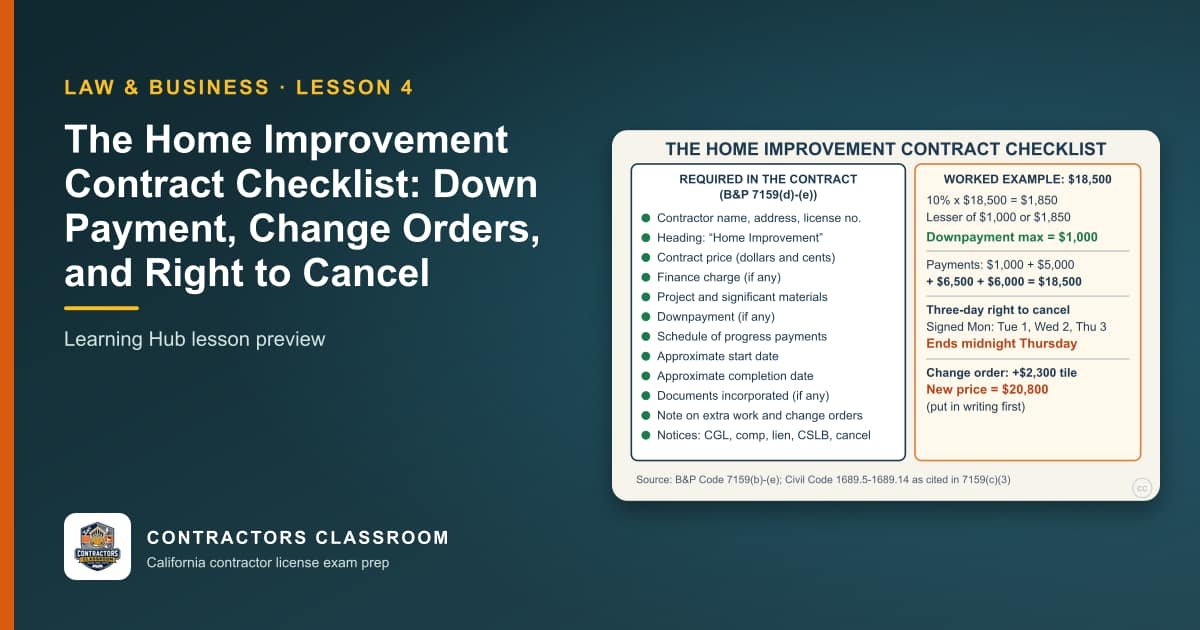
In California, a very small job can fall outside the licensing law, but the exemption is narrow, and the dollar figure depends on which source you read. CSLB's Get Licensed to Build says any construction project worth $500 or more, counting labor and materials together, has to go to a licensed contractor. (CSLB Get Licensed to Build, p. 4) The 2026 License Law book prints a $1,000 figure in the exemption section, with conditions attached. (License Law Book 2026, B&P §7048) This article walks through both, plus the penalties, and uses the editions we reviewed. Confirm the current threshold with CSLB before you take a job.
The $500 figure versus the $1,000 figure
The guide's statement is simple: licensed contractors perform work of $500 or more, counting labor and materials, and you need your license before you bid. (CSLB Get Licensed to Build, p. 4) The guide's own copyright line, in its front matter, reads 2021-2024.
Section 7048 in the 2026 law book says the licensing chapter does not apply to one project or undertaking if the combined price of labor, materials and every other item falls below $1,000, the work is casual, minor or inconsequential, and it does not need a building permit. (License Law Book 2026, B&P §7048(a)) The guide itself tells readers to consult the License Law book for specific laws. When the two numbers differ, treat the law book's text as the more current statement and call CSLB to confirm.
Home improvement has its own $500 mark. A home improvement contract, for purposes of the contract rules, is one whose total price for labor, services and materials is more than $500. (License Law Book 2026, B&P §7159(b))
You cannot split a job to get under the line
Both sources close this loophole. The guide calls it illegal to break a job into pieces in order to dodge the limit. (CSLB Get Licensed to Build, p. 4) The law says the exemption does not apply when the work is only part of a larger operation, or when the operation is divided into contracts under the threshold to evade the licensing law. (License Law Book 2026, B&P §7048(b))
A worked example: a customer wants $2,400 of work, and you write it up as three $800 invoices. Under the law, that is still one undertaking priced at $2,400, so the small-job exemption does not protect you.
Small-job exemptions can still be lost
Even a cheap job can fall outside the exemption. The law's definition of a contractor reaches anyone who offers to do work or submits a bid, not only the person who finishes it. (License Law Book 2026, B&P §7026) The small-job exemption also does not apply to someone who advertises, or uses a sign or card that suggests being a contractor, or who employs another person to do or help with the work. (License Law Book 2026, B&P §7048(c))
Advertising has its own rule. It is a misdemeanor to advertise covered work without a valid license in the classification advertised, with a fine of $700 to $1,000. (License Law Book 2026, B&P §7027.1) An unlicensed person may advertise only when the total price is under $1,000 and the ad states that the person is not licensed. (License Law Book 2026, B&P §7027.2)
Permits matter too. A city or county that requires a permit must also require the applicant to state a license number, or the basis for any claimed exemption, with a civil penalty of up to $500 for violations. (License Law Book 2026, B&P §7031.5)
Who is exempt besides small jobs
The guide lists these exemptions: (CSLB Get Licensed to Build, p. 4)
- Public employees doing public projects
- Court officers acting within the scope of their duties
- Public utilities, under specified conditions
- Oil and gas work done by an owner or lessee
- Retailers of installed carpet, when they hold the right dealer's license and use a licensed carpet installer
- Licensed security alarm company operators, while fire alarm company operators must hold CSLB licenses
- Registered installers of residential satellite antenna systems
Owner-builders can be exempt on their own property when conditions are met, such as living in the home for 12 months before completion of the work and limiting how many structures they work on. (CSLB Get Licensed to Build, p. 5) The law also exempts people who only furnish materials or supplies, (License Law Book 2026, B&P §7052) and employees who receive wages as their sole pay and do not run an independent business. (License Law Book 2026, B&P §7053)
What happens if you contract without a license
The criminal side comes first. Contracting without a license is a misdemeanor. A first conviction carries a fine up to $5,000, up to six months in county jail, or both. (License Law Book 2026, B&P §7028(b)) After a prior conviction the court must impose the greater of $5,000 or 20 percent of the price (or of payments made), and generally at least 90 days in jail. (License Law Book 2026, B&P §7028(c)) A third or later conviction brings a fine of at least $5,000, and jail of 90 days to one year. (License Law Book 2026, B&P §7028(d)) In an area under a state or federal disaster declaration, the guide says unlicensed contracting can bring felony charges. (CSLB Get Licensed to Build, p. 5)
On the administrative side, CSLB issues citations. The guide says civil penalties of $200 to $15,000 are possible. (CSLB Get Licensed to Build, p. 5) The law book prints a newer version of the citation section that became operative July 1, 2026, with a minimum of $1,500 and the same $15,000 maximum. (License Law Book 2026, B&P §7028.7)
Then the money problems:
- An unlicensed contractor generally cannot sue to collect payment for work that required a license. (License Law Book 2026, B&P §7031(a))
- The customer can sue to recover everything paid to the unlicensed contractor. (License Law Book 2026, B&P §7031(b))
- A security interest taken for that work is unenforceable. (License Law Book 2026, B&P §7031(c))
- Someone who hired the unlicensed person is treated as a crime victim for restitution, even if they did not know. (License Law Book 2026, B&P §7028(h))
Charges can be brought within four years of the contract proposal, contract, completion or abandonment, whichever is last. (License Law Book 2026, B&P §7028(g))
If you are already licensed
A license is not a free pass on other people's work. Entering into a contract with a contractor who is not licensed is a cause for disciplinary action against a licensee. (License Law Book 2026, B&P §7118) So is acting under an inactive license or a suspended one. (License Law Book 2026, B&P §7117.5)
Starting out in a trade? Look at the Residential Remodeling exam prep or the painting contractor license exam prep, and see how the contract rules work in our home improvement contract checklist.
Sources
Code sections and publications this article relies on, as printed in the editions we reviewed. Codes and CSLB procedures change: check the current text before you rely on a detail.
- CSLB, Get Licensed to Build: A Guide to Becoming a Licensed Contractor, page 4
- California Contractors License Law & Reference Book, 2026 edition (CSLB), B&P Code section 7048
- California Contractors License Law & Reference Book, 2026 edition (CSLB), B&P Code section 7048(a)
- California Contractors License Law & Reference Book, 2026 edition (CSLB), B&P Code section 7159(b)
- California Contractors License Law & Reference Book, 2026 edition (CSLB), B&P Code section 7048(b)
- California Contractors License Law & Reference Book, 2026 edition (CSLB), B&P Code section 7026
- California Contractors License Law & Reference Book, 2026 edition (CSLB), B&P Code section 7048(c)
- California Contractors License Law & Reference Book, 2026 edition (CSLB), B&P Code section 7027.1
- California Contractors License Law & Reference Book, 2026 edition (CSLB), B&P Code section 7027.2
- California Contractors License Law & Reference Book, 2026 edition (CSLB), B&P Code section 7031.5
- CSLB, Get Licensed to Build: A Guide to Becoming a Licensed Contractor, page 5
- California Contractors License Law & Reference Book, 2026 edition (CSLB), B&P Code section 7052
- California Contractors License Law & Reference Book, 2026 edition (CSLB), B&P Code section 7053
- California Contractors License Law & Reference Book, 2026 edition (CSLB), B&P Code section 7028(b)
- California Contractors License Law & Reference Book, 2026 edition (CSLB), B&P Code section 7028(c)
- California Contractors License Law & Reference Book, 2026 edition (CSLB), B&P Code section 7028(d)
- California Contractors License Law & Reference Book, 2026 edition (CSLB), B&P Code section 7028.7
- California Contractors License Law & Reference Book, 2026 edition (CSLB), B&P Code section 7031(a)
- California Contractors License Law & Reference Book, 2026 edition (CSLB), B&P Code section 7031(b)
- California Contractors License Law & Reference Book, 2026 edition (CSLB), B&P Code section 7031(c)
- California Contractors License Law & Reference Book, 2026 edition (CSLB), B&P Code section 7028(h)
- California Contractors License Law & Reference Book, 2026 edition (CSLB), B&P Code section 7028(g)
- California Contractors License Law & Reference Book, 2026 edition (CSLB), B&P Code section 7118
- California Contractors License Law & Reference Book, 2026 edition (CSLB), B&P Code section 7117.5
Every lesson and question we write is grounded in California code books and CSLB materials. How we build our lessons


