Included with every course

Law and Business Exam Prep for California Contractors

The Law and Business exam is part of every California contractor license application. Study with 694 practice questions in 10 categories and 8 Learning Hub lessons, made for California contractor applicants. It comes with every trade course.

One-time purchase, no subscription. Law & Business included.

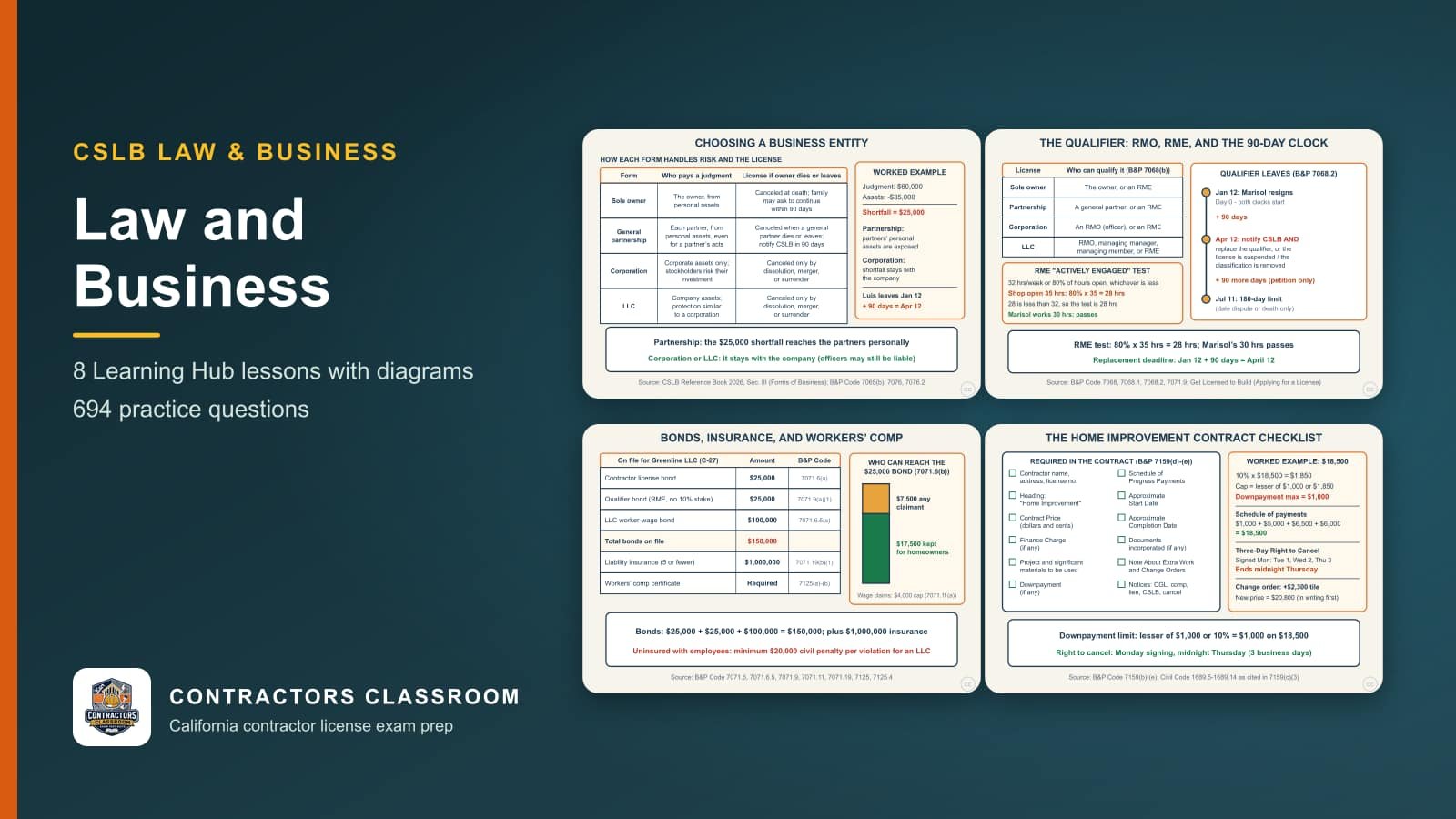
Diagrams from the LB law and business lessons: Choosing a Business Entity: Liability, Taxes, and What Happens to the License, The Qualifying Individual: RMO, RME, and the 90-Day Replacement Clock, Bonds, Liability Insurance, and Workers’ Comp: What the License Requires on File and The Home Improvement Contract Checklist: Down Payment, Change Orders, and Right to Cancel
694practice questions
10categories
8Learning Hub lessons
$249Law & Business included

What the exam covers: Law & Business

The CSLB Law and Business exam is a closed-book, multiple-choice test. CSLB's official study guide divides it into seven major sections and gives each an approximate weight: Business Organization and Licensing (about 13%), Business Finances (about 15%), Employment Requirements (about 20%), Insurance and Liens (about 12%), Contract Requirements and Execution (about 21%), Public Works (about 5%), and Safety (about 14%).

Contract Requirements and Execution carries the most weight, about 21%, so it deserves roughly that share of your study time, with Employment Requirements next at about 20%.

Contractors Classroom turns that outline into 694 practice questions in 10 categories (Business Organization and Licensing, Business Finances, Employment Requirements, Bonds, Insurance, and Liens, Insurance and Liens, and Contract Requirements and Execution, and more), plus 8 Learning Hub lessons with diagrams (such as "Choosing a Business Entity: Liability, Taxes, and What Happens to the License" and "The Qualifying Individual: RMO, RME, and the 90-Day Replacement Clock"). Law and Business is included with every trade course.

Exam sections and approximate weights

  • Business Organization and Licensing~13%
  • Business Finances~15%
  • Employment Requirements~20%
  • Insurance and Liens~12%
  • Contract Requirements and Execution~21%
  • Public Works~5%
  • Safety~14%

Practice question categories

  • Business Organization and Licensing87 practice questions
  • Business Finances82 practice questions
  • Employment Requirements110 practice questions
  • Bonds, Insurance, and Liens92 practice questions
  • Insurance and Liens76 practice questions
  • Contract Requirements and Execution68 practice questions
  • Licensing Requirements59 practice questions
  • Public Works18 practice questions
  • Safety63 practice questions
  • Public Works39 practice questions

What the Law and Business exam covers, section by section

Business Organization and Licensing (~13%)

Before a contractor can take on work, the business itself must be set up properly. This area looks at choosing a legal structure and managing the company, meeting the requirements to hold and keep a contractor license, and following the rules that apply to promoting services and hiring other contractors to perform part of a job.

  • Choose and manage a business structure such as a sole owner or corporation
  • Meet the conditions for obtaining, keeping, and using a contractor license
  • Follow the rules for promoting services and hiring other contractors

Business Finances (~15%)

Many construction businesses fail from poor money management rather than poor workmanship. Candidates are expected to understand how money moves in and out of a company, how to plan spending ahead, what tax obligations come with running a business, and how financial statements show whether the company is healthy.

  • Keep enough cash on hand to cover payroll, materials, and overhead between payments
  • Plan spending ahead with budgets and forecasts for the year
  • Handle the tax duties that come with operating a business
  • Prepare and read statements that show profit, debt, and financial strength

Employment Requirements (~20%)

Once a contractor has a crew, a whole layer of legal and practical duties appears. The material follows the employment relationship from bringing someone on board, through guiding and developing them, to documenting their performance and paying them correctly and on time.

  • Recruit and onboard workers while following the rules on hiring
  • Direct crews and provide the training they need to work competently
  • Review performance fairly and maintain the records employers must keep
  • Calculate wages, deductions, and withholdings and pay workers on schedule

Insurance and Liens (~12%)

Construction exposes a business to injuries, property damage, and unpaid bills, and the law provides tools to manage each. This area covers coverage that protects employees hurt on the job, the policies that shield the company from other losses, and the legal claims available to secure payment when a project goes unpaid.

  • Provide coverage for employees injured while working for the company
  • Carry policies that protect the business against claims and property losses
  • Use lien rights and other legal remedies to pursue unpaid work

Contract Requirements and Execution (~21%)

This is the largest portion of the exam and follows a project from the first price to the final check. It deals with preparing a competitive proposal, tracking spending against the plan, coordinating people and tasks, forming a sound written agreement, and managing how and when money changes hands.

  • Prepare bids that reflect true costs and a reasonable margin
  • Track labor and material spending so overruns are caught early
  • Coordinate schedules, subcontractors, and paperwork across the project
  • Write and sign agreements that clearly state scope, price, and obligations
  • Handle progress payments, change orders, and final billing in an orderly way

Public Works (~5%)

Government-funded construction carries extra obligations that private jobs may not. A small portion of the exam looks at the wage standards that apply to workers on those projects, the financial guarantees often demanded of the contractor, and the coverage the agency may require before work can begin.

  • Pay workers on government-funded projects the wage rates set for their trade
  • Furnish the financial guarantees that public owners require from contractors
  • Carry the insurance coverage that public agencies specify for their projects

Safety (~14%)

Running a construction business means owing the crew a safe workplace. This area touches on instruction and incident documentation that employers are obliged to provide, everyday practices that prevent injuries on a job, and the right way to respond when a worker meets a substance nobody has identified.

  • Provide required safety instruction and report workplace injuries as the rules direct
  • Apply everyday practices that keep crews safe around tools and heights
  • Stop work and respond carefully when a suspicious or unlabeled material turns up

Code books behind the Law and Business exam

The exam outline published for this trade lists these references.

  • California Contractors License Law & Reference BookThis combined volume gathers the licensing statutes and a plain-language business guide: who must be licensed, how entities and qualifiers are handled, bonds, discipline, home improvement contract rules, liens and stop notices, taxes and financial control. It is the broadest single reference behind Business Organization and Licensing and Contract Requirements and Execution, and it also touches Insurance and Liens.
  • California Employer's Guide (DE 44)The state payroll agency prints this guide for anyone who hires help. It explains when you become an employer, how to classify a worker, new-hire reporting, the four California payroll taxes, deposit schedules, returns, and recordkeeping. It supports the Employment Requirements section, the second-largest part of the exam outline, especially hiring, payroll, and record-keeping questions.
  • California Financial Code (regarding the PACE program)Only the part dealing with PACE financing matters here. PACE lets a property owner pay for efficiency, renewable energy, or water improvements through an assessment on the property tax bill. The code sets rules for how such financing is offered and documented, so it feeds Business Finances and Contract Requirements and Execution whenever a customer funds work this way.
  • California Labor CodeThis is the state's body of employment law: wages and hours, overtime, meal and rest breaks, pay statements, final pay, required workers' compensation coverage, apprentices, and the rules for public works pay. It is the reference behind Employment Requirements, part of Insurance and Liens, and the prevailing wage topics in Public Works, so expect it across several sections.
  • Get Licensed to BuildWritten for applicants, this guide walks through the road to a license: classifications, experience and its verification, the application and fee steps, the exams, fingerprints, bond and insurance filings, and who may qualify each kind of business. It is the plain-English companion for the Licensing Requirements topics inside Business Organization and Licensing.
  • Maintain and Change Your LicenseOnce the license exists, this booklet covers keeping it alive: renewal, inactive status, adding a classification, changing the business name, address, entity, or qualifier, and keeping the bond and insurance filings current. It informs the license-upkeep side of Business Organization and Licensing, including what happens when ownership or the qualifying person changes.
  • NASCLA Contractors Guide to Business, Law and Project Management, 14th EditionA national textbook for contractors that treats the business as a whole: choosing a legal form, accounting and financial statements, taxes, insurance and bonding, hiring, bidding, contracts, cost control, scheduling, and jobsite safety. Because it spans so many topics, it lines up with nearly every section of the outline, especially Business Finances and Contract Requirements and Execution.
  • Publication 15, (Circular E), Employer's Tax GuideThe federal tax agency's employer guide explains withholding, social security and Medicare taxes, the wage base, deposit schedules based on a lookback period, quarterly returns, and year-end wage reporting. It sits behind the payroll and tax questions in Employment Requirements and the Taxes topic in Business Finances.
  • Public Works ManualPublished by the state labor department's enforcement division, this manual explains how prevailing wage law is applied: which projects are covered, how rates are determined and posted, apprentice rules, certified payroll, and the penalties for underpayment or missing records. It is the reference for the Public Works section, small in weight but full of precise rules worth memorizing.
  • State of California Construction & Electrical Safety Orders (Cal/OSHA)These Title 8 safety regulations, together with the companion General Industry volume, set workplace safety duties: written injury prevention programs, training, hazard communication, reporting of serious injuries, and trade-specific protection on construction sites. They are the reference behind the Safety section, including training and reporting requirements and handling hazardous or unknown materials.

Key terms for the Law and Business exam

Responsible managing officer (RMO)
A corporate officer whose name is on file with the license board and who passes the exams to qualify the company's license. The RMO must supervise and control construction operations, and a corporation or LLC cannot hold a license without a qualifier of this kind or an RME.
Responsible managing employee (RME)
A permanent, bona fide employee, not an owner or officer, who qualifies the license for a classification. The RME must be actively engaged in that kind of work for a substantial share of the business's operating hours, and usually needs a qualifier bond because ownership does not exempt this person.
Qualifier bond
An extra $25,000 bond filed when the person qualifying the license is not the sole owner, a general partner, or an owner holding enough of the company. It exists to protect the public from that employee's misconduct and is separate from the company's own license bond.
Contractor license bond
A $25,000 surety bond required to obtain and keep any license. It pays valid claims from homeowners, injured customers, and unpaid workers, but capped amounts apply to non-homeowner claimants. Do not confuse it with project performance or payment bonds, which cover one job.
Limited liability company (LLC)
A business form that protects its members from business debts in a way close to a corporation, yet follows its own tax treatment. A licensed LLC faces added security duties: a separate wage-claim bond and higher minimum liability insurance limits that rise with the number of people on its personnel record.
Preliminary notice
The early warning a subcontractor or supplier sends to the owner, prime contractor, and lender after first providing labor or materials. Serving it on time keeps lien and stop notice rights alive; missing the deadline can weaken them, while prime contractors and wage-earning laborers are not required to send one.
Mechanics lien
A claim recorded against the improved property by someone who supplied labor or materials and went unpaid. Strict timelines govern recording the claim and then suing to enforce it. It cannot be used on public projects, where other remedies replace it.
Stop payment notice
A claim aimed at money, not at the real estate: it asks the owner or lender to hold back funds still owed to the prime contractor so the claimant can be paid. It is the main collection tool on public works and may be used alongside a lien on private jobs.
Home improvement contract
A written agreement for repairing or improving a residence above a small price threshold. The law prescribes its headings, type size, payment schedule, change order form, subcontractor disclosure, and consumer notices, and omitting required content can bring discipline.
Downpayment limit
In a home improvement contract, the advance a contractor may collect before work starts is capped at the lesser of a fixed dollar amount or a percentage of the contract price. Questions often give a price and ask you to compute the legal maximum.
Right to cancel
A consumer's window to back out of certain home contracts, such as those signed away from the contractor's own premises. The written notice must be in the contract, the period is longer for seniors and for disaster repair, and refunds must follow within a set number of days.
ABC test
California's three-part standard for deciding whether a worker is an employee. The hiring business must prove the worker is free from its control, does work outside its usual business, and runs an independent trade of the same kind. Failing any one part means employee status and payroll duties.
Employment Training Tax (ETT)
One of four California payroll levies, paid only by the employer, at a very small rate on each worker's first slice of annual wages. Along with unemployment insurance it is a true employer cost, whereas disability insurance and income tax come out of the employee's pay.
Payroll deposit schedule
The calendar that tells an employer when withheld taxes must reach the government. Federal timing is monthly or semiweekly depending on a past lookback total, not on how often you pay people, and California's schedule generally follows the federal one once amounts grow.
Working capital
Current assets minus current liabilities: the cushion of short-term resources left after near-term debts are covered. Lenders and bonding companies watch it because a profitable contractor can still fail by running short of cash while waiting on receivables.
Current ratio
Current assets divided by current liabilities, a measure of ability to pay bills as they come due. A result above one means more short-term resources than short-term debts; exam items usually hand you a small balance sheet and ask you to compute and interpret it.
Quick ratio
A stricter liquidity test that leaves inventory out of current assets before dividing by current liabilities. For a contractor, jobs in progress can tie up cash, so the quick ratio can look much weaker than the current ratio on the same statement.
Prevailing wage
The locally determined pay rate for each craft on public works, made up of a base hourly wage together with employer-paid fringes such as health, pension, and training contributions. Underpaying it brings back wages and daily penalties, and the rates must be posted at the job site.
Certified payroll record
A weekly payroll report for public work listing each worker's classification, hours, rate, and deductions, signed under penalty of perjury. Prime contractors must collect their subcontractors' records too, and late or incomplete submissions can lead to withheld progress money.
DIR registration
Enrollment with the state labor department that a contractor or subcontractor must hold to bid on, be listed for, or be awarded public work. Subcontractor lists on bid proposals ask for that registration number, so an unregistered firm cannot simply be listed.

Where to spend practice time for the Law and Business exam

  • Contract requirements and executionAt about 21 percent of the outline, this is the heaviest section, which spans bidding, controlling costs, organizing the project, contracts, and payments. Practice the home improvement contract checklist, including required headings and the down payment cap. Work money problems that compare change orders, schedules of progress payments, and project costs, then rehearse the order in which a contract document is prepared and executed.
  • Employment and payroll dutiesEmployment Requirements carries about 20 percent, spanning hiring, supervision and training, evaluation and record-keeping, and payroll. Drill the ABC test until you can apply each prong to a scenario, then sort the four California payroll taxes into employer-paid and employee-withheld. Practice deciding monthly versus semiweekly federal deposits, and review which new-hire reports are due and how soon.
  • Business finances and ratiosBusiness Finances is about 15 percent and mixes cash management, budgeting, taxes, and financial reporting. Practice reading a small balance sheet and computing working capital plus the current and quick ratios by hand with a calculator. Also sort costs into direct job costs versus general and administrative costs, and recall how retention ties up cash on a profitable job.
  • Safety and hazardous materialsSafety makes up about 14 percent, covering required training and reports, everyday jobsite safety, and hazardous or unknown materials. Review what a written injury prevention program must contain, when serious injuries must be reported and how fast, and how training duties apply. Practice choosing the correct response when an unidentified material turns up on a job, since that topic is named in the outline.
  • Business organization and licensingWorth roughly 13 percent, this section deals with how a company is organized, what licensing demands, advertising, and subcontracting. Build a comparison table of sole owner, partnership, corporation, and LLC showing liability, taxes, and who may qualify each one. Rehearse how a license is affected if an owner passes away or a qualifier departs, including the replacement deadline, and what advertising must show.
  • Insurance, liens, and remediesInsurance and Liens is close to 12 percent and deals with workers' compensation coverage, business insurance, liens, and the other ways to collect. Make a calendar of the lien sequence: preliminary notice, recording the claim, then enforcement, and note how it differs for prime contractors and subcontractors. Separately recall when a workers' compensation exemption applies and what an uninsured lapse does to a license.

Scenarios to talk through before the Law and Business exam

  • The qualifier walks outA corporation's responsible managing employee quits on a Friday, and the owner has three bids due next week. Talk through what the company must tell the license board and how soon, who could replace the qualifier, whether the new person needs a bond, and what becomes of the license if nobody has been filed as the replacement when the clock ends.
  • Kitchen table remodel contractA homeowner signs a remodel agreement at her own dining table. The contractor wants a large deposit up front and later adds a patio on a handshake. Walk through what the written contract must contain, how the deposit is capped, which notices the customer receives, whether she may cancel, and how the patio should be documented.
  • Unpaid tile subcontractorA tile subcontractor delivered materials in March, never sent anything to the owner, and is still unpaid in July. Reason through which notices were due and to whom, what the difference is between a lien and a stop payment notice, what an owner's recorded completion notice would change, and which deadline decides whether a lawsuit is still possible.
  • A helper paid in cashA sole owner pays a helper cash each week, calls him an independent contractor, and lends him a truck and tools. Apply the three-part test, then list what changes if the helper is an employee: tax accounts, new-hire reporting, withholding, deposits, and the workers' compensation question that follows.
  • A lender studies your statementsA bank officer reviews a contractor's balance sheet and notices heavy retention receivable and unbilled work in progress. Explain how that affects working capital, why the current ratio may look comfortable while the quick ratio does not, and what you would tell the lender about timing of cash from finished jobs.
  • First public works bidA small firm wants to bid a school project and plans to list an unregistered subcontractor. Think through what registration is needed before listing or awarding, what prevailing wage includes beyond the hourly rate, how certified payroll flows from the sub to the prime, and who pays if the sub underpays workers.
  • Two partners form an LLCTwo licensed partners dissolve their partnership and form an LLC under a new name. Reason through what happens to the old license, who must be listed on the new one, who can qualify it, which extra bond and insurance limits an LLC carries, and what it means if the state suspends the LLC while a job is under way.
  • Unmarked drums and an injuryWhile trenching, a laborer is hurt and the crew also uncovers unmarked drums. Talk through the sequence: caring for the injured worker, which injuries must be reported and how fast, who should be told about the unknown material, and what training and written programs the employer is expected to have shown beforehand.

Learning Hub lessons

Each lesson has guided steps, a diagram, a worked example and a quick check inside the classroom.

Preview the lesson diagrams

  1. Choosing a Business Entity: Liability, Taxes, and What Happens to the LicenseSteps: Why the Legal Form Matters; Sole Owner and Partnerships; Corporations and LLCs; How the License Attaches to Each Form; What Ends the License When an Owner Dies or Leaves
  2. The Qualifying Individual: RMO, RME, and the 90-Day Replacement ClockSteps: What a Qualifier Is and Does; Who Can Qualify Each Entity; The RME Test: Bona Fide Employee, Actively Engaged; The Qualifier Bond and Who Is Exempt; When the Qualifier Leaves: The 90-Day Clock
  3. Bonds, Liability Insurance, and Workers’ Comp: What the License Requires on FileSteps: The License Bond Is Not a Job Bond; How the $25,000 Is Divided; Extra Security for LLCs; Workers’ Compensation and the Exemption; What Going Uninsured Costs
  4. The Home Improvement Contract Checklist: Down Payment, Change Orders, and Right to CancelSteps: When Section 7159 Applies; The Required Headings; The Money Rules; Change Orders and Subcontractor Disclosure; Required Notices and the Right to Cancel
  5. The Preliminary Notice and Mechanics Lien CalendarSteps: A Lien Is a Claim on Property; a Stop Notice Is a Claim on Funds; Step One: The 20-Day Preliminary Notice; Step Two: The Subcontractor’s Clock After Completion; Step Three: The Prime Contractor’s Clock; Step Four: Enforce the Lien or Lose It
  6. Your First Employee: the ABC Test, Payroll Taxes, and Deposit DeadlinesSteps: Employee or Independent Contractor: the ABC Test; When You Become an Employer and What You Must Report; The Four California Payroll Taxes; The Federal Side; California Deposits and Returns
  7. Reading a Balance Sheet: Working Capital, Current Ratio, and Quick RatioSteps: Two Statements, Two Jobs; Current Assets and Current Liabilities; The Current Ratio; The Quick Ratio; Use the Ratios With the Income Statement and Retention
  8. Public Works Basics: DIR Registration, Bonds, Prevailing Wage, and Certified PayrollSteps: Register Before You Bid, and List Your Subs; Contract Bonds on a Public Contract; Prevailing Wage Is More Than the Hourly Rate; Certified Payroll Records; What Underpayment and Missing Records Cost

See the classroom in action

Frequently asked questions

How do I get a California contractor license?

The Contractors State License Board (CSLB) generally requires documented journey-level experience in your trade, a contractor bond, and passing scores on the Law and Business exam and the exam for your trade. Rules change, so confirm them with CSLB. This course covers the exam part, and Law and Business comes with every trade.

What does the Law and Business exam ask about contract requirements and execution?

Contract Requirements and Execution is the heaviest part of the Law and Business exam, at about 21%. Expect questions on prepare bids that reflect true costs and a reasonable margin, track labor and material spending so overruns are caught early, and coordinate schedules, subcontractors, and paperwork across the project. Next in weight come employment requirements (about 20%) and business finances (about 15%).

What kinds of questions are on the Law and Business exam?

The three sample questions in CSLB's Law and Business study guide ask about how often an employer's payroll deposits are due, the deadline for returning an agreement to arbitrate, and where a company car's depreciation is booked. Like every question on the exam, each has four choices and one best answer.

Which laws and books does the Law and Business exam reference?

CSLB's Law and Business study guide lists the Cal/OSHA safety orders (Title 8) and publications such as California Contractors License Law & Reference Book, Get Licensed to Build, and Maintain and Change Your License. Use them to study; the exam itself is closed-book.

Is the Law and Business exam open book?

No. The Law and Business study guide says no reference materials may be used, even though it names California Contractors License Law & Reference Book and Get Licensed to Build among the books to study from. A calculator is provided, and guessing is not penalized.

Can I take the Law and Business exam outside California?

Yes. CSLB's exam FAQ says Law and Business can be taken out of state, while trade exams are given in California or Oregon only. Check the current PSI list when you schedule.

How are the 694 Law and Business practice questions organized?

They are split into 10 categories, largest first: Employment Requirements (110), Bonds, Insurance, and Liens (92), Business Organization and Licensing (87), Business Finances (82), and 5 more. Employment Requirements holds about 16% of the questions. 8 Learning Hub lessons add diagrams and worked examples for the harder topics. The missed-question review collects every question you get wrong.

Is there a free trial?

Yes. The free preview opens the real classroom with no sign-up, using the first question from every category. The full course is a one-time $249 purchase for one trade, and Law and Business is included.

Is Law and Business exam prep available in Spanish?

The website and the eight demo videos are available in Spanish. The classroom and the 694 Law and Business practice questions are in English for now; translating the questions is not part of the course yet.

Ready to practice for real?

Try the real classroom free, no sign-up, or get the full course for your trade.

Independent exam preparation. Contractors Classroom is not affiliated with the Contractors State License Board, and no course can guarantee a passing result.


