CSLB C-4

Boiler and Steam Fitting Contractor License Exam Prep (C-4)

Getting ready for the California boiler and steam fitting contractor license exam (CSLB C-4)? Study with 597 practice questions in 4 categories and 7 Learning Hub lessons, made for boiler and steam fitters, with the Law and Business exam included.

One-time purchase, no subscription. Law & Business included.

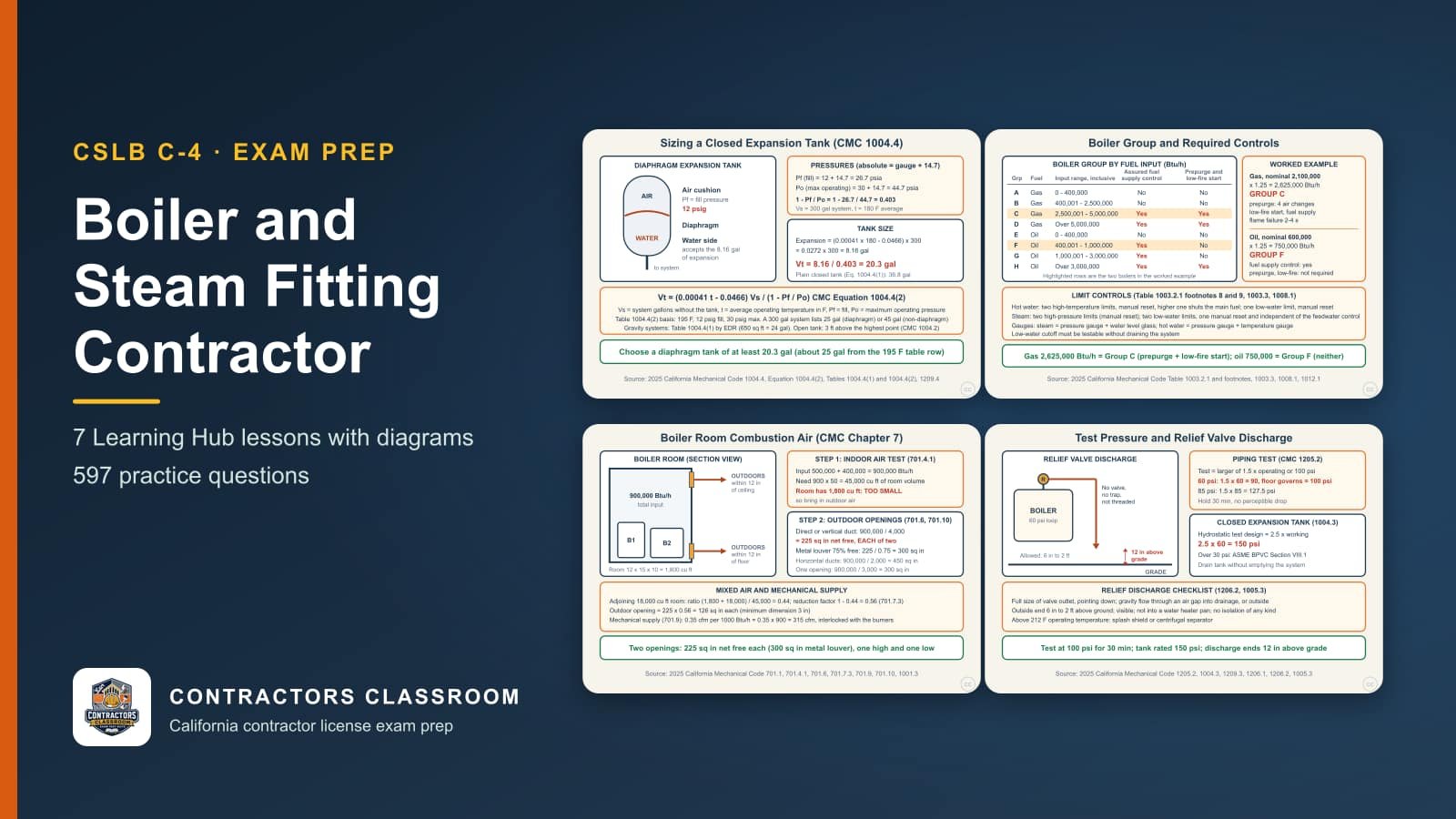
Diagrams from the C-4 boiler and steam fitting contractor lessons: Sizing a Closed Expansion Tank by CMC Section 1004.4, Boiler Group and Required Controls (CMC Table 1003.2.1), Combustion Air for a Boiler Room (CMC Chapter 7) and Hydronic Test Pressure and Relief Valve Discharge (CMC 1205.2, 1206.2)
597practice questions
4categories
7Learning Hub lessons
$249Law & Business included

What the exam covers: Boiler and Steam Fitting (C-4)

The CSLB exam for the California boiler and steam fitting contractor license (C-4) is a closed-book, multiple-choice test. CSLB's official study guide divides it into five major sections and gives each an approximate weight: Planning and Estimating (about 15%), Boiler System Removal, Preparation, and Installation (about 29%), Specialty Boiler Installation (about 17%), Boiler System Maintenance, Repair, and Retrofit (about 22%), and Safety (about 17%).

Boiler System Removal, Preparation, and Installation carries the most weight, about 29%, so it deserves roughly that share of your study time, with Boiler System Maintenance, Repair, and Retrofit next at about 22%.

Contractors Classroom turns that outline into 597 practice questions in 4 categories (Planning and Estimating, Boilers & Fired Pressure Vessels Installation, Steam & Hydronic Piping Systems, and Pressure Vessel Safety & Cal-OSHA), plus 7 Learning Hub lessons with diagrams (such as "Sizing a Closed Expansion Tank by CMC Section 1004.4" and "Boiler Group and Required Controls (CMC Table 1003.2.1)"). Law and Business, which most applicants take alongside their trade exam, is included at no extra charge.

Exam sections and approximate weights

  • Planning and Estimating~15%
  • Boiler System Removal, Preparation, and Installation~29%
  • Specialty Boiler Installation~17%
  • Boiler System Maintenance, Repair, and Retrofit~22%
  • Safety~17%

Practice question categories

  • Planning and Estimating185 practice questions
  • Boilers & Fired Pressure Vessels Installation146 practice questions
  • Steam & Hydronic Piping Systems96 practice questions
  • Pressure Vessel Safety & Cal-OSHA170 practice questions

What the Boiler and Steam Fitting Contractor exam covers, section by section

Planning and Estimating (~15%)

A boiler job begins with understanding the heating demand and the building it will serve. Planning looks at fuel type, equipment location, venting, piping routes, controls and room for service, along with permits and coordination with other trades and the owner. Estimating then turns that plan into a price, adding equipment, piping, fittings, insulation, labor and the cost of any removal, testing and startup.

  • Working out equipment size, fuel supply, venting, and piping layout before ordering parts
  • Pricing boiler hardware, piping, controls, labor, removal, and startup into a complete bid

Boiler System Removal, Preparation, and Installation (~29%)

Replacing a boiler is a sequence: shut down, drain and disconnect the old unit safely, then take it out of the room. The space is cleaned and checked, bases and supports are readied, and the new boiler is set, piped, vented and wired to its controls. Before the building goes back to the owner, the system is filled, leak-checked, fired and adjusted.

  • Draining, isolating, and cutting out the old boiler and its attached piping
  • Cleaning the equipment room, checking structure and clearances, and setting new supports
  • Setting the unit, connecting water, fuel, flue, and electrical, and installing safety devices
  • Filling the system, purging air, checking for leaks, and confirming proper operation

Specialty Boiler Installation (~17%)

Boilers differ widely by building type. Commercial and industrial installations are larger, often use multiple units with sophisticated controls, and demand careful commissioning. Schools and hospitals must keep heat and hot water reliable with backup capacity, while residential hydronic systems circulate heated water through baseboards or radiant floors and call for attention to zoning, pumps and expansion.

  • Handling larger commercial plants with staged units, pumps, and central controls
  • Meeting process and high-demand needs in industrial settings with heavy-duty equipment
  • Providing dependable backup and steady heat or hot water for schools and hospitals
  • Zoning, circulating, and balancing heated water in baseboard or radiant home systems

Boiler System Maintenance, Repair, and Retrofit (~22%)

Boilers last and run efficiently when someone looks after them. Regular care includes cleaning heat-exchange surfaces, checking burners and controls, testing safeties, and watching water quality. Repairs begin with finding why something failed, such as a leak, a worn pump or a faulty control, before parts are swapped. Retrofitting upgrades older systems with newer burners, controls or piping to improve efficiency and reliability.

  • Cleaning, inspecting, and tuning burners, controls, and safety devices on a routine basis
  • Tracing the real cause of leaks, noise, or shutdowns before replacing parts
  • Upgrading old equipment with modern burners, controls, or piping to improve performance

Safety (~17%)

Boiler rooms combine heat, pressure, fuel and tight quarters. Workers lock out energy sources, let equipment cool, and relieve pressure before opening anything. Entering a boiler shell or tank is confined space work, needing air testing, ventilation, a watcher outside and a rescue plan. Old insulation, chemical treatments, fuel and combustion gases are dangerous substances that must be identified and handled with the right protection.

  • Applying lockout, cooldown, and pressure-relief steps before touching any boiler component
  • Guarding against burns, falls, lifting strain, and electrical shock in mechanical rooms
  • Testing air, ventilating, and planning rescue before anyone enters a vessel
  • Identifying and protecting against asbestos, chemicals, fuels, and combustion gases

Code books behind the Boiler and Steam Fitting Contractor exam

The exam outline published for this trade lists these references.

  • 2025 California Mechanical CodeThe primary code for the C-4 boiler exam. Its boiler and hydronic chapters cover controls and limit devices by boiler group, expansion tanks, relief valves and their discharge piping, combustion air, venting, and pressure testing. It supports nearly every section, especially the removal, preparation and installation section and Specialty Boiler Installation. Reading the boiler group table and the combustion air rules together makes the installation questions easier to follow.
  • 2025 California Plumbing CodeBoilers meet the plumbing code where they connect to domestic water: makeup water protection against backflow, indirect waste and air gaps at drains, relief valve discharge, and the water heating equipment rules that sit beside the mechanical code. It supports the installation and testing topics and the maintenance and repair section. Pay attention to how makeup water connects to a closed loop, since backflow protection is a recurring theme.
  • Boiler Operator’s GuideA practical guide to running and maintaining boilers: water level and feedwater control, water treatment, blowdown, safety devices, combustion basics and routine operating checks. It is the study source for the maintenance and repair section and for the water-side topics, such as foaming and carryover, that the exam asks about. Water treatment ideas from this book also explain why scale and sludge shorten boiler life.
  • Modern Hydronic Heating: For Residential and Light Commercial BuildingsA modern text on hot water heating design: piping arrangements, circulators and pumping, air and dirt removal, zoning, mixing, controls and low-temperature systems. It is the main reference for Residential hydronic boiler systems under Specialty Boiler Installation and for the planning and retrofit decisions in other sections. Its sections on hydraulic separation and pump selection are especially useful for planning.
  • Radiant Floor HeatingThis book focuses on radiant systems: tubing layouts in slabs and framed floors, floor coverings and heat output, manifolds, mixing and controls, and typical problems. It supports questions about residential hydronic systems and the retrofit side of the maintenance, repair and retrofit section. Understanding floor assemblies helps with questions about water temperature limits.
  • State of California General Industry & Electrical Safety Orders (Cal/OSHA)The Title 8 safety orders contain rules specific to boilers and pressure vessels, including isolation, blinding and entry into shells, drums, fire boxes and flues, plus atmosphere testing, hazard communication and electrical safety. They are the reference behind the Safety section and the largest block of practice questions for this trade. Study the entry steps in order, because the sequence is what the questions test.

Key terms for the Boiler and Steam Fitting Contractor exam

Closed expansion tank
A sealed tank with a rubber diaphragm and a pre-charged air cushion that absorbs the extra volume of heated water in a closed loop. Its size depends on system volume, fill pressure, maximum pressure and average water temperature.
Equivalent direct radiation
An older rating unit for radiators and convectors, where each square foot stands for a fixed heat output. It still appears when older gravity or radiator systems are evaluated, and some expansion tank tables are organized around it.
Boiler group
A category in the mechanical code that sorts automatic boilers by fuel and by input range. The larger the group, the more safeguards it needs, such as assured fuel supply, low-fire start and automatic reset shutoff valves.
Low-water cutoff
A control that shuts off the burner when the water level falls too low, preventing a dry-fired and overheated boiler. On steam boilers it is exercised regularly by blowing it down to check that it is not stuck with sludge.
High-limit control
A safety that cuts the fuel when water temperature or steam pressure goes beyond a setting. A manual-reset type stays shut until a person resets it, forcing someone to find out why the limit tripped.
Prepurge
A timed burner fan cycle that sweeps unburned gas out of the combustion chamber and flue passages before ignition. It prevents a delayed ignition explosion and is among the added controls required of larger gas and oil units.
Blowdown
Draining part of the boiler water, from the bottom or the surface, to remove sludge and dissolved solids. It controls scale and foaming, and its discharge piping must end where hot, treated water cannot hurt anyone.
Foaming
A layer of froth on the boiler water surface, most often caused by a high concentration of dissolved solids or contamination. It carries water into the steam lines, makes the gauge glass hard to read, and is treated by blowdown and water treatment.
Steam trap
An automatic valve that lets condensate and air out of steam piping while holding live steam back. A trap that fails open wastes fuel, and one that fails closed floods the line and invites banging water hammer.
Primary-secondary piping
A layout in which the boiler loop and each distribution circuit are hydraulically separated by two closely spaced tees. Each pump then moves only its own flow, so zones do not disturb one another or the boiler's required flow.
Air separator
A fitting that strips dissolved and free air from circulating water so it can be vented. Removing air reduces noise, pump cavitation and oxygen corrosion, and keeps radiators and baseboards from becoming air-bound.
Zone valve
A small motorized valve that opens when a thermostat calls for heat, letting hot water into one zone while others stay closed. It allows a single boiler and one circulator to serve several independently controlled areas.
Oxygen barrier tubing
Plastic radiant floor tubing with a layer that stops oxygen from diffusing through its walls. Without that layer, oxygen enters the loop and corrodes iron parts such as the boiler, pumps and fittings.
Radiant mixing valve
A valve or injection arrangement that blends hot boiler water with cooler return water so a floor loop receives a much lower temperature than the boiler produces. It protects flooring and tubing from excess heat.
Return-water temperature
The temperature of water coming back to the boiler. Many boilers need a minimum value to keep flue gases from condensing on their heat exchanger, so piping and controls are designed to meet the manufacturer's figure.
Spectacle blind
A solid steel plate shaped like a pair of eyeglasses that sits between pipe flanges, with one solid disc and one open ring. Turning it to the solid side completely closes the line, which closing a valve alone cannot ensure.
Double block and bleed
An isolation arrangement of two closed valves with an open vented or drained gap between them. If the first valve leaks, the leakage escapes through the bleed instead of reaching a boiler that someone is working in.
Hydrostatic test
Filling new or repaired piping with water and raising pressure above working pressure to find leaks and weak points. The required level is a multiple of operating pressure, with a minimum floor, and plastic pipe has its own limits.
Condensate return
The piping and tank that bring condensed steam back to the boiler feed system. Returning it saves heat and treated water, so a leak or failed trap raises makeup water demand and chemical use.

Where to spend practice time for the Boiler and Steam Fitting Contractor exam

  • Removal, preparation and installationThis is the heaviest section, about 29 percent of the exam, covering old boiler removal, site preparation, installation, testing and completion. Practice the sequence of isolating and draining an old boiler, preparing the room, setting and piping the new unit, and testing before handover. Combustion air, venting and relief piping questions live here. Be ready to say why each step comes before the next.
  • Maintenance, repair and retrofitAbout 22 percent of the exam asks how to keep boilers safe and working. Review what each control does and how it is tested, water-side problems such as foaming and scale, and how a retrofit changes controls or return-water conditions. Link every symptom to a cause and a first check.
  • Specialty boiler installationsSpecialty Boiler Installation is about 17 percent of the exam and spans commercial, industrial, school, hospital and residential hydronic work. Compare how requirements grow with size and occupancy, then focus on residential hydronics: zoning, expansion tanks, air removal and piping arrangements. Sketching two or three layouts from memory is useful practice.
  • Planning and cost calculationsPlanning and Estimating is about 15 percent of the exam, yet it is the biggest group of practice questions in the bank. Many are arithmetic, such as totaling materials, testing and commissioning costs, or finding what remains due after a percentage was already paid. Rehearse percentage steps slowly and double-check which base the percentage applies to. Slow, written steps beat mental arithmetic.
  • Controls, tanks and relief devicesInstallation and piping practice questions repeat the same equipment: expansion tank sizing, boiler group controls, relief valve count and discharge, test pressure and insulation. Work each as a short calculation or checklist, and learn which items depend on the boiler's input and which depend on system volume or operating pressure.
  • Safety around pressure vesselsSafety is about 17 percent of the exam and has the second largest practice set. Concentrate on isolating a boiler before anyone enters, blind plates and a double block with a bleed, testing the atmosphere, protecting people around fire boxes and flues, and handling dangerous materials. Learn the logic of each step rather than a memorized list.

Scenarios to talk through before the Boiler and Steam Fitting Contractor exam

  • Replacing an old boilerYou are removing an old boiler that shares headers with another unit. In what order do you shut down, isolate and drain it, how would blinding and a double block with bleed be used, and what must be true before anyone enters the shell? Mention how you would label each closed valve for the crew.
  • Expansion tank for a new loopA closed hydronic loop needs an expansion tank. Which system facts do you gather to size it, what does the fill pressure do, where does the tank connect, and how does it relate to the relief valve setting? Say what would happen if the tank were charged to the wrong pressure. Say what you would check when the pressure rises after a long run.
  • Small boiler roomA boiler is going into a small room with a louvered door. How would you test whether the room itself supplies enough air, when would openings to the outdoors be needed, and how do louver type and net free area change the plan? Say what you would do if the needed opening is blocked by the door frame. Describe the air path from the louver to the burner.
  • Steam boiler with unstable levelA steam boiler shows a jumpy water level and wet steam. Consider foaming, dissolved solids and carryover, then describe what blowdown can do, how you would test the low-water cutoff, and what water treatment questions to ask the operator. Add the symptoms you would expect if the cutoff were stuck with sludge.
  • Adding radiant floor heatA homeowner wants a radiant floor loop on an existing boiler. Discuss tubing with an oxygen barrier, a mixing arrangement for lower water temperature, zoning, air removal and the minimum return-water temperature the boiler maker specifies. Explain what happens to the floor if too-hot water is supplied. Mention which piping details prevent air from collecting.
  • Final test before handoverThe new piping is complete. How do you choose the test pressure from the operating pressure, why can plastic pipe change the method, how do you route relief valve discharge, and what do you confirm before handing the boiler over? Say how you would document the result for the building owner. Mention how long the pressure should hold.
  • Banging steam mainsA steam heating system bangs when it starts and some radiators stay cold. Think about steam traps, condensate return, pitch of the piping and makeup water use, and decide what you would examine first and what it might cost the owner. Explain why leaving the problem alone will raise operating costs.
  • Moving from house to schoolYou usually install residential units but a school needs a larger gas boiler. How does its boiler group change the controls required, what do prepurge and assured fuel supply add, and what handoff duties remain for the burner contractor? Add which limit controls must still be manually reset. Say who must sign off before the unit runs.

Learning Hub lessons

Each lesson has guided steps, a diagram, a worked example and a quick check inside the classroom.

Preview the lesson diagrams

  1. Sizing a Closed Expansion Tank by CMC Section 1004.4Steps: A Closed Hot-Water System Must Have an Expansion Tank; Open Versus Closed Tanks; Pick the Sizing Method the Code Lets You Use; Table 1004.4(2) Is a Shortcut With Fixed Assumptions; The Diaphragm-Tank Equation
  2. Boiler Group and Required Controls (CMC Table 1003.2.1)Steps: Automatic Boilers Are Sorted Into Groups; Find the Group From the Input Range; What the Bigger Groups Add; Limit Controls and Gauges for Every Automatic Boiler; Large Gas and Oil Burners, and Your Handoff Duties
  3. Combustion Air for a Boiler Room (CMC Chapter 7)Steps: Where Boiler Combustion Air Is Governed; Test the Room First: Indoor Air; Outdoor Air: Two Openings or One; Louvers, Ducts and Dampers; Mixed Air Sources and Mechanical Supply
  4. Hydronic Test Pressure and Relief Valve Discharge (CMC 1205.2, 1206.2)Steps: The Pressure Test Rule; Apply the Larger-Of Rule; Expansion Tank Test Rating Is Different; Relief Valves: Number, Location, Listing; Discharge Piping Rules
  5. Hydronic and Steam Pipe Insulation (Energy Code Table 120.3-A-1)Steps: What the Energy Code Makes You Insulate; Read Table 120.3-A-1 by Temperature Row and Pipe Size Column; Insulation That Is Not in the Conductivity Range; Protect the Insulation; Related Limits: Supply Temperature and Touch Surfaces
  6. Boiler Energy Code Rules: Input Size and Return Water TemperatureSteps: What Counts as a Commercial Boiler; Mandatory Features: Section 120.9; Hydronic System Measures: Section 140.4(k); High-Capacity Gas Boiler Systems: Section 140.4(k)8; How This Meets the Mechanical Code
  7. Entering a Boiler: Isolation, Blinding and Double Block and Bleed (8 CCR 3312)Steps: Why Isolation Comes Before Entry; Entering the Shell or Drum: Section 3312(a); Blowdown and Backflow Lines; Fire Boxes, Flues and Combustion Chambers: Section 3312(b); Defined Terms and Atmosphere Limits From Section 5157

See the classroom in action

Frequently asked questions

How do I get a California boiler and steam fitting contractor license?

A boiler installer or steamfitter who wants to contract independently applies under C-4. CSLB generally requires documented journey-level experience, a bond, and passing scores on both the Law and Business exam and the C-4 exam. Rules change, so confirm them with CSLB.

What does the boiler and steam fitting contractor exam ask about boiler system removal, preparation, and installation?

Boiler System Removal, Preparation, and Installation is the heaviest part of the C-4 exam, at about 29%. Expect questions on draining, isolating, and cutting out the old boiler and its attached piping, cleaning the equipment room, checking structure and clearances, and setting new supports, and setting the unit, connecting water, fuel, flue, and electrical, and installing safety devices. Next in weight come boiler system maintenance, repair, and retrofit (about 22%) and specialty boiler installation (about 17%).

What kinds of questions are on the boiler and steam fitting contractor exam?

The three sample questions in CSLB's C-4 study guide ask about what causes foaming in a boiler, which kind of fitting cannot be used on cast-iron pipe, and how much of a project cost is still due after a partial payment. Like every question on the exam, each has four choices and one best answer.

Which codes and books does the C-4 exam reference?

CSLB's C-4 study guide lists the 2025 California Mechanical and Plumbing Codes (Title 24), the Cal/OSHA safety orders (Title 8), and trade references such as Boiler Operator’s Guide, Modern Hydronic Heating: For Residential and Light Commercial Buildings, and Radiant Floor Heating. Use them to study; the exam itself is closed-book.

Is the boiler and steam fitting contractor exam open book?

No. The C-4 study guide says no reference materials may be used, even though it names Boiler Operator’s Guide and Modern Hydronic Heating: For Residential and Light Commercial Buildings among the books to study from. A calculator is provided, and guessing is not penalized.

Can I take the boiler and steam fitting contractor exam outside California?

CSLB's exam FAQ says trade exams are given in California or Oregon only, so C-4 is not offered in other states, although Law and Business can be taken out of state. Check the current PSI list when you schedule.

How are the 597 C-4 practice questions organized?

They are split into 4 categories, largest first: Planning and Estimating (185), Pressure Vessel Safety & Cal-OSHA (170), Boilers & Fired Pressure Vessels Installation (146), and Steam & Hydronic Piping Systems (96). Planning and Estimating holds about 31% of the questions. 7 Learning Hub lessons add diagrams and worked examples for the harder topics. The missed-question review collects every question you get wrong.

Is there a free trial for boiler and steam fitting contractor exam prep (C-4)?

Yes. The free C-4 preview opens the real classroom with no sign-up and gives you the first question from every C-4 category, including Planning and Estimating and Pressure Vessel Safety & Cal-OSHA, plus Law and Business. The full course is a one-time $249 purchase.

Is boiler and steam fitting contractor exam prep available in Spanish?

The website and the eight demo videos are available in Spanish. The classroom and the 597 C-4 practice questions are in English for now; translating the questions is not part of the course yet.

Ready to practice for real?

Try the real classroom free, no sign-up, or get the full course for your trade.

Independent exam preparation. Contractors Classroom is not affiliated with the Contractors State License Board, and no course can guarantee a passing result.


