
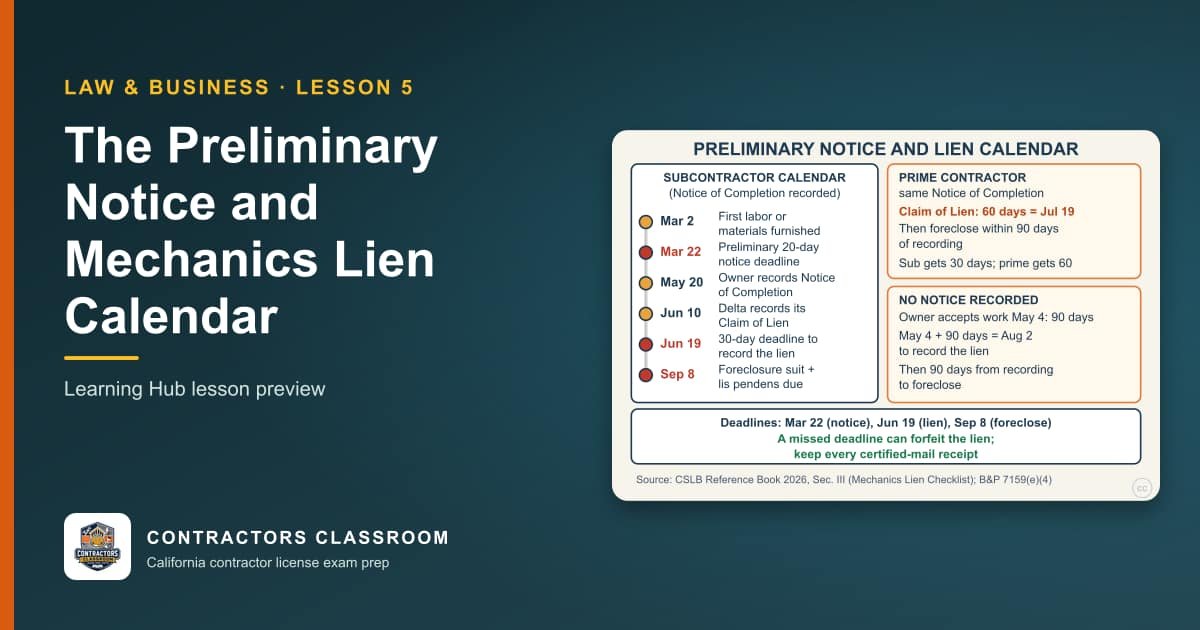
A preliminary notice is a short written warning that tells the property owner, the prime contractor and the construction lender that you are on the job and have a right to be paid from it. In California, the License Law reference book tells subcontractors and material suppliers to serve that notice within 20 days of first furnishing labor or materials. This article explains who sends it, when the clock starts, how to deliver it and what it keeps alive.
The timing and delivery details below come from the mechanics lien chapter of the License Law book we reviewed (2026 edition), Section III, Chapter 3. That chapter is a checklist rather than a numbered statute, so check the current Civil Code text and talk to a lawyer before you rely on it for a real claim.
What the notice is for
A mechanics lien is a claim against the property for unpaid work. The book describes the constitutional basis for it: laborers, artisans and people who furnish materials have a lien on the property they improved, for the value of what they provided. People who file do not need a contract directly with the owner. They do need a contract with the owner's agent, which includes a contractor, subcontractor or builder in charge of the work.
The notice comes first because the owner often has no idea who is working behind the prime contractor. The mandatory home improvement contract language makes the same point to the homeowner. It warns that unpaid subcontractors, suppliers and laborers may record a lien even when the owner paid the contractor in full, and that the owner could end up paying twice. (License Law Book 2026, B&P §7159(d)(4)) The same warning explains that the preliminary notice is not a lien. It is a heads-up that the sender has a right to record one if payment does not arrive. (License Law Book 2026, B&P §7159(d)(4))
Who sends it, and who does not
Under the book's checklist, the notice is a task for subcontractors and material suppliers. The prime contractor does not send one, and neither do laborers. The homeowner warning says the owner will not receive notices from the prime contractor or from workers on the project, because the law assumes the owner already knows they are improving the property. (License Law Book 2026, B&P §7159(d)(4))
That leaves two groups with a deadline to watch:
- Subcontractors at any tier who hired on to the prime contractor or another sub.
- Material suppliers who deliver to the job.
The book adds one limit: a material supplier is not an agent of the owner, so the supplier's own supplier does not get a statutory lien. Also, the work or material has to be incorporated into the structure. In other words, it has to be installed.
The 20-day window
The checklist says to serve the notice within 20 days of first furnishing labor or materials. The count starts on your first day on site or first delivery, not on the day you sign a purchase order or the day the invoice goes out. The home improvement warning describes the same period from the owner's side: the notice may go out as late as day 20 after a sub begins work or a supplier ships material. (License Law Book 2026, B&P §7159(d)(4))
You send one notice for the whole job. The book says it does not matter how many deliveries you make or how long you keep furnishing; one preliminary notice is enough. The notice must also contain specific wording that tells the owner about a new duty to notify anyone else who has served a preliminary notice.
A practical routine, using a hypothetical subcontractor:
- Write down the first day your crew works on the job or your first delivery arrives.
- Count 20 days forward and put that date on the calendar with a few days of margin.
- Collect the legal description of the property, the owner's name, the prime contractor's name and the lender, if any.
- Send the notice, keep proof, and file your copy with the job records.
Who receives it
The checklist names three recipients: the owner, the original contractor and the construction lender. Before serving, the book suggests gathering basic facts about the property and the parties: the legal description, the owner's name and interest, whether the owner is the person requesting the work, and the name of any construction lender. A missing lender name is a common gap on small jobs, so ask early.
How to deliver it
The book names mail as the usual method: certified or registered, first class, with a return receipt and prepaid postage. Send it to the home or business of the recipient, to the address on the building permit, or to an address shown on a recorded mortgage or deed of trust. You can also hand it over personally, or leave it with an adult who is in charge at the home or business.
Keep the post office receipts. The book points out that you may need them later to prove service in court.
The checklist also notes that you may file the preliminary notice with the county recorder in the county where the property sits. If you do, the recorder notifies you when someone records a notice of completion or a notice of cessation, which are the events that start shorter lien clocks.
What the notice preserves
The notice does not create a lien by itself. It preserves your ability to record one later and to pursue a stop notice, which the book describes as a lien on funds rather than on the property. Skip it and the option can disappear, even though the money is still owed. Suing on the contract remains available either way, because the book states that a person with lien rights can still sue on a contract theory or any other legal theory.
Related business duties sit near this one:
- A contractor may not require a lien-rights waiver from a subcontractor, employee or supplier in a way that violates the Civil Code. (License Law Book 2026, B&P §7034)
- A prime contractor or subcontractor must pay subcontractors within seven days of receiving each progress payment, unless the parties agreed otherwise in writing. (License Law Book 2026, B&P §7108.5)
- On a home improvement job, the payer can ask the contractor for a full, unconditional lien release covering the work a payment pays for. (License Law Book 2026, B&P §7159.5(a)(6))
Why it shows up on the exam
The license board expects applicants to show general knowledge of the lien laws, along with building and safety law. (License Law Book 2026, B&P §7068(a)) Expect questions on who serves the notice, the number of days and where the notice goes. Learn the sequence: notice at the start, lien after the job ends, lawsuit after the lien.
For hands-on practice, see the preliminary notice and lien calendar lesson. General contractors can study the business-law material in General Building (B) exam prep, and the full list of classifications is in the trade exam prep index.
This article is general education, not legal advice. Notice rules, forms and deadlines are set by statute and change, so verify them before acting on a live project.
Sources
Code sections and publications this article relies on, as printed in the editions we reviewed. Codes and CSLB procedures change: check the current text before you rely on a detail.
- California Contractors License Law & Reference Book, 2026 edition (CSLB), B&P Code section 7159(d)(4)
- California Contractors License Law & Reference Book, 2026 edition (CSLB), B&P Code section 7034
- California Contractors License Law & Reference Book, 2026 edition (CSLB), B&P Code section 7108.5
- California Contractors License Law & Reference Book, 2026 edition (CSLB), B&P Code section 7159.5(a)(6)
- California Contractors License Law & Reference Book, 2026 edition (CSLB), B&P Code section 7068(a)
Every lesson and question we write is grounded in California code books and CSLB materials. How we build our lessons


