California contractors must file a $25,000 contractor license bond, or a cashier's check in that amount, with CSLB. (CSLB Get Licensed to Build, p. 31) An inactive license does not need it. (CSLB Get Licensed to Build, p. 28) Depending on how your business is set up, you may also need a second $25,000 bond for your qualifier and, for an LLC, a $100,000 worker bond. (CSLB Get Licensed to Build, p. 31) This article lays out each bond, who it protects and how to get one, using CSLB's Get Licensed to Build and the 2026 License Law book as printed in the editions we reviewed. Amounts and forms change, so confirm current details with CSLB.
The contractor license bond
The law makes a $25,000 contractor's bond a condition of issuing, reinstating, reactivating, renewing and maintaining a license. (License Law Book 2026, B&P §7071.6) A surety company admitted in the state executes it in favor of the State of California, and you file it with CSLB. (License Law Book 2026, B&P §7071.5)
It exists to protect people who deal with you. The listed beneficiaries include:
- A homeowner whose personal family residence is damaged by a violation of the contractor law
- An owner building a single-family home that is not for sale, when damaged by a violation
- Anyone harmed by a willful and deliberate violation, or by fraud, in a construction contract
- An employee harmed by unpaid wages
- A person or entity owed unpaid fringe benefits (License Law Book 2026, B&P §7071.5)
How far the $25,000 goes
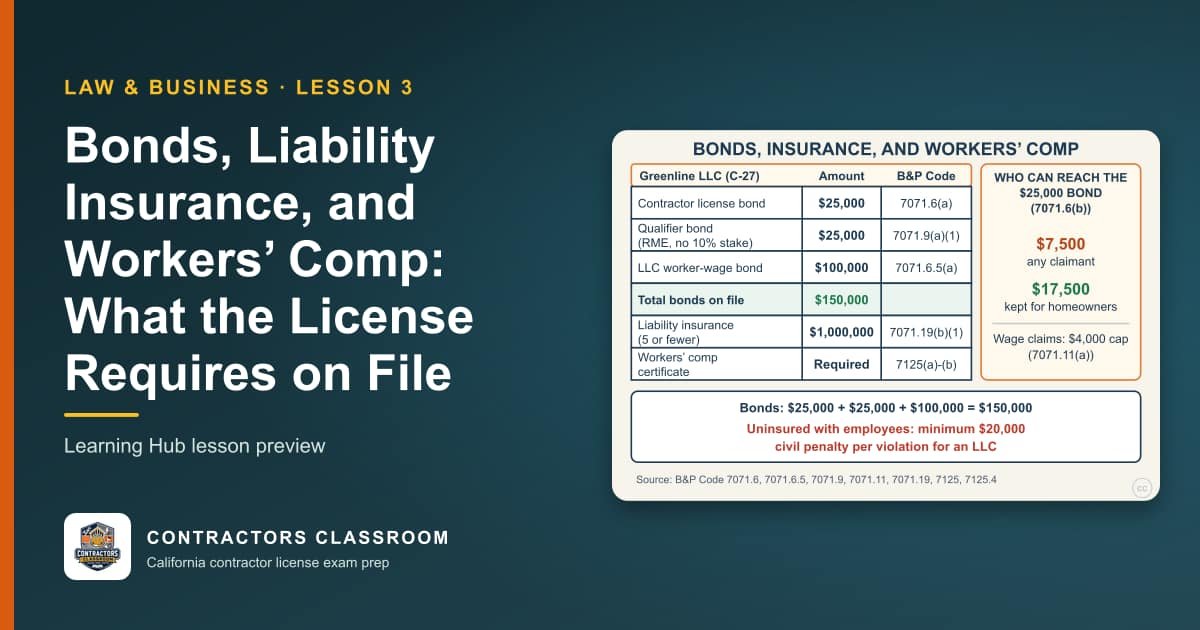
Not everyone can reach the full amount. A surety's total liability to most claimants is capped at $7,500, and everything above that is reserved for homeowner claims, though a homeowner can still claim the full measure of the bond. (License Law Book 2026, B&P §7071.6(b)) A worked example: on a $25,000 bond, $25,000 minus $7,500 leaves $17,500 held back for homeowners. Claims for wages and fringe benefits have a separate cap of $4,000 against these bonds, except for a disciplinary bond. (License Law Book 2026, B&P §7071.11(a))
The qualifying individual's bond
A second bond applies when your qualifier is not the owner. If the qualifying individual is not the proprietor, a general partner or a joint licensee, that person files a separate $25,000 qualifying individual's bond. It does not combine with the contractor's bond. (License Law Book 2026, B&P §7071.9(a)) The guide calls it a bond of qualifying individual and says it covers every RME, plus any RMO holding under a 10 percent stake in the corporation or LLC. (CSLB Get Licensed to Build, p. 27)
The exceptions are specific:
- A sole owner who qualifies personally, or a general partner, does not need one. (License Law Book 2026, B&P §7071.10)
- An RMO who owns 10 percent or more of a corporation's voting stock and certifies that on the registrar's form does not need one. (License Law Book 2026, B&P §7071.9(c))
- An LLC qualifier with at least a 10 percent membership interest who certifies it does not need one either. (License Law Book 2026, B&P §7071.9(d))
Example: a corporation qualified by an RME on payroll has two $25,000 bonds on file, one in the business name and one for the RME. The guide notes that this bond has to name both the qualifying individuals and the business. (CSLB Get Licensed to Build, p. 16) For more on who qualifies a license, read what a qualifier is.
The LLC worker bond
Limited liability companies add a $100,000 surety bond on top of the $25,000 contractor bond. (CSLB Get Licensed to Build, p. 31) The guide edition we reviewed says this applies whether the license is active or inactive, but the 2026 License Law book says the bond does not apply while a license is inactive, so confirm the current rule with CSLB. (License Law Book 2026, B&P §7071.6.5(e)) The bond protects employees who are harmed because the LLC does not pay wages, wage interest or fringe benefits. (License Law Book 2026, B&P §7071.6.5) That puts an LLC qualified by an RME at $25,000 plus $25,000 plus $100,000, or $150,000 in bonds.
Where to get a bond
CSLB does not issue bonds. Buy through your insurance agent or one of the private firms that the California Department of Insurance licenses. (CSLB Get Licensed to Build, p. 31) CSLB's website carries the approved bond form and information on the cashier's check option. (CSLB Get Licensed to Build, p. 31)
The cashier's check or deposit route is narrow. The law accepts a surety bond or a deposit of lawful money or a cashier's check under the Code of Civil Procedure, and no other method, such as a certificate of deposit, satisfies the requirement. (License Law Book 2026, B&P §7071.4) The sources we reviewed do not print what a bond costs, so get quotes before you apply. The law also bars denying a contractor's bond solely on grounds such as race, religion, color, national origin, ancestry or sex, and a violation carries liability for actual damages plus $250. (License Law Book 2026, B&P §7071.14)
Timing: when the bond goes in
Do not send a bond with your application. (CSLB Get Licensed to Build, p. 15) After the qualifier passes the exams, CSLB sends instructions, and the guide recommends submitting the fees, bonds and proof of workers' compensation together to avoid delays. (CSLB Get Licensed to Build, p. 16)
If a bond takes effect before CSLB receives it, the registrar honors it from the date printed on the bond, provided it arrives within 90 days of that date, and reinstates the license retroactively if you are otherwise eligible. (License Law Book 2026, B&P §7071.7)
Bond amounts at a glance
- Contractor license bond: $25,000, with a $7,500 cap per claimant for most claims. (License Law Book 2026, B&P §7071.6(b))
- Qualifying individual's bond: $25,000, when your qualifier is not the owner or general partner. (License Law Book 2026, B&P §7071.9(a))
- LLC worker bond: $100,000, in addition to the others. (License Law Book 2026, B&P §7071.6.5)
- Disciplinary bond: at least $25,000, set by the registrar. (License Law Book 2026, B&P §7071.8(b))
Keeping the bond in place
An active licensee must keep the contractor bond, the qualifying individual's bond if required, and workers' compensation if there are employees. (CSLB Get Licensed to Build, p. 28) An inactive license does not need either bond. (CSLB Get Licensed to Build, p. 28) If you let a required bond lapse, the license is subject to suspension or revocation. (License Law Book 2026, B&P §7071.15)
Other bonds can be required by circumstance:
- After discipline, the registrar can require a bond of at least $25,000 and up to 10 times the standard amount. (License Law Book 2026, B&P §7071.8(b))
- The board can require twice the standard bond from an applicant convicted of unlicensed contracting or cited for it, when substantial injury to the public is involved. (License Law Book 2026, B&P §7071.6(d))
- A licensee with an unsatisfied final judgment for failing to pay a contractor, supplier, consumer or employee can be required to post a bond that secures the judgment. (License Law Book 2026, B&P §7071.17)
One last rule: referring to your bond in advertising or other public presentations is a ground for suspending your license. (License Law Book 2026, B&P §7071.13) If you are building toward a license, see our exam prep for electrical contractors and plumbing contractors.
Sources
Code sections and publications this article relies on, as printed in the editions we reviewed. Codes and CSLB procedures change: check the current text before you rely on a detail.
- CSLB, Get Licensed to Build: A Guide to Becoming a Licensed Contractor, page 31
- CSLB, Get Licensed to Build: A Guide to Becoming a Licensed Contractor, page 28
- California Contractors License Law & Reference Book, 2026 edition (CSLB), B&P Code section 7071.6
- California Contractors License Law & Reference Book, 2026 edition (CSLB), B&P Code section 7071.5
- California Contractors License Law & Reference Book, 2026 edition (CSLB), B&P Code section 7071.6(b)
- California Contractors License Law & Reference Book, 2026 edition (CSLB), B&P Code section 7071.11(a)
- California Contractors License Law & Reference Book, 2026 edition (CSLB), B&P Code section 7071.9(a)
- CSLB, Get Licensed to Build: A Guide to Becoming a Licensed Contractor, page 27
- California Contractors License Law & Reference Book, 2026 edition (CSLB), B&P Code section 7071.10
- California Contractors License Law & Reference Book, 2026 edition (CSLB), B&P Code section 7071.9(c)
- California Contractors License Law & Reference Book, 2026 edition (CSLB), B&P Code section 7071.9(d)
- CSLB, Get Licensed to Build: A Guide to Becoming a Licensed Contractor, page 16
- California Contractors License Law & Reference Book, 2026 edition (CSLB), B&P Code section 7071.6.5(e)
- California Contractors License Law & Reference Book, 2026 edition (CSLB), B&P Code section 7071.6.5
- California Contractors License Law & Reference Book, 2026 edition (CSLB), B&P Code section 7071.4
- California Contractors License Law & Reference Book, 2026 edition (CSLB), B&P Code section 7071.14
- CSLB, Get Licensed to Build: A Guide to Becoming a Licensed Contractor, page 15
- California Contractors License Law & Reference Book, 2026 edition (CSLB), B&P Code section 7071.7
- California Contractors License Law & Reference Book, 2026 edition (CSLB), B&P Code section 7071.8(b)
- California Contractors License Law & Reference Book, 2026 edition (CSLB), B&P Code section 7071.15
- California Contractors License Law & Reference Book, 2026 edition (CSLB), B&P Code section 7071.6(d)
- California Contractors License Law & Reference Book, 2026 edition (CSLB), B&P Code section 7071.17
- California Contractors License Law & Reference Book, 2026 edition (CSLB), B&P Code section 7071.13
Every lesson and question we write is grounded in California code books and CSLB materials. How we build our lessons


