- AIC rating
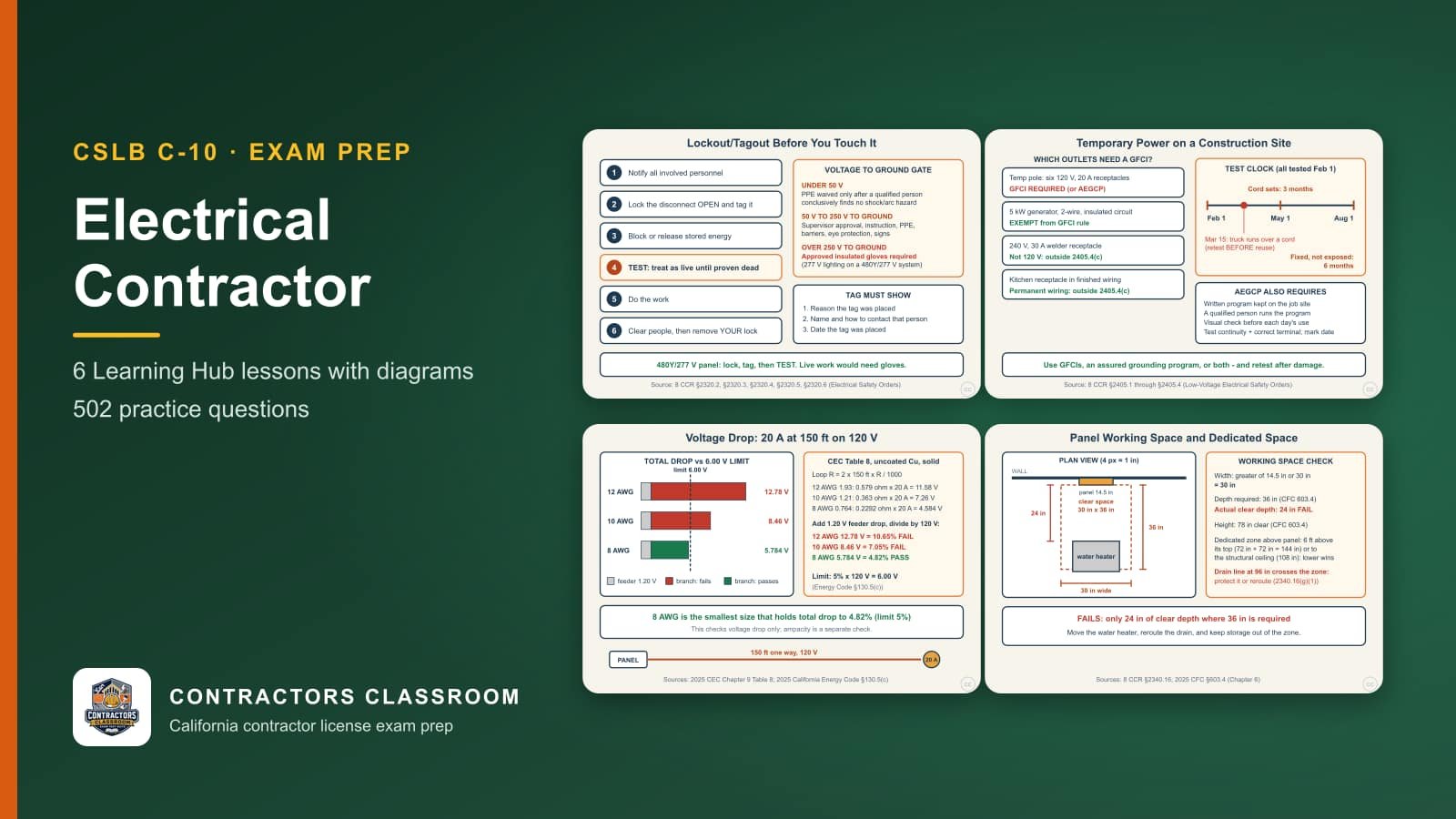
- The highest fault current a breaker or fuse can open safely without rupturing. A replacement device must match the original in size and amperage, and its interrupting capability must at least equal the fault current available at the panel where it will sit.
- Available fault current
- The largest short-circuit current the supply could push through a point in the system, shaped by the utility transformer and the impedance of the conductors in between. It decides which interrupting ratings and equipment ratings the installation must use.
- Dedicated equipment space
- The column of floor-to-ceiling room above and below a panelboard that is reserved for the electrical system alone. Pipes, ducts and unrelated equipment may not occupy it, so future work and heat dissipation are not blocked.
- Working space
- The clear zone in front of energized equipment, measured in depth, width and headroom, that lets a qualified person operate or service it and step away quickly. It is different from the dedicated space, and large equipment rooms may need doors that swing outward.
- Assured equipment grounding conductor program
- A written, recorded testing routine for cord sets and receptacles on temporary power. Visual checks and continuity tests at set intervals stand in for GFCI protection, but only if someone is named to run it and the results are kept.
- GFCI protection
- A device that compares current leaving on the hot conductor with current returning on the neutral and opens within a fraction of a second when a few milliamperes go missing. It protects people from shock at wet locations, outdoors and on temporary power.
- AFCI protection
- A breaker or outlet that recognizes the electrical signature of dangerous arcing in branch circuit wiring and trips before it ignites insulation or framing. Unlike a GFCI, its job is fire prevention, and it is required in many dwelling living areas.
- Voltage drop budget
- The limit on how much voltage may be lost between the source and the load, set by the Energy Code and good practice. Long runs, small wire and heavy current all eat into it, so the fix is usually a larger conductor.
- Conductor derating
- Lowering the allowable current of a wire because it runs through a hot ambient area or shares a raceway with several other loaded conductors. Heat cannot escape as easily, so the same copper must carry less to protect its insulation.
- Raceway fill
- The share of a conduit's inside cross-section that conductors may take up, with a lower percentage allowed as the wire count rises. It keeps heat down and prevents insulation damage during the pull.
- Grounding electrode conductor
- The wire that joins the service grounding point to the grounding electrodes, such as ground rods, a concrete-encased electrode or metal water piping. It ties the system to earth to steady voltage and drain lightning and surges.
- Equipment grounding conductor
- The path that carries fault current from metal enclosures and frames back to the source, so the breaker opens fast instead of leaving a case energized. On a roof array it connects the module frames and mounting hardware.
- Bonding jumper
- A short conductor that makes sure two metal parts are electrically continuous, such as service enclosures, across expansion fittings or around loose knockouts. It keeps any fault current on a low-resistance path.
- Transfer switch
- Equipment that moves a load between the utility and a generator or other source while making it impossible for both to feed the circuit together. It is the main defense against sending power back onto the grid.
- Back-feed
- Unplanned power flowing from a generator, battery inverter or other source into utility lines or a panel believed to be dead. It can injure line crews and damage equipment, and listed interlocks or transfer equipment exist to prevent it.
- Megohmmeter
- An insulation tester that applies a high direct voltage and reads resistance in millions of ohms. Electricians use it on motor windings, feeders and cable runs to find moisture or aging insulation before energizing.
- Clamp-on ammeter
- A meter whose jaws close around one conductor to read the current from its magnetic field, with no need to open the circuit. It is the quick way to compare a motor's running current with its nameplate during startup.
- Tamper-resistant receptacle
- An outlet with internal shutters that open only when both prongs are pushed at once, so a hairpin or key inserted into one slot does nothing. Dwellings and child-focused spaces call for them.
- JA8 high-efficacy light source
- A residential lamp or integrated luminaire that meets the Energy Code's test for efficacy and for performance at elevated temperature. Recessed downlights and similar fixtures in homes must use this kind of source.