
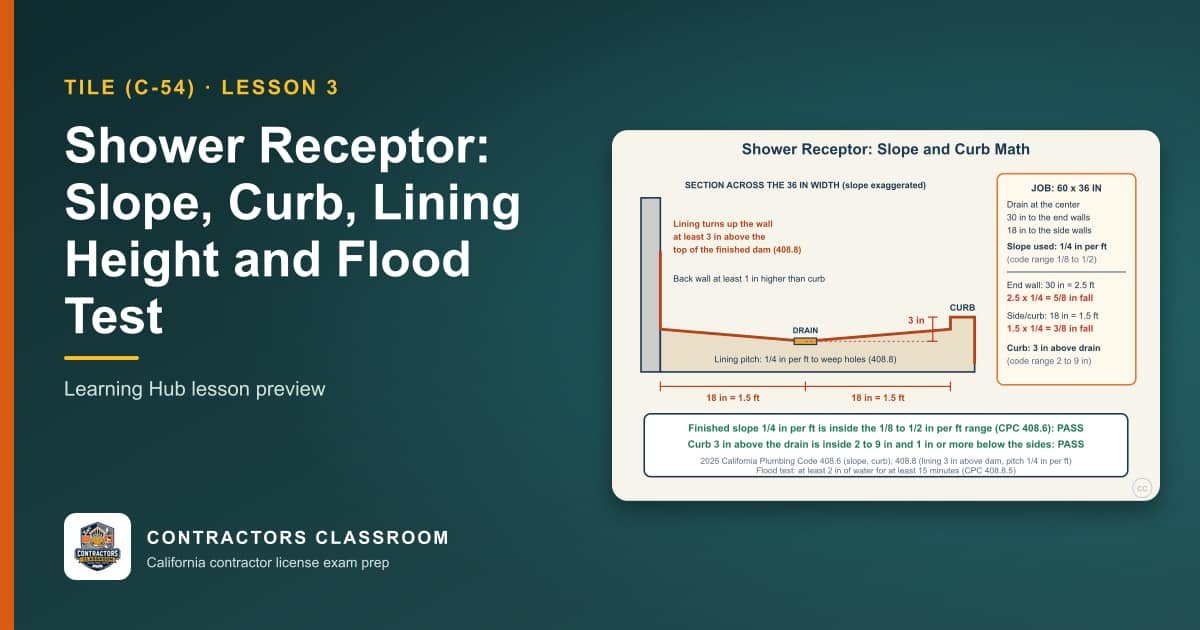
Before the tile goes down, a shower receptor has to be watertight, sloped toward a drain of the right size, and finished with a curb or threshold that meets a few specific dimensions. The 2025 California Plumbing Code puts those rules in Section 408, and an inspector will usually check them against a short list. This guide goes through what that list contains and gives you a pass-through checklist.
Everything below comes from the 2025 CPC text we reviewed. Local jurisdictions can amend it, so confirm with your building department before you pour or line anything.
The drain, trap and waste outlet
A shower needs a waste outlet and fixture tailpiece at least 2 inches in diameter. (2025 CPC §408.5) The strainer serving the shower drain must meet the standard named in that section. (2025 CPC §408.5)
The trap follows from the fixture table. A single-head shower trap has a 2 inch minimum trap and trap arm size, at 2.0 drainage fixture units. (2025 CPC Table 702.1) A 2 inch trap arm has to reach its vent within 60 inches, and not closer than 4 inches. (2025 CPC Table 1002.2) If the shower is horizontally wet vented, the limit for a 2 inch fixture drain is 8 feet. (2025 CPC Table 1002.2)
Remember that the trap seal itself must be at least 2 inches and no more than 4 inches deep, unless the local authority wants it deeper. (2025 CPC §1005.1)
Slope, curb and threshold
On a receptor with a finished curb or threshold, the dam must sit at least 1 inch lower than the sides and back. (2025 CPC §408.6) Measured from the top of the dam to the top of the drain, the depth can be no less than 2 inches and no more than 9 inches. (2025 CPC §408.6)
The finished floor must slope uniformly from the sides toward the drain. The range is 1/8 inch per foot (10.4 mm per meter) at the least and 1/2 inch per foot (41.6 mm per meter) at the most. (2025 CPC §408.6) Each receptor also needs a watertight nailing flange, either built in or field installed per the manufacturer, rising at least 1 inch above the top of the receptor sides. (2025 CPC §408.6)
Thresholds must be wide enough for a door 22 inches wide, and shower doors must open to keep at least a 22 inch unobstructed opening. (2025 CPC §408.6) With no threshold at all, the floor space in that room counts as a wet location under the building, residential and electrical codes. (2025 CPC §408.6)
Compartment size
A shower compartment's finished interior must provide not less than 1,024 square inches and be able to hold a 30 inch circle. (2025 CPC §408.7) The dimensions are measured at the top of the threshold and have to be kept clear up to 70 inches above the drain outlet, with only valves, showerheads, soap dishes, shelves and grab bars allowed to intrude. (2025 CPC §408.7) Showers designed under California Building Code Chapter 11A for accessibility are an exception. (2025 CPC §408.7)
Lining a site-built receptor
A receptor built on site must be watertight and made of dense, nonabsorbent, non-corrosive materials. It needs reinforcement, an approved flanged floor drain that makes a watertight joint, and smooth, impervious surfaces. (2025 CPC §408.8)
Key lining details:
- The subfloor and the rough side of the walls get covered with sheet plastic, lead, copper or another durable watertight material, and the lining climbs at least 3 inches past the finished dam or threshold. (2025 CPC §408.8)
- A built-in seat gets the same treatment, with the lining 3 inches above its horizontal surfaces. (2025 CPC §408.8)
- The lining is pitched 1/4 inch per foot toward the weep holes in the subdrain, over a smooth, solid subbase. (2025 CPC §408.8)
- Do not nail or perforate the lining lower than 1 inch above the finished dam or threshold. (2025 CPC §408.8)
- The subdrain sets flush with the subbase, uses a clamping ring to tighten the lining to the drain, and has weep holes protected from clogging. (2025 CPC §408.8)
A built-up nonmetallic pan can use at least three layers of 15 pound asphalt felt, each hot-mopped to the one below. Corner folds, laps and webbing extend at least 4 inches in every direction from the corner. (2025 CPC §408.8)
Sheet materials have their own minimums. Sheet lead weighs at least 4 pounds per square foot. (2025 CPC §408.8.3) Sheet copper is at least 12 ounces per square foot, or No. 24 gauge. (2025 CPC §408.8.4)
The flood test
Receptors are tested for watertightness by filling them with water at least 2 inches deep and leaving it at least 15 minutes. (2025 CPC §408.8.5) If there is no threshold, a temporary 2 inch barrier is built for the test. (2025 CPC §408.8.5) The test plug goes where both the top and underside of the subpan are tested at the clamped drain connection. (2025 CPC §408.8.5)
A worked example
Take a 60 by 36 inch receptor with the drain at the center, so the drain sits 30 inches from each end wall and 18 inches from each side wall.
- Slope range: at 1/4 inch per foot, a run of 18 inches (1.5 feet) falls 3/8 inch, and a run of 30 inches (2.5 feet) falls 5/8 inch. Both sit inside the 1/8 to 1/2 inch per foot range. (2025 CPC §408.6)
- Curb: a finished dam 3 inches above the drain is inside the 2 to 9 inch limits. (2025 CPC §408.6)
- Lining: the lining has to run at least 3 inches above the top of that dam. (2025 CPC §408.8)
- Test: fill to 2 inches for 15 minutes. (2025 CPC §408.8.5)
Inspector pass-through checklist
- Waste outlet and tailpiece at least 2 inches, strainer in place. (2025 CPC §408.5)
- Trap arm within the 4 to 60 inch range for a 2 inch pipe. (2025 CPC Table 1002.2)
- Dam height 2 to 9 inches above the drain, and 1 inch below the sides and back. (2025 CPC §408.6)
- Floor slope between 1/8 and 1/2 inch per foot. (2025 CPC §408.6)
- Lining 3 inches above the dam, pitched to the weep holes, with no nails below the 1 inch line. (2025 CPC §408.8)
- Flood test water held 15 minutes at 2 inches. (2025 CPC §408.8.5)
- Compartment at least 1,024 square inches and able to hold a 30 inch circle. (2025 CPC §408.7)
Tile setters and plumbers cross paths on exactly these items. The shower receptor lesson works the same numbers with a diagram. Prep pages for the C-36 plumbing contractor exam and the C-54 tile contractor exam cover each trade's side.
Sources
Code sections and publications this article relies on, as printed in the editions we reviewed. Codes and CSLB procedures change: check the current text before you rely on a detail.
- 2025 California Plumbing Code (CPC), Title 24 Part 5, Section 408.5
- 2025 California Plumbing Code (CPC), Title 24 Part 5, Table 702.1
- 2025 California Plumbing Code (CPC), Title 24 Part 5, Table 1002.2
- 2025 California Plumbing Code (CPC), Title 24 Part 5, Section 1005.1
- 2025 California Plumbing Code (CPC), Title 24 Part 5, Section 408.6
- 2025 California Plumbing Code (CPC), Title 24 Part 5, Section 408.7
- 2025 California Plumbing Code (CPC), Title 24 Part 5, Section 408.8
- 2025 California Plumbing Code (CPC), Title 24 Part 5, Section 408.8.3
- 2025 California Plumbing Code (CPC), Title 24 Part 5, Section 408.8.4
- 2025 California Plumbing Code (CPC), Title 24 Part 5, Section 408.8.5
Every lesson and question we write is grounded in California code books and CSLB materials. How we build our lessons


