- Dry run
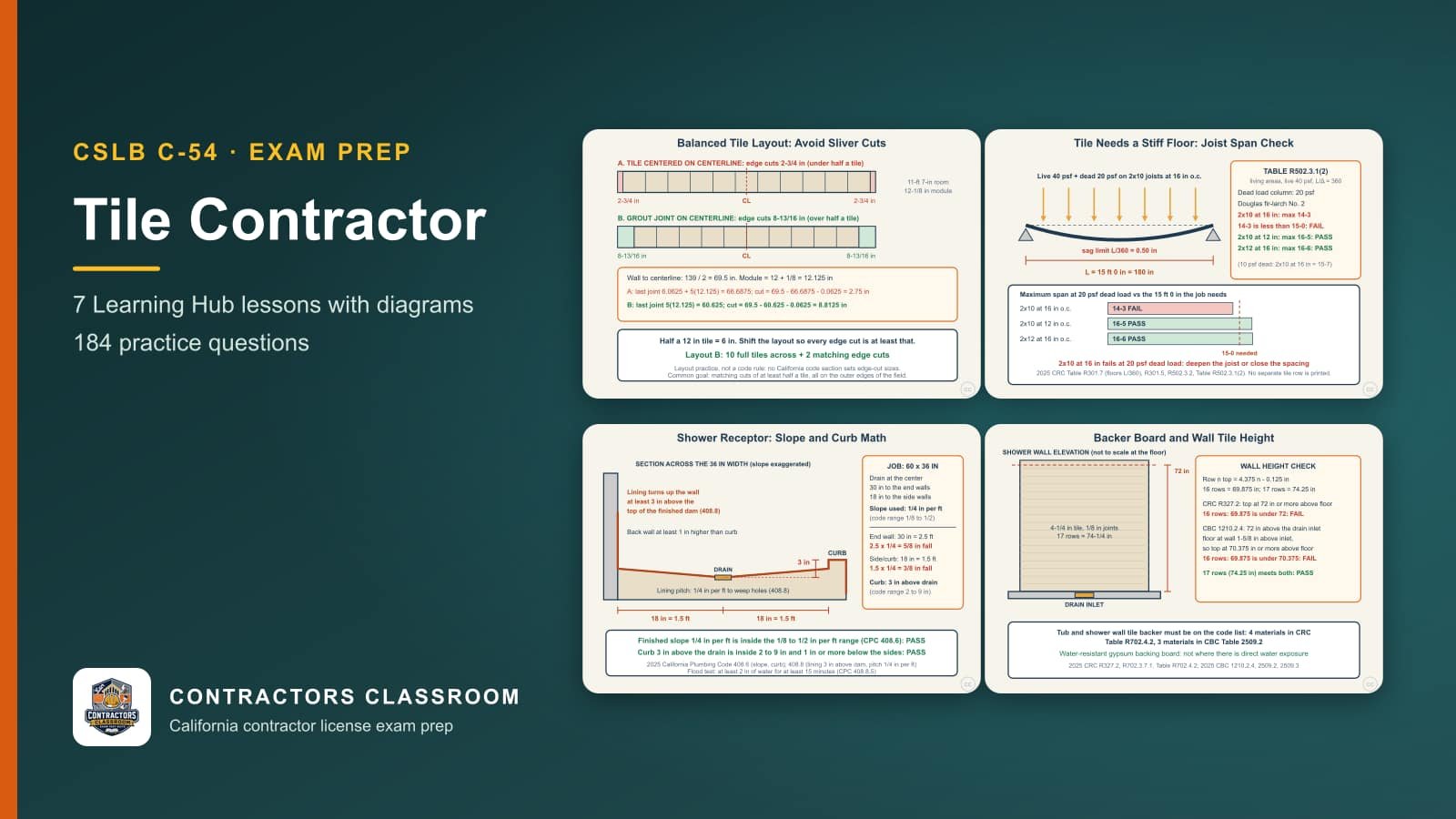
- Laying a row of loose tile along both room axes, with spacers, before any mortar is mixed. It shows where edge cuts will land so the starting lines can be shifted, and it is how a setter avoids thin slivers at the walls.
- Balanced cuts
- A layout that centers the pattern so cuts on opposite walls end up the same width. It also pushes the grout joint away from the wall, which helps hide a wavy or out-of-square wall, and it is the usual first goal when planning a room.
- Sliver cut
- An edge piece trimmed so narrow that it appears accidental, snaps readily, and magnifies every wobble in the wall. Many setters avoid cuts under half a tile, shifting the layout instead, except when working with small mosaic pieces.
- Deflection limit
- The most a floor member may sag under load, expressed as a fraction of its span. Tile, thin-set, and grout cannot flex, so a floor that bends too far cracks the finish; the cure is stiffer framing, not extra mortar or another layer.
- Thin-set mortar
- A cement-based bonding mortar spread in a thin layer with a notched trowel to adhere tile to a flat, sound surface. Its performance depends on the right mortar for the tile and location, correct coverage, and a surface that is clean and flat enough.
- Mortar bed
- A thick, sloped or leveled layer of sand-and-cement mortar placed under tile to build up or pitch a surface, as in a shower floor. Because it is thicker, it can correct larger variations than thin-set, but it needs proper mixing, compaction, and curing.
- Back-buttering
- Spreading a thin film of mortar on the back of a tile before pressing it into the bed. It improves contact on large tiles or stone and helps fill the surface so no hollow spots remain beneath the piece.
- Lippage
- A height difference between the edges of neighboring tiles. It comes from warped tile, uneven substrate, or poor setting, and large tiles show it more, so flatness checks and leveling techniques matter before and during installation.
- Movement joint
- A flexible gap, filled with sealant rather than rigid grout, placed where a tiled surface meets walls, changes plane, or spans large areas. It lets the tile and substrate expand and shift without cracking or popping loose.
- Cementitious backer board
- A panel made to stay stable when wet, screwed over framing as the base for wall or floor tile where water is constant. Only certain panel types are permitted there, and ordinary water-resistant drywall has limits, so the choice of backer is a common question.
- Shower receptor
- The floor assembly of a site-built shower: a watertight pan with a flanged drain and lining laid over a sloped base, finished with a curb or threshold. The code sets its slope, curb height, and lining height, and it is tested with water before tile.
- Weep holes
- Small openings in the drain clamping ring that let water reaching the pan's lining drain away through the subdrain. They keep the layers above from staying saturated, which is why the lining is pitched toward them and the holes must stay open.
- Pre-slope
- A sloped mortar layer that falls toward the drain beneath a shower liner, so water that gets through the tile still runs to the weep holes. The final tile bed on top then follows its own gentler slope.
- Flood test
- Plugging the drain and filling the receptor with water for a set time to prove the liner is watertight. It must happen before mortar or tile cover the pan, because afterward a leak is costly to find and fix.
- Roll-in shower
- An accessible shower with a very low threshold so a wheelchair can enter directly. For the tile setter the details are the maximum threshold height, a floor slope that drains yet stays within the accessible limit, a slip-resistant surface, and small drain-grate openings.
- Steam room envelope
- The continuous waterproof and vapor-resistant shell around a steam room, walls and ceiling included. The ceiling is normally sloped so condensation runs down the walls instead of dripping, and every joint and penetration must be sealed.
- Crackle glaze
- A decorative glaze finished with a fine web of surface cracks. Unlike most tile it needs sealing before grouting, because grout can stain into the crazing, which is why such tile appears in questions about preparation before joint work.
- Wet cutting
- Running tile saws with a continuous water feed to the blade so silica dust is suppressed at its source. Dry cutting porcelain or stone indoors can push the day's dust exposure past the limit, so the water supply is the first control.
- Tile adhesive VOC limit
- The ceiling on volatile organic compounds, in grams per liter, that the state's green building code sets for ceramic tile adhesives. It is stricter than some other adhesives and looser than others, and comparing a label with it is a typical product-choice question.
- Nonabsorbent wall surface
- The smooth, water-resistant finish, tile for instance, that the code requires on shower and tub-surround walls up to a stated height above the floor. Knowing that height, and that it differs outside dwelling units, helps in counting tile rows.