
A water heater swap looks simple, but in California the inspector is checking five things beyond the plumbing connections: the permit, the earthquake strapping, the relief valve and its discharge pipe, the drain pan if one is required, and the location. The 2025 California Plumbing Code spreads these across Chapter 5 and Chapter 6. This guide pulls them into one pass so you know what is likely to be examined.
The rules below are from the 2025 CPC text we reviewed. Local amendments exist, and manufacturers' instructions control many details, so check with your building department.
Permit and inspection
It is unlawful to install, remove or replace a water heater without first getting a permit from the local authority. (2025 CPC §502.1) Vents and chimneys get inspected after they are installed and before they are covered or concealed. (2025 CPC §503.1) The final inspection happens after the permitted work is in, and no appliance or part of it may be covered up until the authority has inspected and approved it. (2025 CPC §503.2)
The chapter also points you to the California Energy Code for extra mandatory water heating requirements. (2025 CPC §501.2)
Earthquake strapping
Water heaters must be anchored or strapped against horizontal movement from an earthquake. (2025 CPC §507.2) The straps go within the upper third and the lower third of the heater's height, and the lower one has to stay at least 4 inches above the controls. (2025 CPC §507.2)
For example, take a heater 60 inches tall. The upper third starts at 40 inches and the lower third ends at 20 inches. If the top of the controls sits 12 inches off the floor, the lower strap must be at least 16 inches up, so it fits in a band from 16 to 20 inches. The upper strap can go anywhere from 40 to 60 inches. The code text includes a note citing the Health and Safety Code, which requires new and replacement water heaters, and existing residential ones, to be braced or strapped. (2025 CPC §507.2)
Relief valve and the discharge pipe
Relief valves and their discharge pipes carry some of the most detailed rules in the chapter. A water system with storage water heating needs an approved combination temperature and pressure relief valve. The exception is a listed non-storage instantaneous heater with an inside diameter of 3 inches or less. (2025 CPC §608.3) The valve is installed on the heater in the location its listing and the manufacturer require. (2025 CPC §608.3)
On the relief device itself:
- The relief pressure setting has to sit higher than the incoming water service pressure, with a ceiling of 150 psi. (2025 CPC §504.4)
- No shutoff valve belongs between the relief valve and the water heater. (2025 CPC §504.6)
- Nothing that shuts off flow belongs in the discharge pipe between the valve and where it ends. (2025 CPC §504.6)
- The device's capacity, in Btu per hour or rated steam relief, has to be at least the heater's input rating. (2025 CPC §504.6)
The discharge pipe itself follows Section 608.5. (2025 CPC §504.6) It can have no valves, obstructions or means of isolation. (2025 CPC §608.5) It must be at least the size of the valve outlet, run that full size down to the flood level of whatever receives the discharge, and point down. (2025 CPC §608.5)
Other requirements for that pipe:
- The material is rated for at least the system's operating temperature. (2025 CPC §608.5)
- It drains by gravity on its own line, either across an air gap into the drainage system or to the outdoors. (2025 CPC §608.5)
- Outdoors, the end of the pipe stops between 6 inches and 2 feet above the ground, pointing down. (2025 CPC §608.5)
- It cannot be trapped or subject to freezing. (2025 CPC §608.5)
- It discharges where it will not cause injury or structural damage. (2025 CPC §608.5)
Thermal expansion is a related item. A system with a check valve, backflow preventer or similar device that keeps pressure from escaping back into the main needs an approved, adequately sized expansion tank. (2025 CPC §608.3) Instantaneous non-storage heaters are excepted. (2025 CPC §608.3)
Drain pan rules
A watertight, corrosion-resistant pan goes under the water heater when the heater is in an attic, on or inside an attic ceiling assembly, in a floor-ceiling or floor-subfloor assembly, or in any spot where a leak would do damage. (2025 CPC §507.5)
The details inspectors check:
- Depth of at least 1 1/2 inches (38 mm). (2025 CPC §507.5)
- A pan drain of at least 3/4 inch (20 mm) diameter running to an approved location, with the terminating end readily visible. (2025 CPC §507.5)
- Piping rated for the water heater's temperature. (2025 CPC §507.5)
- No relief valve discharge into the drainage pan. (2025 CPC §507.5)
That last line trips people up: the relief valve discharge pipe and the pan drain are two separate lines.
Location and support
- Bedrooms and bathrooms: the water heater must be a direct-vent type. A fuel-burning heater may also go in a closet with a listed gasketed door and listed self-closing device, with outdoor combustion air, and the closet is for the heater alone. (2025 CPC §504.1)
- Vent proximity: a heater that is not the direct-vent type goes near the chimney or gas vent, as close as is practical. (2025 CPC §504.2)
- Clearances: a listed heater follows its listing and the manufacturer's instructions. (2025 CPC §504.3.1) An unlisted one needs approval first and at least 12 inches of clearance on all sides. (2025 CPC §504.3.2)
- On the ground: the heater rests on level concrete or another approved base that rises at least 3 inches above the surrounding ground. (2025 CPC §507.4)
- Garages: elements such as burners and ignition devices sit at least 18 inches off the floor, with an exception for flammable-vapor-resistant listed heaters. (2025 CPC §507.13)
A pre-inspection walk-through
- Permit pulled, and nothing concealed that still needs inspection.
- Straps in the upper and lower thirds, with the lower strap 4 inches above the controls.
- Relief valve installed with no shutoff valve; discharge pipe full size, pointing down, not trapped.
- Pan, where required, at least 1 1/2 inches deep with a visible 3/4 inch drain.
- Expansion tank present if the system has a check valve or backflow preventer.
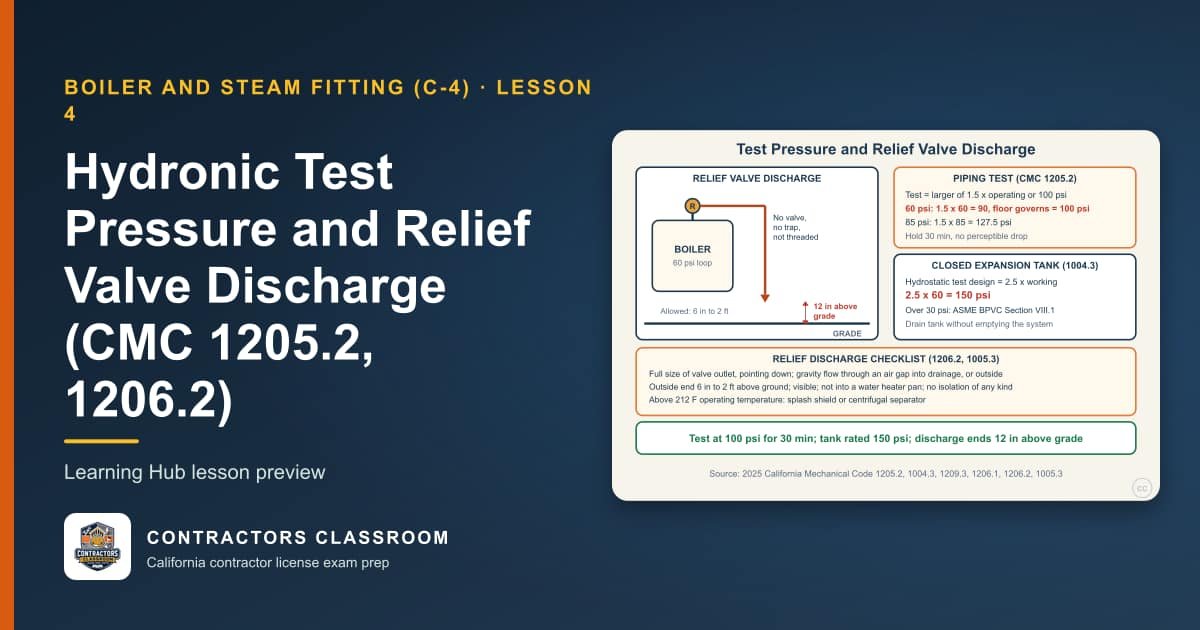
For the trade context, see the C-36 plumbing contractor exam prep and the C-20 HVAC contractor exam prep, since vents and combustion air cross both. The hydronic relief valve discharge lesson covers boiler-side discharge habits that parallel these.
Sources
Code sections and publications this article relies on, as printed in the editions we reviewed. Codes and CSLB procedures change: check the current text before you rely on a detail.
- 2025 California Plumbing Code (CPC), Title 24 Part 5, Section 502.1
- 2025 California Plumbing Code (CPC), Title 24 Part 5, Section 503.1
- 2025 California Plumbing Code (CPC), Title 24 Part 5, Section 503.2
- 2025 California Plumbing Code (CPC), Title 24 Part 5, Section 501.2
- 2025 California Plumbing Code (CPC), Title 24 Part 5, Section 507.2
- 2025 California Plumbing Code (CPC), Title 24 Part 5, Section 608.3
- 2025 California Plumbing Code (CPC), Title 24 Part 5, Section 504.4
- 2025 California Plumbing Code (CPC), Title 24 Part 5, Section 504.6
- 2025 California Plumbing Code (CPC), Title 24 Part 5, Section 608.5
- 2025 California Plumbing Code (CPC), Title 24 Part 5, Section 507.5
- 2025 California Plumbing Code (CPC), Title 24 Part 5, Section 504.1
- 2025 California Plumbing Code (CPC), Title 24 Part 5, Section 504.2
- 2025 California Plumbing Code (CPC), Title 24 Part 5, Section 504.3.1
- 2025 California Plumbing Code (CPC), Title 24 Part 5, Section 504.3.2
- 2025 California Plumbing Code (CPC), Title 24 Part 5, Section 507.4
- 2025 California Plumbing Code (CPC), Title 24 Part 5, Section 507.13
Every lesson and question we write is grounded in California code books and CSLB materials. How we build our lessons


