- Psychrometric chart
- A graph of moist-air properties, including dry-bulb and wet-bulb temperature, humidity ratio, enthalpy and dew point. Plotting two known values reveals the rest, and following a line across the chart shows what a coil or heater does to the air.
- Sensible heat ratio
- The fraction of a cooling load that changes air temperature rather than moisture content. A low ratio means a large humidity load, which pushes equipment selection toward coils and airflow that remove more water.
- Static pressure
- The pressure air exerts against duct walls, measured in inches of water column. The total across coil, filter and ducts is the resistance a blower must overcome, and the fan's rated airflow is only valid at the pressure shown in its performance table.
- Friction rate
- The pressure lost per hundred feet of duct, used to size ducts by the equal friction method. Dividing the pressure budget by the longest effective run gives a rate that, together with airflow, sets each duct's diameter.
- Plenum
- The sheet metal box at the outlet or inlet of an air handler or furnace that collects or distributes air for branch ducts. It must be sealed and sized well, and it is where static pressure and temperature readings are commonly taken during diagnostics.
- Net free area
- The open area of a louver, grille or screen once slats and wire are subtracted. Combustion air openings are sized by this figure rather than by outside dimensions, so a decorative grille can pass far less air than its face suggests.
- Air changes per hour
- How many times the air volume of a space is replaced in an hour. Multiplying the room volume by the rate and dividing by sixty gives the airflow in cubic feet per minute, which determines how many fans of a given size a ventilation job needs.
- Fan efficacy
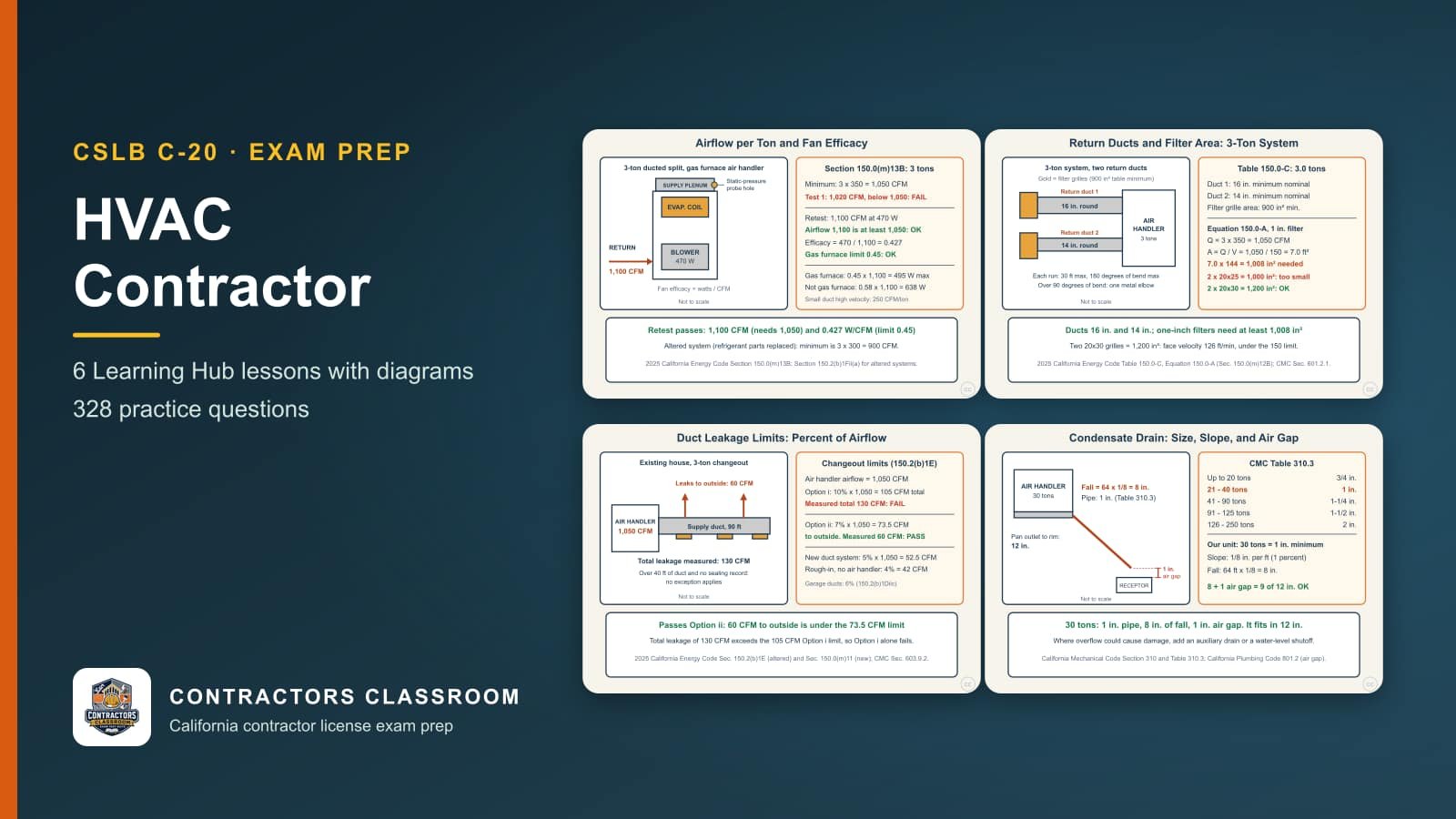
- The electrical power an air handler fan uses for each cubic foot per minute it moves, expressed in watts per cfm. The Energy Code verifies it by field testing, so low-resistance ducts and good filters help an installation pass.
- MERV rating
- A scale that rates how well an air filter captures particles of different sizes. A higher rating usually means more resistance to airflow, so choosing a filter means balancing air quality goals against fan capacity, filter area and duct sizing.
- Seal Class A
- The tightest sealing category in duct construction standards, requiring transverse joints, longitudinal seams and wall penetrations to be sealed. The California codes apply it to ducts at every pressure class, which makes mastic and tape quality a design item.
- Thermocouple
- A junction of two dissimilar metals that produces a small voltage when heated by a pilot flame. That voltage holds the gas valve open, so if the flame goes out, the valve closes and fuel stops flowing.
- Flame rollout switch
- A one-shot thermal safety that opens when flames spill out of the burner compartment, shutting down the gas valve. It usually points to a blocked heat exchanger or venting problem, so the cause must be found before it is reset.
- Heat exchanger
- The metal barrier in a furnace that keeps combustion gases separate from the air sent to the rooms. A crack or corrosion hole can let flue products mix into the supply air, so condition checks and carbon monoxide testing are priorities in maintenance.
- Reversing valve
- The refrigerant valve in a heat pump that swaps the roles of the indoor and outdoor coils. One circuit can then heat or cool, and a valve that sticks can leave the unit running in the wrong mode.
- Thermostatic expansion valve
- A metering device that adjusts refrigerant flow into the evaporator using a sensing bulb on the suction line. It aims to hold a steady superheat so the coil is well used and liquid does not return to the compressor.
- Superheat
- How many degrees the refrigerant vapor leaving the evaporator is above its boiling temperature at the suction pressure. Technicians compare it with a target to judge charge and metering device behavior.
- Capacitor
- A component that stores electrical charge to give a motor starting torque or smoother running. Weak capacitors are a very common cause of hard starts and tripped overloads, and the stored charge must be discharged safely before anyone handles one.
- Condensate float switch
- A sensor in a drain pan or line that shuts off cooling when water rises to an unsafe level. It is one of the accepted ways to protect a ceiling or attic from a plugged drain.
- Water-source heat pump
- A packaged heat pump that exchanges heat with a circulating water loop instead of outdoor air. Because the loop takes the place of the outdoor coil, the unit has no air-cooled condenser, a point worth remembering for component questions.
- Air-side economizer
- A set of dampers and controls that brings in cool outdoor air for cooling when conditions allow, reducing compressor run time. Its sensors and damper operation are common startup and troubleshooting checkpoints on commercial units.