The California Law and Business exam is split into seven major sections, and the CSLB study guide prints an approximate weight beside each one. (CSLB Study Guide LAW) The biggest are Contract Requirements and Execution at 21% and Employment Requirements at 20%, while Public Works is the smallest at 5%. (CSLB Study Guide LAW) Every applicant who has to test takes this exam in addition to a trade exam, and CSLB describes it as multiple-choice questions on business management and California construction law. (CSLB Get Licensed to Build, p. 23) Below is what each section means in plain words, how the exam relates to your trade exam, and what CSLB says about getting ready.
Why this exam exists
State law has the board require applicants to know California's laws on building, safety, health and liens, plus how a contracting business is administered. (License Law Book 2026, B&P §7068) The written exam is required to include questions on the laws of California and on the contracting business as well as the trade. (License Law Book 2026, B&P §7065) In other words, the Law and Business exam is where the business half of the license is tested. You may be an excellent framer or electrician and still need to learn payroll deposits, lien deadlines and contract rules.
The seven sections and their weights
The study guide for exams scheduled on or after December 1, 2021 lists these sections, with percentages that it says are approximate: (CSLB Study Guide LAW)
- Business Organization and Licensing (13%). Covers how the company is organized, the licensing rules, and advertising and subcontracting.
- Business Finances (15%). Managing cash, budgeting and planning, taxes, and financial reporting, which is where balance sheets fit.
- Employment Requirements (20%). Hiring people, supervising and training them, evaluating them and keeping records, plus payroll.
- Insurance and Liens (12%). Workers' compensation coverage, general business insurance, and lien rights and related remedies.
- Contract Requirements and Execution (21%). Bids, controlling costs, organizing a project, the contract itself and getting paid.
- Public Works (5%). Prevailing wage, bonding and insurance requirements.
- Safety (14%). Training and reporting requirements, general safety, and hazardous or unknown materials.
Those percentages add up to 100. Three sections, Contract Requirements, Employment and Business Finances, carry 56% between them (21 + 20 + 15). That is a strong signal about where a first week of study should go.
Sample questions show the style
The guide prints three sample questions. One asks what determines how often payroll deposits go to the IRS. Another asks how many days participants have to return an agreement to arbitrate after CSLB's Registrar mails it. The third asks which account a company car's depreciation is charged to. (CSLB Study Guide LAW) None of them asks you to recite a statute word for word. They ask you to apply a rule from payroll, dispute handling or accounting, which is why reading the material once is not enough.
The format is the same as other CSLB exams. Every question has four choices with one best answer, some questions need math, and a calculator is provided. (CSLB Study Guide LAW) There is no penalty for guessing, and the guide says it is better to answer than to leave a blank. (CSLB Study Guide LAW) The exam is closed book. (CSLB Study Guide LAW)
How it relates to your trade exam
You need both. Applicants must pass this exam plus the trade exam for their classification, with an exception only where a waiver applies. (CSLB Get Licensed to Build, p. 21) The waiver conditions CSLB lists, such as currently qualifying a license in the same classification, are about the trade exam. (CSLB Get Licensed to Build, p. 21) Plan on studying for the law and business exam no matter how experienced you are.
The two exams overlap a little in topic, since trade guides also include Safety sections, such as 15% on the General Building (B) outline. (CSLB Study Guide B) But the Law and Business version of safety stresses training and reporting requirements, general safety and hazardous or unknown materials. (CSLB Study Guide LAW) The remaining sections have no counterpart in a trade exam, so they need their own study time.
Passing one exam is not wasted if you miss the other. Exam results are good for five years, and you retake only the exam you did not pass. (CSLB Get Licensed to Build, p. 25)
How CSLB says to prepare
CSLB's advice is direct: study the latest edition of the License Law & Reference Book, which can be read free on CSLB's website or bought from a publisher. (CSLB Get Licensed to Build, p. 23) It also points to the Candidate Information Bulletin that PSI sends applicants and to the study guides on CSLB's website. (CSLB Get Licensed to Build, p. 23)
The study guide's own resource list is broader. It names the Law and Reference Book, the California Employer's Guide (DE 44), the Labor Code, the IRS employer's tax guide (Publication 15), the DIR Public Works Manual, Title 8 of the California Code of Regulations (Cal/OSHA), Get Licensed to Build and a NASCLA business and law guide, among others. (CSLB Study Guide LAW)
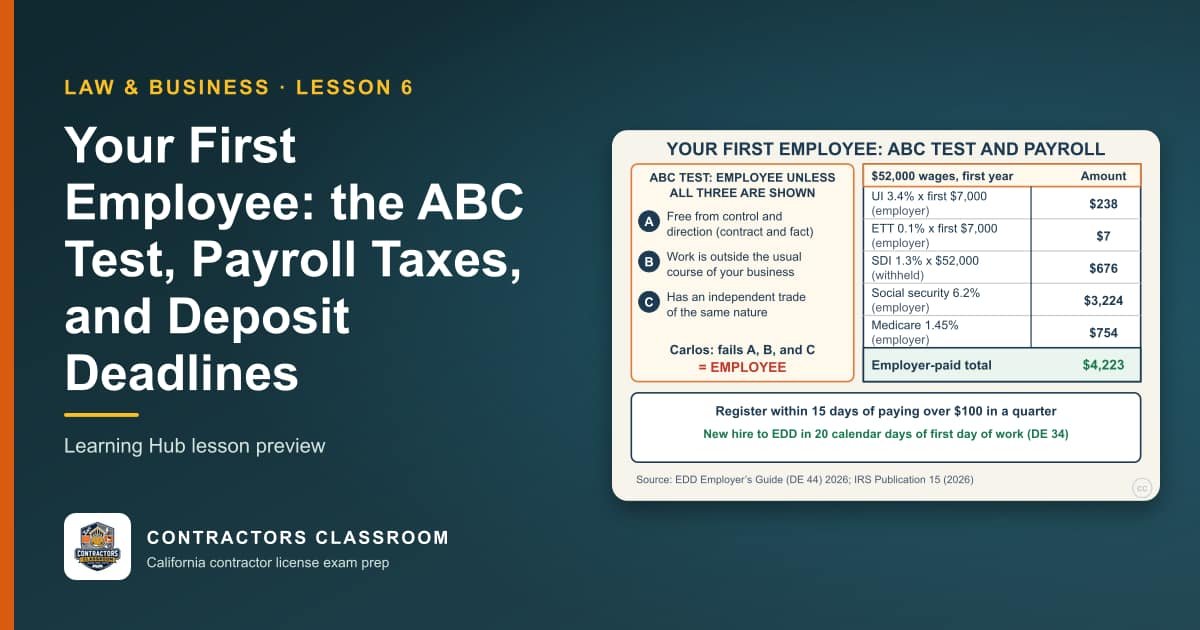
A simple planning method, which is ours and not a CSLB rule, is to split study time by weight. With 10 study hours in a week, the seven sections get 1.3, 1.5, 2.0, 1.2, 2.1, 0.5 and 1.4 hours, which adds up to 10.0. Then move a few of those hours toward your weakest area. If you have not worked with employees yet, for example, Employment Requirements deserves extra time, and our first employee lesson on the ABC test and payroll is a good place to start. If liens confuse you, work through the preliminary notice and lien calendar lesson.
A study order that fits the weights
- Start with Contract Requirements and Execution (21%) and Employment Requirements (20%), because they carry the most weight. (CSLB Study Guide LAW)
- Move to Business Finances (15%) and Safety (14%). (CSLB Study Guide LAW)
- Cover Business Organization and Licensing (13%) and Insurance and Liens (12%). (CSLB Study Guide LAW)
- Finish with Public Works (5%), which is small but easy to miss. (CSLB Study Guide LAW)
- Add practice questions on your trade, such as General Building, through our General Building contractor exam prep, and see the full trade list for other classifications.
Whatever order you pick, check CSLB's current guide before you test, because the printed weights and publisher details can be updated.
Sources
Code sections and publications this article relies on, as printed in the editions we reviewed. Codes and CSLB procedures change: check the current text before you rely on a detail.
- CSLB official examination study guide, classification LAW
- CSLB, Get Licensed to Build: A Guide to Becoming a Licensed Contractor, page 23
- California Contractors License Law & Reference Book, 2026 edition (CSLB), B&P Code section 7068
- California Contractors License Law & Reference Book, 2026 edition (CSLB), B&P Code section 7065
- CSLB, Get Licensed to Build: A Guide to Becoming a Licensed Contractor, page 21
- CSLB official examination study guide, classification B
- CSLB, Get Licensed to Build: A Guide to Becoming a Licensed Contractor, page 25
Every lesson and question we write is grounded in California code books and CSLB materials. How we build our lessons


