
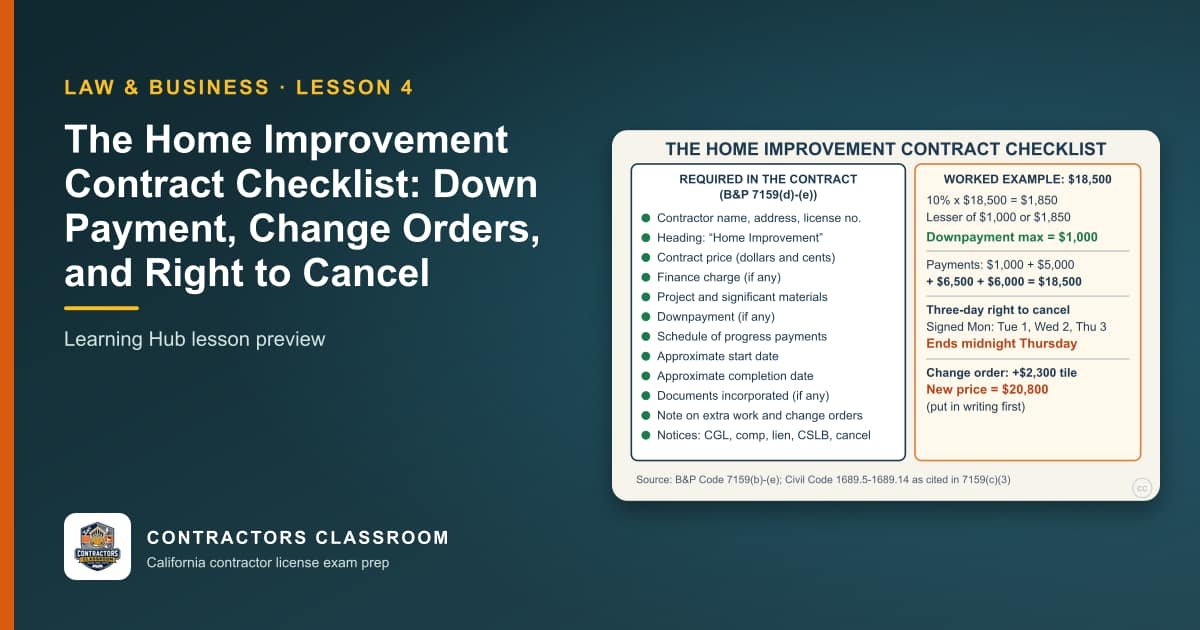
A California home improvement contract has to be in writing, signed by both sides before the work starts, and filled with a specific set of headings, dollar figures, dates and consumer notices. Business and Professions Code section 7159 is the checklist, and the License Law book we reviewed (the 2026 edition) prints it in full. (License Law Book 2026, B&P §7159(d))
What follows is a plain-language walk through that section, in the order most contracts read. Statutes get amended, so confirm the current wording with CSLB or a construction attorney before you build your own form.
Which jobs count as a home improvement contract
The law defines a home improvement contract as an agreement, written or oral, between a contractor and an owner or a tenant for home improvement work, where the combined price of labor, services and materials goes over $500. (License Law Book 2026, B&P §7159(b))
A tenant counts no matter how many units the building has, as long as the work is done in or on the tenant's own unit. (License Law Book 2026, B&P §7159(b)) The definition also reaches an agreement between a salesperson and an owner or tenant for selling, installing or furnishing home improvement goods or services. (License Law Book 2026, B&P §7159(b))
Two carve-outs matter. Service and repair contracts that follow the separate rules in section 7159.10 are outside section 7159, and so are some small fire alarm sales and alarm monitoring charges. (License Law Book 2026, B&P §7159(a))
Rules that apply to every home improvement contract
Before the item list, section 7159 sets general ground rules. The writing must be legible, and printed forms need at least 10-point type with at least 10-point boldface headings, unless the section calls for larger type. (License Law Book 2026, B&P §7159(c))
Other general rules, in short:
- Before any work starts, you hand the buyer a copy signed and dated by both of you. Receiving that copy starts the buyer's cancellation rights. (License Law Book 2026, B&P §7159(c))
- The first page must show the date the buyer signed, plus the name, address and email address where a Notice of Cancellation can be sent, along with a phone number for help filling it out. (License Law Book 2026, B&P §7159(c))
- The contract must say that after each satisfactory payment, and before the next one, you will furnish a full and unconditional release from lien claims for the work paid for. (License Law Book 2026, B&P §7159(c))
- Near the signatures, a notice must tell the owner or tenant that they may require you to carry a performance and payment bond. (License Law Book 2026, B&P §7159(c))
- A yes/no box must state whether a subcontractor will be used. If you check yes, a disclaimer about the subcontractor list must appear. (License Law Book 2026, B&P §7159(c))
- If you furnish joint control, you may not hold a financial or other interest in it. (License Law Book 2026, B&P §7159(c))
What the contract has to contain
Subdivision (d) is the longest list. In order, the contract and every change to it must include these items. (License Law Book 2026, B&P §7159(d))
- Your name, business address and license number, plus the name and registration number of any home improvement salesperson who brought in or negotiated the job.
- The heading "Home Improvement" in at least 10-point boldface.
- A boldface statement, at least 12-point, telling the buyer they are entitled to a completely filled-in copy signed by both parties before any work starts.
- A "Contract Price" heading with the amount in dollars and cents, and a separate "Finance Charge" heading with its own amount if there is one.
- A description of the project and of the significant materials and equipment, with a plan and scale drawing for swimming pools.
- A "Downpayment" heading, the actual amount, and the required warning in at least 12-point boldface, if a downpayment is charged.
- A "Schedule of Progress Payments" if payments are due before completion, with each payment in dollars and cents and tied to specific work and materials.
- "Approximate Start Date" and "Approximate Completion Date" headings with dates, along with a statement of what counts as substantial commencement of work.
- A list of any documents incorporated into the contract.
- A "Note About Extra Work and Change Orders."
Notices that go in the contract or an attachment
Subdivision (e) adds a set of notices. (License Law Book 2026, B&P §7159(e)) Several of them may ride along as attachments if the contract says so.
- Insurance: a commercial general liability notice and a workers' compensation notice, each with the statement that fits your situation. (License Law Book 2026, B&P §7159(e))
- Mechanics Lien Warning: a long consumer notice explaining that unpaid subcontractors, suppliers and laborers can record liens even when the owner pays the contractor in full. (License Law Book 2026, B&P §7159(e))
- CSLB information: a notice in at least 12-point type that CSLB is the consumer protection agency for contractors and that using an unlicensed contractor can limit the owner's remedies. (License Law Book 2026, B&P §7159(e))
- Right to cancel: a three-day notice (not needed when the contract is negotiated at the contractor's place of business), a five-day notice when the buyer is a senior citizen, or a seven-day notice for repairs after a declared disaster. (License Law Book 2026, B&P §7159(e))
A contractor who furnishes a qualifying bond or approved joint control is excused from some of these. The Mechanics Lien Warning and the downpayment and progress-payment statements are among the items that can be left out. (License Law Book 2026, B&P §7159.5(a)(8))
Change orders: signed first, work second
Extra work gets paid for most cleanly when the paperwork comes first. A change-order form must be part of the contract, and a change becomes part of the contract only if it is in writing and signed by both parties before the changed work begins. (License Law Book 2026, B&P §7159(c))
A separate section adds that an extra work or change order cannot be enforced against the buyer unless it states three things: the scope of the work, the amount added or subtracted, and the effect on the progress payments or the completion date. (License Law Book 2026, B&P §7159.6(a))
For example, say a tile upgrade adds $2,300 to an $18,500 job. The change order should describe the tile work, show the new total of $20,800, and say whether any progress payment or the finish date moves. If the subcontractor box on the original contract was checked yes, the same subcontractor disclaimer has to appear on that change order too. (License Law Book 2026, B&P §7159(c))
The buyer cannot demand extra work without giving written authorization. (License Law Book 2026, B&P §7159.6(b)) And if the paperwork was skipped, the section still leaves room for legal or equitable remedies meant to prevent unjust enrichment, so a missed form does not automatically erase what you earned. (License Law Book 2026, B&P §7159.6(c))
What happens when a contract falls short
Leaving out the required information, notices or disclosures is cause for discipline against a licensee, a person who should be licensed, or their agent or salesperson. (License Law Book 2026, B&P §7159(a)) If the applicable Notice of Cancellation is missing from the contract, the buyer may file a complaint with CSLB. (License Law Book 2026, B&P §7159(a))
The prime contractor is responsible for finishing the project according to the contract, plans and specifications, and that does not stop discipline of a subcontractor or home improvement salesperson. (License Law Book 2026, B&P §7159(a))
A quick pre-signing pass catches most gaps:
- Is the total over $500, and is the writing signed and dated by both sides?
- Do the headings, dates, amounts and project description match the list in section 7159(d)?
- Are the insurance, lien, CSLB and cancellation notices included, in the right type size?
- Does a change-order form travel with the contract?
For the money side of the same section, the home improvement contract checklist lesson works through the down payment and cancellation numbers. The CSLB study guide for Law and Business lists contract requirements as a major section, at roughly one fifth of the exam. (CSLB Study Guide LAW) Contractors working toward a General Building (B) license or a Residential Remodeling (B-2) license will meet these rules on residential work.
Sources
Code sections and publications this article relies on, as printed in the editions we reviewed. Codes and CSLB procedures change: check the current text before you rely on a detail.
- California Contractors License Law & Reference Book, 2026 edition (CSLB), B&P Code section 7159(d)
- California Contractors License Law & Reference Book, 2026 edition (CSLB), B&P Code section 7159(b)
- California Contractors License Law & Reference Book, 2026 edition (CSLB), B&P Code section 7159(a)
- California Contractors License Law & Reference Book, 2026 edition (CSLB), B&P Code section 7159(c)
- California Contractors License Law & Reference Book, 2026 edition (CSLB), B&P Code section 7159(e)
- California Contractors License Law & Reference Book, 2026 edition (CSLB), B&P Code section 7159.5(a)(8)
- California Contractors License Law & Reference Book, 2026 edition (CSLB), B&P Code section 7159.6(a)
- California Contractors License Law & Reference Book, 2026 edition (CSLB), B&P Code section 7159.6(b)
- California Contractors License Law & Reference Book, 2026 edition (CSLB), B&P Code section 7159.6(c)
- CSLB official examination study guide, classification LAW
Every lesson and question we write is grounded in California code books and CSLB materials. How we build our lessons


