CSLB C-11

Elevator Contractor License Exam Prep (C-11)

Getting ready for the California elevator contractor license exam (CSLB C-11)? Study with 584 practice questions in 5 categories and 4 Learning Hub lessons, made for elevator mechanics and installers, with the Law and Business exam included.

One-time purchase, no subscription. Law & Business included.

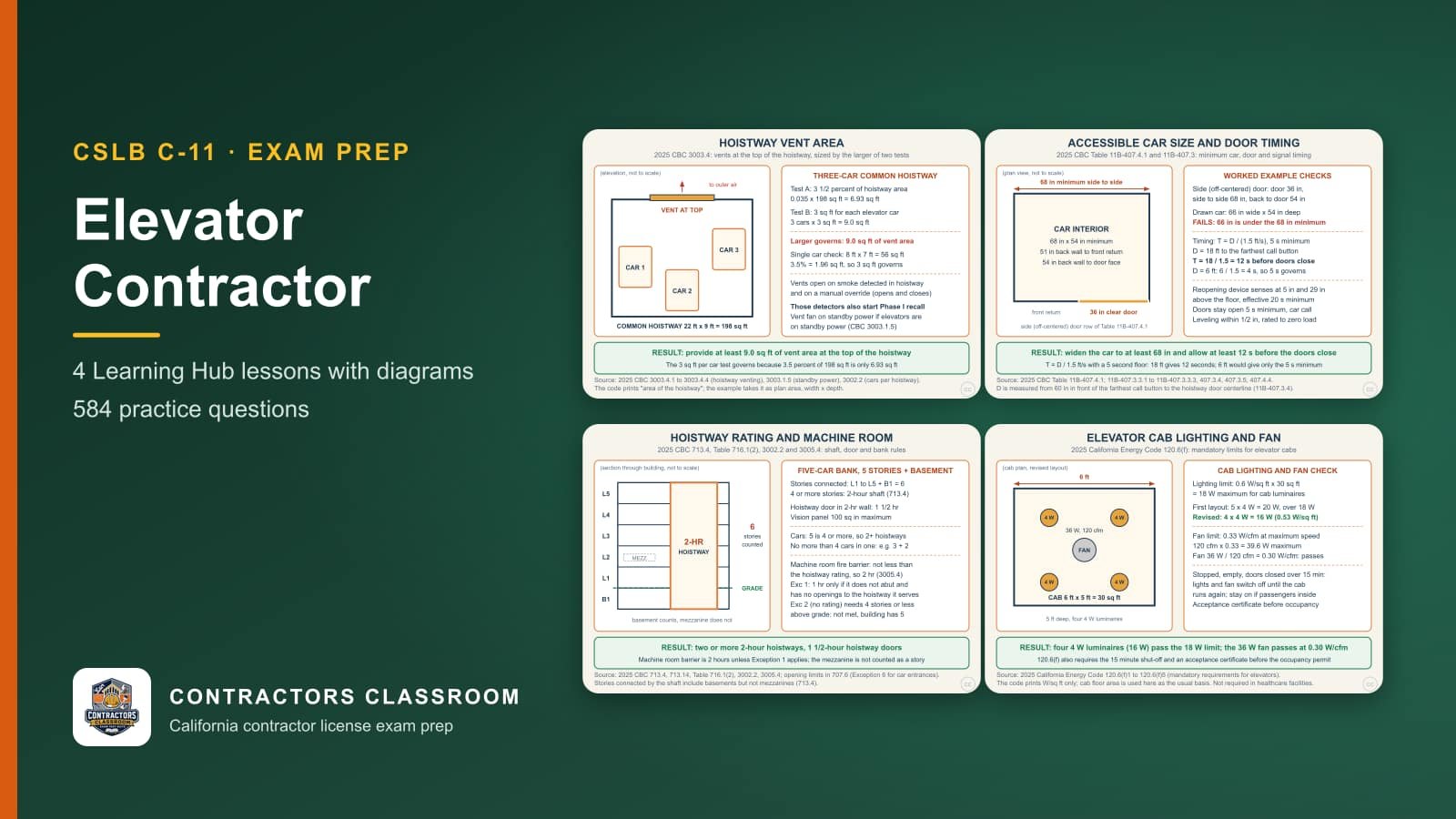
Diagrams from the C-11 elevator contractor lessons: Hoistway Vent Area and Operation, Accessible Car Size and Door Timing, Hoistway Fire Rating and Machine Room Enclosure and Elevator Cab Lighting and Fan Energy Limits
584practice questions
5categories
4Learning Hub lessons
$249Law & Business included

What the exam covers: Elevator (C-11)

The CSLB exam for the California elevator contractor license (C-11) is a closed-book, multiple-choice test. CSLB's official study guide divides it into four major sections and gives each an approximate weight: Planning and Estimating (about 17%), Conveyance System Installation (about 34%), Conveyance Repair, Maintenance, and Modernization (about 24%), and Safety (about 25%).

Conveyance System Installation carries the most weight, about 34%, so it deserves roughly that share of your study time, with Safety next at about 25%.

Contractors Classroom turns that outline into 584 practice questions in 5 categories (Planning and Estimating, Hoistway Construction & Rigging, Hydraulic & Traction Elevator Systems, Cal-OSHA Elevator Safety Orders (Subchapter 6), and Safety), plus 4 Learning Hub lessons with diagrams (such as "Hoistway Vent Area and Operation" and "Accessible Car Size and Door Timing"). Law and Business, which most applicants take alongside their trade exam, is included at no extra charge.

Exam sections and approximate weights

  • Planning and Estimating~17%
  • Conveyance System Installation~34%
  • Conveyance Repair, Maintenance, and Modernization~24%
  • Safety~25%

Practice question categories

  • Planning and Estimating110 practice questions
  • Hoistway Construction & Rigging90 practice questions
  • Hydraulic & Traction Elevator Systems165 practice questions
  • Cal-OSHA Elevator Safety Orders (Subchapter 6)109 practice questions
  • Safety110 practice questions

What the Elevator Contractor exam covers, section by section

Planning and Estimating (~17%)

Installing or altering an elevator, lift, or escalator is a long, coordinated effort, and much of it is settled before work starts. Planners review hoistway or truss conditions, equipment drawings, and delivery schedules, then price labor and materials. Permits, notices, and site protection are arranged first, and good communication with the owner, general contractor, and inspectors keeps the schedule realistic. Underestimating access, hoisting, or existing conditions is a common way for these projects to lose money and time. Machine room layout, pit depth, and overhead clearance are checked against the manufacturer's drawings so that crane picks, rigging, and material staging can be planned before components are delivered.

  • Reviewing building conditions and equipment drawings to map out the steps of the job
  • Pricing equipment, labor, and specialty materials for lifts, elevators, and escalators
  • Arranging permits, notifications, and temporary protection before work begins

Conveyance System Installation (~34%)

Installation often starts with taking out old equipment, which has to be done in a controlled order. New work then proceeds through rails, machines, cars, doors, and controls, each aligned to tight tolerances. Interior and exterior finishes follow, and the electrical systems are adjusted and tested until the unit starts, stops, and levels as intended. Craftsmanship here determines ride quality and reliability. Because passengers depend on the result every day, shortcuts tend to reveal themselves later as noise, rough stops, or nuisance shutdowns. Welded or bolted brackets, plumb guide rails, counterweight frames, and landing sill alignment must be checked repeatedly as the work climbs, because small errors accumulate over the height of a hoistway.

  • Dismantling and hauling out old components in a safe, planned sequence that protects the structure around them
  • Setting guide rails, machines, cars, and doors in precise alignment so moving parts run smoothly and quietly
  • Fitting cab interiors, entrances, and other visible finish elements
  • Tuning controls and verifying safety circuits and operation under power

Conveyance Repair, Maintenance, and Modernization (~24%)

Once equipment is running, it needs ongoing attention. Routine maintenance means inspecting, lubricating, adjusting, and cleaning on a schedule so wear is caught early. When a unit stops, jams, or rides roughly, a service call demands logical diagnosis, and repairs may range from swapping a small part to rebuilding major components as part of an upgrade to older equipment. Modernization ties newer components into older gear while the building continues to depend on it. Typical tasks include cleaning pits, checking door operators and safety edges, inspecting ropes or chains, and adjusting handrail and step tension on escalators and moving walks, followed by a test ride.

  • Carrying out scheduled inspection, lubrication, and adjustment on every type of unit, catching wear before it causes a shutdown
  • Diagnosing breakdowns and entrapments quickly when customers call for help
  • Fixing or replacing worn parts and restoring safe, smooth operation

Safety (~25%)

Elevator and escalator mechanics work in shafts, pits, machine rooms, and on moving equipment where mistakes are severe. Personal protective habits, controlled energy, and fall protection are essential, as are good communication with co-workers and clear procedures for isolating equipment. Protecting riders, building staff, and the public around the work area is equally important. Reliable habits matter here because the equipment can restart or shift unexpectedly if it is not properly controlled. Lockout of the main disconnect, working from the car top with the inspection switch engaged, and watching for the moving counterweight or pinch points on escalator steps are routine safeguards.

  • Protecting mechanics from falls, crushing, shock, and moving machinery
  • Barricading work areas and controlling hazards that could reach the public

Code books behind the Elevator Contractor exam

The exam outline published for this trade lists these references.

  • 2025 California Building CodeFor elevator work the building code supplies the shaft around the equipment: hoistway fire-resistance ratings and door ratings, smoke and heat venting, machine room enclosure, and the accessibility rules for car size, door timing and signals. It feeds the planning topics and the hoistway construction portions of Conveyance System Installation.
  • 2025 California Electrical CodeThe electrical code covers the power side of conveyances: feeders and disconnects, machine room and hoistway wiring methods, lighting and receptacles in the pit and machine room, grounding and bonding, and standby power arrangements. It is the reference behind electrical adjusting and testing within the installation section.
  • ASME A17.1 Safety Code for Elevators and EscalatorsThe core safety code for elevators, escalators and related equipment. It specifies hoistway and pit features, machine spaces, car and counterweight equipment, safeties, governors, buffers, interlocks, hydraulic and traction systems and maintenance duties. It feeds installation, repair, maintenance and safety topics throughout the exam.
  • ASME A17.2 Guide for Inspection of Elevators, Escalators, and Moving WalksAn inspector's companion to the safety code, laying out what to check and how to test a conveyance. For a contractor it models acceptance tests and periodic checks, so it supports electrical adjusting and testing, maintenance routines and service calls where equipment must be examined methodically.
  • ASME A18.1 Safety Standard for Platform Lifts and Stairway ChairliftsThis standard covers wheelchair platform lifts and stairway chairlifts, which are smaller, lower-rise machines than elevators. It addresses their construction, enclosure, controls, safety devices and operation. It feeds the lift portions of Conveyance Repair, Maintenance, and Modernization and of installation.
  • Elevator Industry Field Employees' Safety HandbookA practical safety manual written for field mechanics, covering working on car tops, in pits and machine rooms, hoistway hazards, rigging, electrical safety and procedures for working on moving equipment. It is a main source for the employee safety and job site safety topics in the Safety section.
  • Elevator Safety OrdersCalifornia's own rules for the design, installation, operation, inspection and maintenance of elevators and related equipment. They set what the state expects of contractors working on conveyances in this state, and feed the installation, maintenance and Safety sections. Knowing how they sit alongside the national code is part of preparation.
  • State of California General Industry & Electrical Safety Orders (Cal/OSHA)With the Construction Safety Orders, this Title 8 set covers general workplace hazards for conveyance crews: electrical safety, ladders and walking surfaces, rigging and hoisting, tools and hazardous materials. It is the reference behind employee protection topics in the Safety section, about a quarter of the exam.

Key terms for the Elevator Contractor exam

Hoistway
The enclosed vertical shaft in which an elevator car and its counterweight travel. It is built as a fire-rated enclosure with limited openings, and nearly every installation and inspection task starts from its dimensions and condition.
Hoistway vent
An opening at the top of the shaft that lets smoke and hot gases escape instead of spreading to floors through door gaps. The code ties its area to the shaft size, and it opens automatically.
Elevator pit
The space below the lowest landing that holds buffers, and for hydraulic units the jack. It needs its own light, a stop switch and safe access, and it is one of the most hazardous places a mechanic works.
Counterweight
A set of steel or concrete weights that balances the car and a share of its load in a traction elevator. It lets a smaller motor lift and lower the car, and it rides on its own guide rails.
Overspeed governor
A speed-sensing device driven by a rope that runs with the car. If the car goes too fast, the governor grips its rope and triggers the car safety to stop the descent.
Car safety
A mechanism under or on the car frame that wedges against the guide rails to stop the car when the governor trips or the suspension fails. Its action is mechanical and independent of the drive.
Buffer
A spring or oil-filled device in the pit that cushions the car or counterweight if it travels past the bottom landing. Oil types compress slowly as fluid is forced through an orifice, so they can be used at higher speeds.
Hydraulic jack and plunger
The cylinder and piston that lift a hydraulic elevator when pressurized oil is pumped in. Lowering happens by releasing oil through a valve, and packing, seals and the plunger surface are routine service items.
Hydraulic power unit
The combined motor, pump, valve block and oil tank that drives a hydraulic elevator. Oil temperature, valve adjustment and noise at this unit are common symptoms during service calls.
Slowdown profile
The shape of the speed curve as a car decelerates into a stop. A gentler approach improves comfort and leveling accuracy but lengthens the run, which can add heat to the oil of a hydraulic unit.
Traveling cable
The flexible multi-conductor cable that hangs from the car to the hoistway wall, carrying power, signals and communication. It is purchased by length, hung with hangers and must not rub on the shaft.
Hoistway door interlock
A device that keeps a landing door locked unless the car is there and prevents the car from running unless the door is closed and locked. It protects people from falling into an open shaft.
Leveling
Bringing the car floor into line with the landing floor so passengers and carts roll on without a step. Accessibility rules control how close and how wide the gap at the sill may be.
Door reopening device
A detector at the door edge or across the opening that reverses a closing door when it senses a passenger or object. Dwell time and nudging behavior are set around it.
Escalator step chain
The chains that pull the steps around the truss. Chain wear, roller condition and lubrication are routine inspection items, and a worn chain can lead to a step coming out of alignment.
Platform lift
A small powered platform that carries a wheelchair user over a short vertical rise, such as to a stage or mezzanine. It falls under its own standard, with different enclosure and control rules than a passenger elevator.
Fire service recall
A mode that brings cars back to a designated floor when a smoke detector or key switch activates, then lets firefighters run a car by hand. Technicians must know how it is tested and reset.
Traction sheave
The grooved drive wheel over which hoist ropes run, moving the car and counterweight by friction. Worn grooves or rope slip are service concerns because lift depends on grip, not on winding.
Guide rails
Vertical steel tracks, fixed to the hoistway with brackets, that keep the car and counterweight on course and give the safeties something to grip. Their alignment strongly affects ride quality.

Where to spend practice time for the Elevator Contractor exam

  • Conveyance installation sequenceConveyance System Installation is the largest block at about 34 percent. It covers removal of old equipment, installing equipment, finishes, and electrical adjusting and testing. Study the order of work in the hoistway, how rails, machine and controller are set, and what is adjusted and verified before a car is turned over to passengers. Walk the sequence aloud once a day.
  • Safety for crews and sitesSafety is about 25 percent, covering employee safety and job site safety. Review work practices for pits, car tops and machine rooms, the interaction of guarding and door interlocks, and the rules that govern working around moving equipment. Rehearse what to check before stepping on a car or entering a pit. Revisit the topic on several separate days.
  • Repair, maintenance and callbacksAt about 24 percent, this section spans maintenance, service calls and repair across passenger elevators, small freight lifts, platform lifts, escalators and moving walks. Practice thinking in symptoms: a door that will not close, a car that levels poorly, a warm hydraulic unit, a noisy step chain. For each, name the likely component and the check you would make first. Keep a short list of symptoms and causes.
  • Planning, quantities and enclosure rulesPlanning and Estimating is about 17 percent, including conveyance planning, costing and preliminary setup. Practice quantity math such as cable by the foot plus hangers, and review hoistway construction: fire rating of the shaft, vent size, machine room enclosure and how many cars may share a hoistway. Recheck every total.
  • Hydraulic versus traction systemsHydraulic and traction systems make up the biggest group of practice material. Build a side-by-side chart: what lifts the car, what controls speed, where the oil or ropes live, which safety devices apply, and which failures show up in each. Include buffers, governors, and the effect of oil temperature on a hydraulic ride. Label a diagram as you go.
  • Accessibility, fire and energy detailsSeveral code items repeat in planning and installation questions: the size a car needs to be accessible, how long doors stay open, hoistway fire ratings, vents, and limits on cab lighting and fan power. Make a one-page list of each requirement with the condition that triggers it, and practice distinguishing similar rules that apply to different building types. Quiz yourself with the table closed.

Scenarios to talk through before the Elevator Contractor exam

  • Hydraulic oil runs hotA hydraulic elevator's oil temperature climbs on busy afternoons and the car begins to level poorly. Reason through the power unit, the slowdown profile, valve adjustment and oil condition, and what you would measure and change in a sensible order. Explain what you would record in the maintenance log. Say what changed.
  • Preparing a new hoistwayA three-stop building is ready for installation. What would you verify about the hoistway fire rating, door ratings, vent, pit and machine room enclosure, how many cars share the shaft, and where the traveling cable and hangers will be located? Explain how you would sequence trades in the shaft. Note any open items.
  • Leveling and door complaintsPassengers say a car stops above the floor and the doors close on them. Distinguish leveling problems from reopening device faults, what sill gap and door timing matter for accessibility, and which adjustments you make while keeping the car out of service. Explain how you would test the repair before reopening.
  • Entering the pitYou must enter an elevator pit to service the buffer. List what must be in place before you step in, how you control the car above you, what you check about lighting, access and the stop switch, and what you do when someone calls to use the elevator. Explain how you keep co-workers informed while you are below.
  • The governor trippedA traction car stopped abruptly and the governor and car safety appear to have operated. Describe how you secure the situation, what you inspect on the rails, ropes and sheave, who must be informed, and what must be verified before the car returns to service. Explain what you would inspect on the ropes and the sheave grooves.
  • A noisy escalatorA mall escalator has a growling noise and dark residue near the step chain. What condition do you suspect, what would you inspect on the chain, rollers and steps, how do you keep riders off it safely, and how would you document your repair? Explain how you would check and adjust the chain tension.
  • A lift for a church stageA church wants a wheelchair platform lift to reach a raised stage. Which standard applies instead of the elevator code, how does the enclosure and control differ from a passenger elevator, and what would you explain about maintenance and use? Explain how the service needs of the two machines differ.
  • Testing fire recallDuring a routine visit you are asked to confirm fire service recall works. Describe what should happen when a smoke detector in the lobby activates, how firefighters then run the car, how you restore normal service, and what you record afterward. Explain how you would test it with the detector and the key switch separately.

Learning Hub lessons

Each lesson has guided steps, a diagram, a worked example and a quick check inside the classroom.

Preview the lesson diagrams

  1. Hoistway Vent Area and OperationSteps: Why a Hoistway Needs a Vent; Where the Vent Goes; The Two Area Tests; How the Vents Operate; Reduced Area and Standby Power
  2. Accessible Car Size and Door TimingSteps: What Section 11B-407 Covers; Car Size from Table 11B-407.4.1; Door and Signal Timing; Reopening Device and Door Delay; Leveling, Sill Gap, Light and Rail
  3. Hoistway Fire Rating and Machine Room EnclosureSteps: A Hoistway Is a Shaft Enclosure; How Many Hours; Door Ratings and Opening Limits; Cars per Hoistway and Stairs; Machine Room Enclosure
  4. Elevator Cab Lighting and Fan Energy LimitsSteps: Where the Rule Lives; Lighting Power Limit; Ventilation Fan Limit; Automatic Shut-Off; Acceptance and Exception

See the classroom in action

Frequently asked questions

How do I get a California elevator contractor license?

An elevator mechanic or elevator installer who wants to contract independently applies under C-11. CSLB generally requires documented journey-level experience, a bond, and passing scores on both the Law and Business exam and the C-11 exam. Rules change, so confirm them with CSLB.

What does the elevator contractor exam ask about conveyance system installation?

Conveyance System Installation is the heaviest part of the C-11 exam, at about 34%. Expect questions on dismantling and hauling out old components in a safe, planned sequence that protects the structure around them, setting guide rails, machines, cars, and doors in precise alignment so moving parts run smoothly and quietly, and fitting cab interiors, entrances, and other visible finish elements. Next in weight come safety (about 25%) and conveyance repair, maintenance, and modernization (about 24%).

What kinds of questions are on the elevator contractor exam?

The three sample questions in CSLB's C-11 study guide ask about what a longer slowdown profile does to a hydraulic elevator, what rust-colored residue on an escalator step chain signals, and a residential traveling-cable cost estimate. Like every question on the exam, each has four choices and one best answer.

Which codes and books does the C-11 exam reference?

CSLB's C-11 study guide lists the 2025 California Building and Electrical Codes (Title 24), the Cal/OSHA safety orders (Title 8), and trade references such as ASME A17.1 Safety Code for Elevators and Escalators, ASME A17.2 inspection guide, and ASME A18.1 platform lift standard. Use them to study; the exam itself is closed-book.

Is the elevator contractor exam open book?

No. The C-11 study guide says no reference materials may be used, even though it names ASME A17.1 Safety Code for Elevators and Escalators and ASME A17.2 inspection guide among the books to study from. A calculator is provided, and guessing is not penalized.

Can I take the elevator contractor exam outside California?

CSLB's exam FAQ says trade exams are given in California or Oregon only, so C-11 is not offered in other states, although Law and Business can be taken out of state. Check the current PSI list when you schedule.

How are the 584 C-11 practice questions organized?

They are split into 5 categories, largest first: Hydraulic & Traction Elevator Systems (165), Planning and Estimating (110), Safety (110), Cal-OSHA Elevator Safety Orders (Subchapter 6) (109), and 1 more. Hydraulic & Traction Elevator Systems holds about 28% of the questions. 4 Learning Hub lessons add diagrams and worked examples for the harder topics. The missed-question review collects every question you get wrong.

Is there a free trial for elevator contractor exam prep (C-11)?

Yes. The free C-11 preview opens the real classroom with no sign-up and gives you the first question from every C-11 category, including Hydraulic & Traction Elevator Systems and Planning and Estimating, plus Law and Business. The full course is a one-time $249 purchase.

Is elevator contractor exam prep available in Spanish?

The website and the eight demo videos are available in Spanish. The classroom and the 584 C-11 practice questions are in English for now; translating the questions is not part of the course yet.

Ready to practice for real?

Try the real classroom free, no sign-up, or get the full course for your trade.

Independent exam preparation. Contractors Classroom is not affiliated with the Contractors State License Board, and no course can guarantee a passing result.


