CSLB C-13

Fencing Contractor License Exam Prep (C-13)

Getting ready for the California fencing contractor license exam (CSLB C-13)? Study with 410 practice questions in 6 categories and 6 Learning Hub lessons, made for fence installers, with the Law and Business exam included.

One-time purchase, no subscription. Law & Business included.

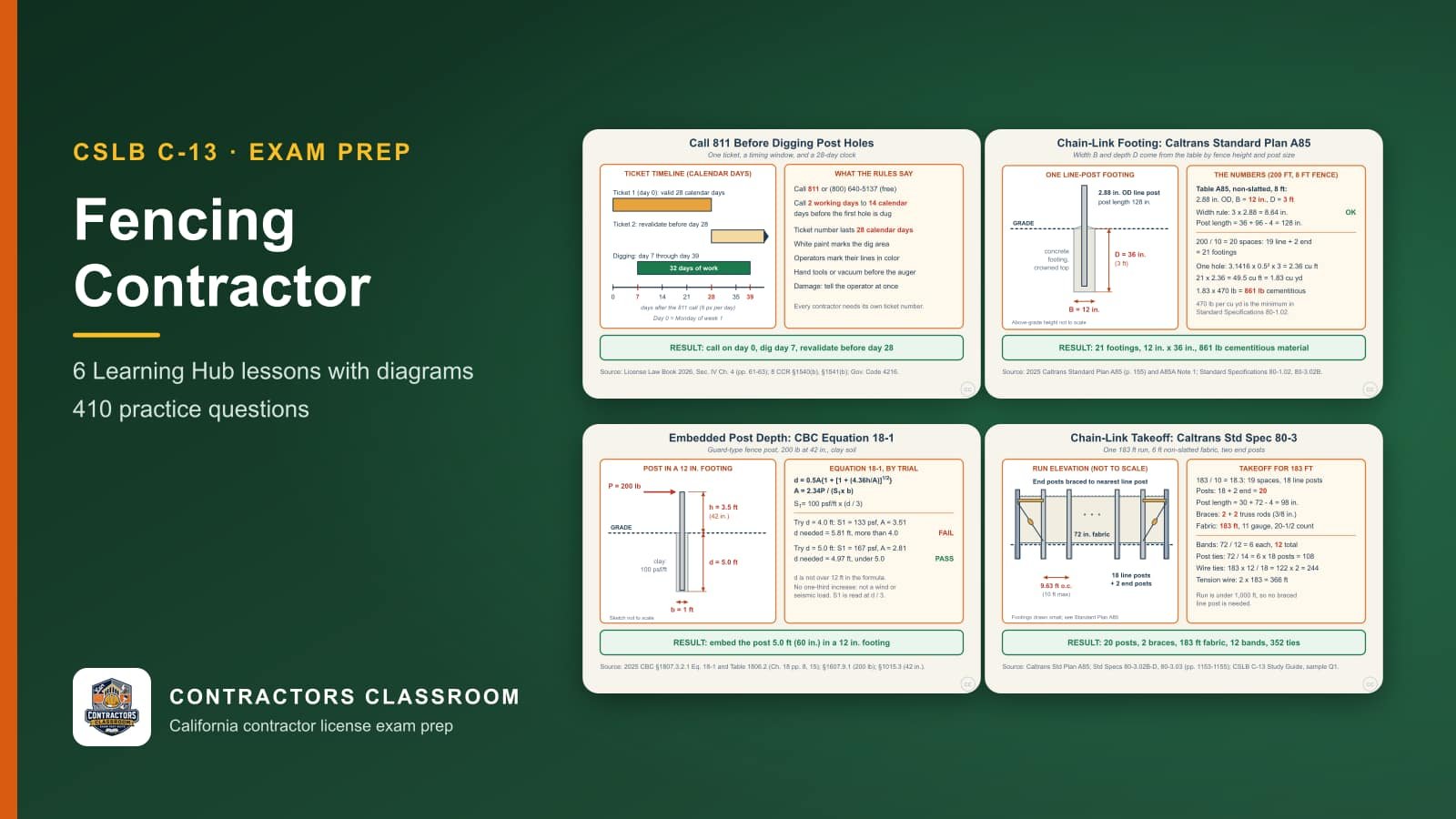
Diagrams from the C-13 fencing contractor lessons: Before You Dig Post Holes: The 811 Ticket and Marking Rules, Chain-Link Post Footings: Caltrans Standard Plan A85, Post Embedment Depth: CBC Equation 18-1 and Table 1806.2 and Chain-Link Takeoff: Posts, Braces, Fabric, and Fasteners
410practice questions
6categories
6Learning Hub lessons
$249Law & Business included

What the exam covers: Fencing (C-13)

The CSLB exam for the California fencing contractor license (C-13) is a closed-book, multiple-choice test. CSLB's official study guide divides it into four major sections and gives each an approximate weight: Planning and Estimating (about 16%), Preparation and Post Installation (about 18%), Fence, Gate, and Rail Installation and Repair (about 50%), and Safety (about 16%).

Fence, Gate, and Rail Installation and Repair carries the most weight, about 50%, so it deserves roughly that share of your study time, with Preparation and Post Installation next at about 18%.

Contractors Classroom turns that outline into 410 practice questions in 6 categories (Planning and Estimating, Post Installation & Footings, Fence & Gate Fabrication - Automation, Fence Framework and Fabric Installation, Cal-OSHA Jobsite & Digging Safety (USA 811), and Gate and Access Control Installation), plus 6 Learning Hub lessons with diagrams (such as "Before You Dig Post Holes: The 811 Ticket and Marking Rules" and "Chain-Link Post Footings: Caltrans Standard Plan A85"). Law and Business, which most applicants take alongside their trade exam, is included at no extra charge.

Exam sections and approximate weights

  • Planning and Estimating~16%
  • Preparation and Post Installation~18%
  • Fence, Gate, and Rail Installation and Repair~50%
  • Safety~16%

Practice question categories

  • Planning and Estimating35 practice questions
  • Post Installation & Footings138 practice questions
  • Fence & Gate Fabrication - Automation30 practice questions
  • Fence Framework and Fabric Installation91 practice questions
  • Cal-OSHA Jobsite & Digging Safety (USA 811)45 practice questions
  • Gate and Access Control Installation71 practice questions

What the Fencing Contractor exam covers, section by section

Planning and Estimating (~16%)

Fence projects look simple but depend on careful planning: where the line goes, what material suits the purpose, how gates will swing, and what the property conditions allow. Reading drawings and notes clarifies heights, post spacing, and hardware. Estimators then figure footage, posts, rails, fabric or pickets, concrete, and labor into an accurate price. A small error in footage or gate placement can ripple through every later step of the installation.

  • Deciding on layout, materials, gate locations, and sequence before ordering anything
  • Interpreting site plans and detail drawings for heights, spacing, and hardware
  • Totaling linear footage, posts, panels, concrete, and crew time into a bid the customer can compare

Preparation and Post Installation (~18%)

A fence is only as straight and sturdy as its posts. Crews mark property lines and post locations, then determine how deep and wide each hole must be for the fence type and soil. Posts are set plumb in concrete footings that are shaped, tamped, and given time to cure before load is applied. Rushing this stage leads to leaning posts, uneven rail heights, and gates that will not latch.

  • Marking the line, corners, gates, and post points on the ground before any digging starts
  • Working out hole depth and diameter based on post size and conditions
  • Setting posts plumb and anchoring them in properly mixed concrete, bracing them while it sets

Fence, Gate, and Rail Installation and Repair (~50%)

This is the largest part of the trade, covering many materials and styles. Each type has its own assembly steps, hardware, and repair methods, from stretching wire fabric to rail-and-picket carpentry, welded or bolted metal panels, and interlocking vinyl or composite parts. Special enclosures around pools, play areas, and courts, along with flagpoles, add safety or structural considerations. Repairs often require matching existing materials and fixing the cause of damage, not just the symptom.

  • Stretching and tying chain-link, and hanging gates that swing and latch properly
  • Building ranch-style and livestock fencing, including wire, rails, and farm gates
  • Assembling wood and ornamental metal fences with correct fasteners and finishes
  • Installing vinyl, composite, and laminate systems according to manufacturer directions
  • Enclosing pools, playgrounds, and courts safely, and erecting flagpoles securely

Safety (~16%)

Fence installers use post-hole augers, saws, welders, tensioning tools, and mixers, often in uneven terrain or near utilities. Personal protection, state workplace rules, and attention to buried lines and overhead wires keep crews safe. Treating cement, treated lumber, solvents, and excavated soil responsibly also protects people and the surrounding environment. Staying aware of utilities and uneven ground before digging prevents damage to property and injury to the crew.

  • Wearing protective gear and using augers, cutters, and welders safely
  • Following state workplace safety requirements and documented company procedures
  • Managing concrete washout, chemicals, and debris so surroundings stay clean

Code books behind the Fencing Contractor exam

The exam outline published for this trade lists these references.

  • 2025 California Building CodeThe building code governs several fence and gate details: minimum gate widths and hardware on accessible routes, force and clearance rules for doors and gates, post embedment methods based on soil and lateral load, and protective barrier requirements at certain locations. It feeds the gate, post-footing and accessibility questions, mainly in the installation and preparation sections.
  • ASTM Standards for Fence Materials and ProjectsThese standards define what fence products are: chain-link fabric types and coatings, pipe and post grades, wire gauges, fittings, galvanizing weights and vinyl coating classes. Because the exam asks you to recognize a material by its standard designation, they are the reference behind the chain-link, coating and material-specification questions in planning and installation.
  • The “Greenbook”: Standard Specifications for Public Works ConstructionThis widely used specification set for public works lays out requirements for materials and workmanship, including fencing and gates, concrete, excavation and backfill on government-funded projects. A fence contractor bidding public jobs follows it, so it informs questions about how work must be built and measured on projects of that type. Expect it to matter for questions about acceptable fabric, post and concrete quality on larger jobs.
  • Standard Plans and Standard SpecificationsThe state transportation department's standard drawings and specifications show standard details for right-of-way fencing, chain-link post footings, gates and barrier railings. They are the source for post size, footing dimension and hardware tables used when working near highways, and so support the planning and post installation questions. They also show how fences terminate at structures and how gates are framed and hung.
  • State of California Construction & Electrical Safety Orders (Cal/OSHA)The construction safety orders apply to fence crews through excavation and trenching rules, powered auger and equipment operation, manual handling, noise, dust, working near traffic and electrical hazards from overhead lines. They feed the Safety section, about 16 percent of the exam, including personnel safety and procedures that employers must follow, as well as how an injury or incident is reported.
  • Underground Service Alert GuidelinesThese guidelines explain how to request a locate before digging, how long the request remains valid, how the dig area is marked with white paint, what the colors of utility marks mean, and what to do if a line is damaged. Every post hole counts as an excavation, so the guidelines are central to safety and to preparation, and they explain why hand tools come before the auger near marks.

Key terms for the Fencing Contractor exam

Line post
An intermediate post set between terminals along a straight run, spaced at regular intervals to hold the top rail and fabric. Its footing is smaller than a terminal's, but its depth and spacing determine how well the fence resists wind.
Terminal post
A post at an end, corner, gate or sharp change of direction that carries the pull of stretched fabric. It is larger than a line post and braced, and its footing is bigger because it resists the tension of the whole run.
Tension band
A flat metal strap that wraps a terminal post and holds a tension bar threaded through the fabric. Band count and spacing depend on fence height, and each one is a point where the pulled fabric anchors to the post.
Tension bar
A flat bar woven through the end row of chain-link fabric so the pull is shared across the full height instead of a few wire ends. It is what the tension bands clamp to the terminal post.
Tension wire
A heavy wire stretched along the bottom or top of a chain-link run, tied to the fabric to keep it taut and stop it from lifting or pulling away. It substitutes for a rail where rails are not used.
Top rail
The horizontal pipe along the top of a chain-link fence, passing through caps on line posts, that stiffens the fence and gives a finished edge. Its sleeves connect lengths, and it expands with heat, so joints are made accordingly.
Knuckled selvage
An edge finish on chain-link fabric where wire ends are bent into closed loops, making a smooth edge, usually the top, that is safer to touch. The opposite twisted finish leaves sharp barbs and is used at the bottom or on security fences.
Galvanized-after-weaving fabric
Chain-link fabric woven from bare wire and then dipped in zinc, so the coating covers the intersections too. It differs from galvanized-before-weaving wire, and the exam expects you to match each designation to its coating method.
Fusion-bonded vinyl fabric
Chain-link wire with a vinyl layer melted onto the metal so the coating is part of the wire and does not peel. This type, rated by its ASTM class, is chosen for color, appearance and corrosion resistance.
Footing crown
The slight slope of the concrete surface around a post, built to shed water away from the metal. A flat or sunken top lets water pond at the pipe and speeds corrosion where the post meets concrete.
Embedment depth
How far a post is buried below grade. For loaded posts, such as signs, flagpoles and tall solid fences, the depth is figured from lateral load, height and soil resistance, not only guessed by crew habit.
Drop rod
A vertical rod on the latch side of a double gate that slides into a hole in the ground to hold the leaf closed. It keeps the first leaf from swinging while the second is latched.
Self-closing, self-latching gate
A gate with hardware that shuts it from any open position and engages the latch without anyone touching it. It is a key feature of enclosures around swimming pools, where the release is placed out of a child's reach.
Pool barrier
A fence or wall required around a swimming pool that meets rules for height, ground clearance, opening size and gate behavior. These characteristics are unique to pools, and the exam may ask which one applies to a given design.
Picket
A narrow vertical board or bar attached to rails in wood, vinyl, aluminum or steel fences. Its width and gap determine privacy and whether a sphere passes between them, which matters around pools and play areas.
Cantilever slide gate
A gate carried on rollers that moves sideways along the fence line with a counterbalance extension, so nothing touches the ground. It needs a footing for its roller posts and clear space beside the opening.
T-post
A rolled steel post with a T-shaped cross-section and anchor plate, driven into the ground rather than set in concrete. It is the common line post for agricultural wire fences, holding woven or barbed wire at intervals.
Fabric stretcher
A come-along or bar-and-puller setup that pulls chain-link fabric tight against a terminal post before it is fastened. Stretching too little leaves sag, while overdoing it can bend the posts.
Underground Service Alert ticket
The record number issued when you notify the one-call center before digging. It starts a waiting period and a validity window, so the post hole work must happen within that period, and marks must be respected.

Where to spend practice time for the Fencing Contractor exam

  • Fence, gate and rail installation (50 percent)Half the exam is installation, spread across chain-link, agricultural, wood, ornamental, vinyl and composite systems, plus pool, playground, game court and flagpole work. Make a comparison table for each type: posts, rails, fasteners, spacing and typical defects. Because the category is huge, rehearse the parts and order of assembly for each fence you might be asked about.
  • Chain-link parts and quantitiesChain-link shows up in nearly every category, in planning math and in installation. Learn each component by name and function, from caps and bands to tension wire and ties, and how many of each a run of a given length and height requires. Practice counting posts, bands and fabric rolls from a site sketch.
  • Post holes, footings and concrete (18 percent)Preparation and post installation carries posts, layout and concrete, and the biggest practice category is post installation and footings. Practice sizing a hole from post diameter and footing rules, estimating concrete volume per hole, setting corner and gate posts differently from line posts, and applying embedment equations. Review layout methods for straight and curved runs.
  • Gates, access and pool rulesGate and access control installation is another large practice area. Compare gate post sizes, width limits, hinge and latch options, accessible route widths, force and clearance, and pool enclosure rules such as height, picket gaps and self-latching hardware. Include powered gates and the safety devices that keep people from being trapped or struck.
  • Planning, plans and fence math (16 percent)Planning and Estimating uses plans, specifications and calculations. Practice reading a site plan for run lengths, corners and gates, computing post counts by spacing, total linear footage, fabric and rail quantities, and concrete bags. Check that your spacing rounds the way fence runs actually work, since one more post than spaces is a common slip.
  • Digging safety and environment (16 percent)Safety is about 16 percent and the practice category on digging and the one-call system is prominent. Review the ticket process and its time limits, marking conventions, hand digging near marks, what to do after striking a line, auger and equipment hazards, and environmental care for concrete washout and runoff. Trace each step from the call to the finished hole.

Scenarios to talk through before the Fencing Contractor exam

  • Gate end post that leansA chain-link gate end post begins to lean a few weeks after installation. Compare it with a line post: footing size, embedment, bracing, the weight of the gate, and how the fabric is anchored to the terminal. What would you check in the hole and the concrete, and what should the original installation have included?
  • Before the first post holeA crew is ready to auger post holes along a street frontage on Monday morning. Walk through the Underground Service Alert ticket, the waiting period, the white paint boundary, what the colored marks mean and why hand digging comes first near them. What happens if the ticket has expired or a mark is missing?
  • Fence around a backyard poolA homeowner wants a wrought-iron style fence around a new backyard pool. Think about the pool barrier characteristics: height, ground clearance, picket gaps, no climbable features, and a self-closing, self-latching gate with the latch placed out of a child's reach. Which design choices would make you push back, and why?
  • Gate on an accessible routeA new walk gate sits on the accessible path to an office entrance. Reason through its clear width, hardware that can be operated without tight grasping, the force needed to open it, the surface at the threshold and what the latch and closer must allow. What measurements would you take on site before ordering the hardware?
  • Vinyl-coated fabric on the orderA project specifies vinyl-coated chain-link in a dark color, and the supplier delivers galvanized fabric with a thin coating. Compare galvanized-after-weaving and fusion-bonded vinyl, the ASTM class designations, matching color on posts, bands and ties, and who needs to sign off on any change. What would you reject, and what would you note on the receiving paperwork?
  • Fence run down a slopeA fence must follow a hillside with a steady downward grade. Consider how line posts are spaced and plumbed, how the top rail and fabric follow the slope or step, what the bottom gap looks like, and how embedment depth is measured from the lower grade. What would you mark out first, and which defect would a neighbor notice immediately?
  • Wire fence for livestockA rancher wants a woven-wire fence with T-posts across a pasture. Think through corner and end assemblies, brace spans, driving depth, wire tension and tie spacing, and where gates are hung. What is different in how force is carried compared with a chain-link run, and what would show the corner is too weak?
  • Concrete mess at the curbAfter setting posts, a crew rinses its tools and wheelbarrows near the curb, and gray water runs toward a storm drain. Consider the footing crown, leftover concrete, washout practices, spill control and other environmental duties on a fence job. How would you set up the work area so wastewater stays out of the street?

Learning Hub lessons

Each lesson has guided steps, a diagram, a worked example and a quick check inside the classroom.

Preview the lesson diagrams

  1. Before You Dig Post Holes: The 811 Ticket and Marking RulesSteps: A Post Hole Is an Excavation; The Call and the Timing Window; The 28-Day Ticket Clock; Mark the Area, Then Find the Lines; Hand Tools Before the Auger; Damage, High-Priority Lines, and Penalties
  2. Chain-Link Post Footings: Caltrans Standard Plan A85Steps: Footing Size Comes From a Table; Reading the Line-Post Table; The Width Rule and the End and Corner Posts; Cut the Post to Length; Concrete and Finishing
  3. Post Embedment Depth: CBC Equation 18-1 and Table 1806.2Steps: When the California Formula Applies; The Equation and Its Letters; Getting S1 From Table 1806.2; Where P and h Come From; Solve by Trial and Check the Backfill
  4. Chain-Link Takeoff: Posts, Braces, Fabric, and FastenersSteps: Split the Line Into Runs; Line Posts: Round Spaces Up, Subtract One; Brace the Terminal Posts; Fabric Quantity and Specification; Bands, Ties, and Tension Wire
  5. Gates: Gate Posts, Width Limits, and California Building Code Gate RulesSteps: Gate Posts Are Bigger Than Line Posts; Width Limits and Gate Details; Walk Gates on an Accessible Route; Hardware, Force, and Clearances; Gates in Egress and Powered Vehicle Gates
  6. Pool Barrier Fence and Gate Rules (HSC §115923, 2025 CRC Appendix CI)Steps: Why Pool Fences Have Their Own Rules; The Five Characteristics of an Enclosure; Height and Ground Clearance; Picket Spacing: The 4-Inch Sphere Rule; The Pool Gate

See the classroom in action

Frequently asked questions

How do I get a California fencing contractor license?

A fence installer or fence builder who wants to contract independently applies under C-13. CSLB generally requires documented journey-level experience, a bond, and passing scores on both the Law and Business exam and the C-13 exam. Rules change, so confirm them with CSLB.

What does the fencing contractor exam ask about fence, gate, and rail installation and repair?

Fence, Gate, and Rail Installation and Repair is the heaviest part of the C-13 exam, at about 50%. Expect questions on stretching and tying chain-link, and hanging gates that swing and latch properly, building ranch-style and livestock fencing, including wire, rails, and farm gates, and assembling wood and ornamental metal fences with correct fasteners and finishes. Next in weight come preparation and post installation (about 18%) and planning and estimating (about 16%).

What kinds of questions are on the fencing contractor exam?

The three sample questions in CSLB's C-13 study guide ask about tension bands on a chain-link end post, the minimum gate width for disability access under the California Building Code, and which material is fusion bonded. Like every question on the exam, each has four choices and one best answer.

Which codes and books does the C-13 exam reference?

CSLB's C-13 study guide lists the 2025 California Building Code (Title 24), the Cal/OSHA safety orders (Title 8), and trade references such as ASTM Standards for Fence Materials and Projects, The “Greenbook”: Standard Specifications for Public Works Construction, and Standard Plans and Standard Specifications. Use them to study; the exam itself is closed-book.

Is the fencing contractor exam open book?

No. The C-13 study guide says no reference materials may be used, even though it names ASTM Standards for Fence Materials and Projects and The “Greenbook”: Standard Specifications for Public Works Construction among the books to study from. A calculator is provided, and guessing is not penalized.

Can I take the fencing contractor exam outside California?

CSLB's exam FAQ says trade exams are given in California or Oregon only, so C-13 is not offered in other states, although Law and Business can be taken out of state. Check the current PSI list when you schedule.

How are the 410 C-13 practice questions organized?

They are split into 6 categories, largest first: Post Installation & Footings (138), Fence Framework and Fabric Installation (91), Gate and Access Control Installation (71), Cal-OSHA Jobsite & Digging Safety (USA 811) (45), and 2 more. Post Installation & Footings holds about 34% of the questions. 6 Learning Hub lessons add diagrams and worked examples for the harder topics. The missed-question review collects every question you get wrong.

Is there a free trial for fencing contractor exam prep (C-13)?

Yes. The free C-13 preview opens the real classroom with no sign-up and gives you the first question from every C-13 category, including Post Installation & Footings and Fence Framework and Fabric Installation, plus Law and Business. The full course is a one-time $249 purchase.

Is fencing contractor exam prep available in Spanish?

The website and the eight demo videos are available in Spanish. The classroom and the 410 C-13 practice questions are in English for now; translating the questions is not part of the course yet.

Ready to practice for real?

Try the real classroom free, no sign-up, or get the full course for your trade.

Independent exam preparation. Contractors Classroom is not affiliated with the Contractors State License Board, and no course can guarantee a passing result.


