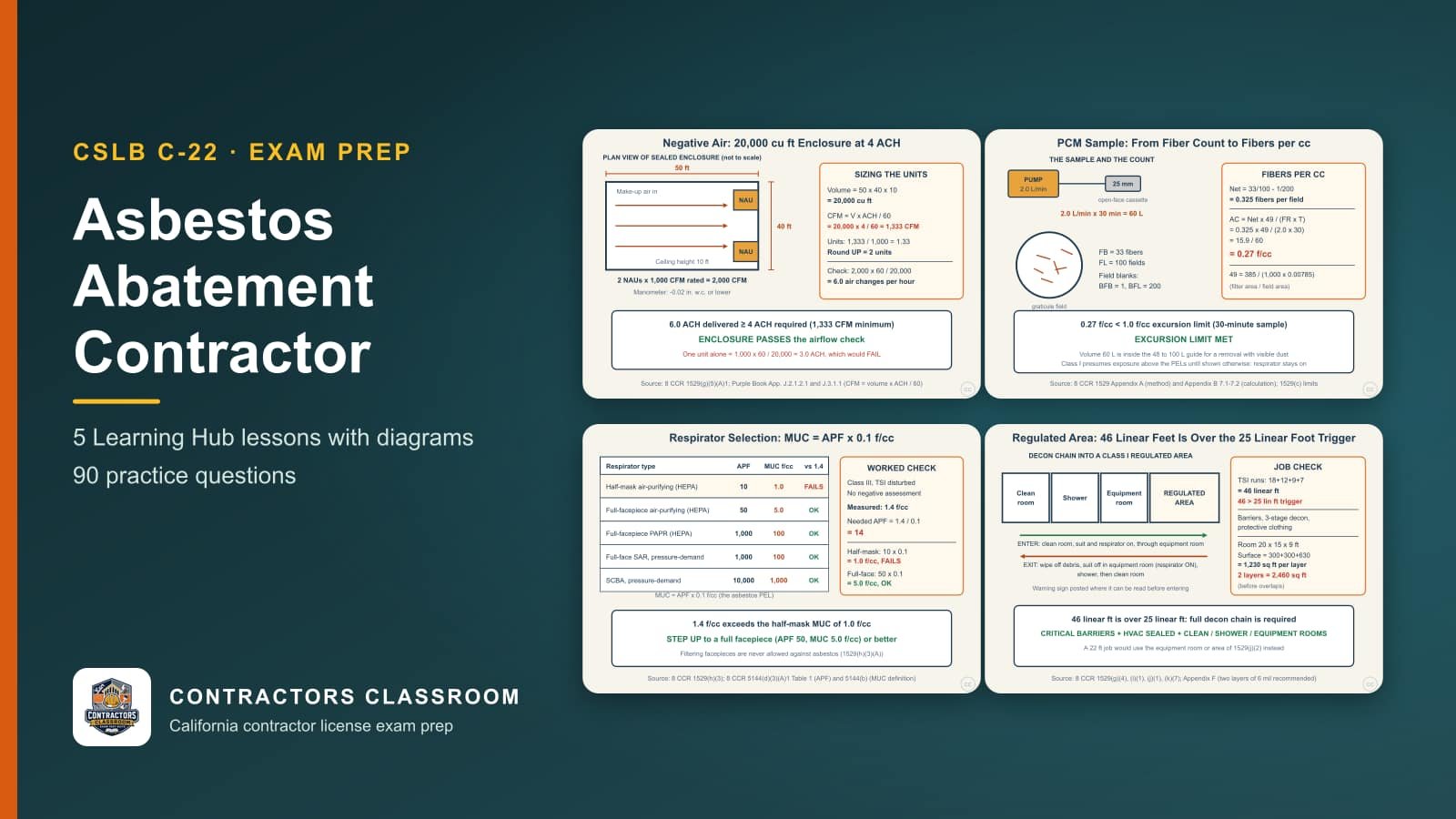
- Negative air unit (NAU)
- A portable machine that pulls room air through a HEPA filter and discharges it outside the work zone, keeping the enclosure under lower pressure than its surroundings. Crews size and count these units from enclosure volume and keep a spare so ventilation never stops.
- Air changes per hour (ACH)
- How many times the whole air volume of an enclosure is replaced in sixty minutes. The standard sets a minimum, and the number feeds the machine-capacity formula, which divides by sixty because exhaust fans are rated per minute rather than per hour.
- Enclosure volume
- The cubic footage inside the barriers you actually build, found from floor area times ceiling height. It is the first input to ventilation sizing, so an error here travels into the machine count, and the enclosure should be the smallest space that still covers all work surfaces.
- Manometer reading
- A gauge measurement showing the pressure difference between the work area and the outside. The standard asks for a small negative value across the barrier, and recorded readings prove the enclosure is holding negative pressure while work is under way.
- Negative pressure enclosure (NPE)
- A sealed work area where exhaust fans hold pressure lower than outside so air leaks inward, never outward. It must keep a minimum air change rate and pressure difference the entire time it is in use, with airflow moving away from the workers toward the filter.
- Critical barrier
- Plastic sheeting sealed over every opening into the regulated area, such as doors, windows, vents, and outlets, so fibers cannot escape. Air handling ducts get a doubled layer, and the barriers are checked for tears and gaps before work begins.
- Regulated area
- The marked zone where Class I, II, and III asbestos work takes place. It is set off to keep people out, limits entry to authorized persons, bans eating and smoking inside, and must be supervised by a competent person for the duration of the work.
- Decontamination unit
- A connected chain of three rooms attached to the regulated area, made up of a clean room, a shower, and an equipment room. Workers enter through it and leave through it in a fixed order, removing contaminated clothing and cleaning up before reaching clean space.
- Glovebag
- A sealed plastic sleeve built around a short length of pipe, with built-in gloves for handling tools and insulation from outside. It holds small amounts of material, must be single-use and leak-tested, and is how many pipe runs are cleaned without a full enclosure.
- Amended water
- Water with a surfactant added so it soaks into insulation instead of beading on top. Keeping asbestos material saturated during cutting, scraping, and cleanup is a core dust control, and the wetting agent makes plain water far more effective.
- HEPA vacuum
- A vacuum fitted with a high-efficiency particulate air filter, the only kind allowed for asbestos debris and dust. Ordinary shop vacuums would blow fine fibers back into the room, so HEPA units also clean tools, suits, and surfaces.
- Phase contrast microscopy (PCM)
- The laboratory technique used to count airborne fibers collected on a filter. It cannot tell asbestos from other fibers, but it is the accepted counting method for comparing work-area samples against the exposure limits.
- Walton-Beckett graticule
- A circular reference grid inside the eyepiece used to count fibers. A fiber completely within the circle counts as one, one crossing the edge counts as half, and the analyst stops after enough fibers or enough fields have been examined.
- Field blank
- A clean filter cassette taken to the site, opened and closed without drawing air, then sent to the lab with the real samples. Its count is subtracted so contamination from handling or the cassette itself does not inflate the result.
- Assigned protection factor (APF)
- A number stating how much a class of respirator is expected to cut exposure when properly fitted and used. A half-mask air-purifying type rates low, while pressure-demand supplied air with a self-contained backup rates very high.
- Maximum use concentration (MUC)
- The highest airborne level in which a given respirator may be worn, found by multiplying its protection factor by the exposure limit. A selection is only correct when measured exposure, outside the respirator, stays at or below this ceiling.
- Pressure-demand supplied-air respirator
- A full facepiece mask fed clean air from a remote source that keeps positive pressure inside the mask, so leakage flows outward. On heavy Class I work it is paired with an auxiliary self-contained unit or egress filters in case the supply fails.
- Clearance air sampling
- Air testing after cleanup to confirm the work area is safe to reoccupy. Several samples are drawn at a relatively high volume, and if any exceed the limit, the whole area is recleaned and tested again.
- Smoke test
- Releasing visible smoke near the edges of an enclosure or glovebag to reveal leaks. It is done before work begins and again as each shift opens for containments, and any leak found is sealed before material is disturbed.
- Warning sign legend
- The exact wording required on signs at a regulated area: danger, asbestos, cancer and lung damage warnings, and authorized personnel only, with an extra line about respirators and protective clothing where they are needed. Workers must be able to understand it.