CSLB C-53

Swimming Pool Contractor License Exam Prep (C-53)

Getting ready for the California swimming pool contractor license exam (CSLB C-53)? Study with 184 practice questions in 2 categories and 8 Learning Hub lessons, made for pool builders, with the Law and Business exam included.

One-time purchase, no subscription. Law & Business included.

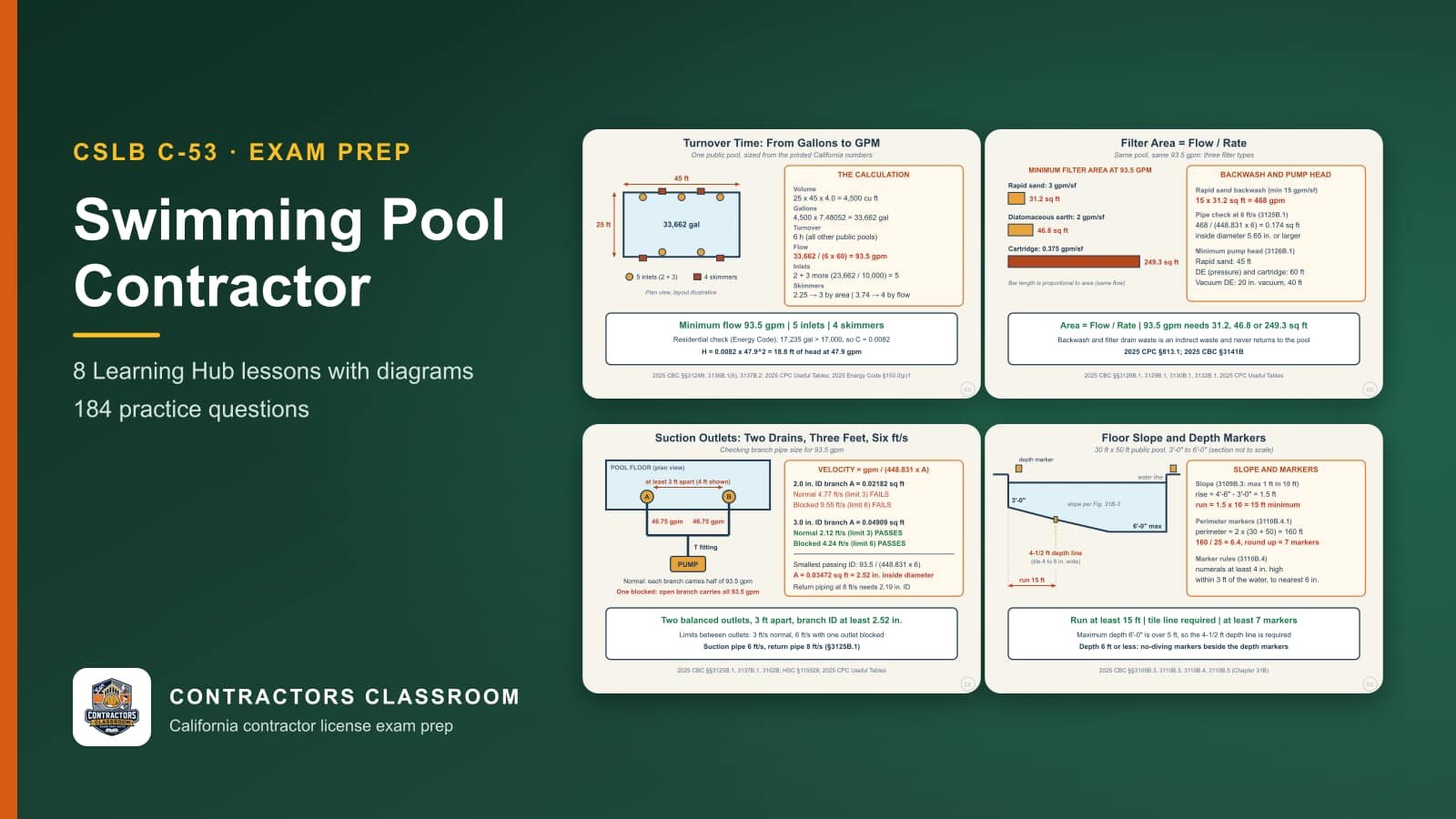
Diagrams from the C-53 swimming pool contractor lessons: Turnover Time, Flow Rate, and Pump Head, Sizing a Filter: Flow Rate per Square Foot, Suction Outlets and Entrapment: Two Drains and the Velocity Limits and Pool Floor Slope, the 4-1/2 Foot Line, and Depth Markers
184practice questions
2categories
8Learning Hub lessons
$249Law & Business included

What the exam covers: Swimming Pool (C-53)

The CSLB exam for the California swimming pool contractor license (C-53) is a closed-book, multiple-choice test. CSLB's official study guide divides it into seven major sections and gives each an approximate weight: Planning and Estimating (about 21%), Swimming Pool/Spa Shell Construction (about 32%), Pool/Spa Systems Installation (about 11%), Pool/Spa Deck and Shell Finish (about 9%), Commercial Swimming Pools/Spas (about 3%), Pool/Spa Repair, Renovation, Removal, and Maintenance (about 6%), and Safety (about 18%).

Swimming Pool/Spa Shell Construction carries the most weight, about 32%, so it deserves roughly that share of your study time, with Planning and Estimating next at about 21%.

Contractors Classroom turns that outline into 184 practice questions in 2 categories (Planning and Estimating and Cal-OSHA Trenching & Chemical Safety), plus 8 Learning Hub lessons with diagrams (such as "Turnover Time, Flow Rate, and Pump Head" and "Sizing a Filter: Flow Rate per Square Foot"). Law and Business, which most applicants take alongside their trade exam, is included at no extra charge.

Exam sections and approximate weights

  • Planning and Estimating~21%
  • Swimming Pool/Spa Shell Construction~32%
  • Pool/Spa Systems Installation~11%
  • Pool/Spa Deck and Shell Finish~9%
  • Commercial Swimming Pools/Spas~3%
  • Pool/Spa Repair, Renovation, Removal, and Maintenance~6%
  • Safety~18%

Practice question categories

  • Planning and Estimating75 practice questions
  • Cal-OSHA Trenching & Chemical Safety109 practice questions

What the Swimming Pool Contractor exam covers, section by section

Planning and Estimating (~21%)

Before any soil moves on a pool or spa job, the contractor has to turn drawings and paperwork into a workable plan. That means understanding the design, walking the property to spot constraints, lining up approvals, and pricing the work so nothing is missed.

  • Read drawings and written specifications to understand what will be built
  • Walk the property for access, slope, utilities, and soil conditions
  • Secure approvals from the building authority before construction begins
  • Price excavation machinery, materials, and pool equipment into a realistic bid

Swimming Pool/Spa Shell Construction (~32%)

The shell is the structural heart of a pool or spa, and this area follows the work from bare ground to hardened concrete. A candidate should understand how the hole is dug, how forms and reinforcing steel are positioned, and how sprayed concrete is placed and kept moist as it sets.

  • Dig to the planned depth and leave a stable, graded base
  • Build accurate forms that define the shape, edges, and levels of the shell
  • Place and tie rebar, then connect the steel electrically for bonding
  • Rough in buried pipe and conduit before concrete covers them permanently
  • Spray the concrete and keep it damp so strength develops evenly

Pool/Spa Systems Installation (~11%)

Once the shell exists, the equipment and circuits that make it usable go in. This part looks at how water moves through pumps, filters, and heaters, how power is delivered safely near water, and how options such as solar heating, prefabricated shells, and covers fit in.

  • Run supply and return lines that circulate water through the system
  • Wire pumps, lighting, and controls with attention to safety around water
  • Set pumps, filters, and heaters on pads with proper connections
  • Add solar water heating or photovoltaic power to cut running costs
  • Handle prefabricated pools and spas, plus covers and fountain-style features

Pool/Spa Deck and Shell Finish (~9%)

The last visible steps decide how the pool looks, feels underfoot, and holds up to daily use. Applicants should know how surrounding walking surfaces are built, how the interior surface is applied and the first fill is handled, and how waterline tile and the edge cap are set so the finished project is safe and durable.

  • Build the surrounding walking surfaces with suitable slope and traction
  • Apply the interior surface, fill the pool, and start up the equipment
  • Set waterline tile and edge caps cleanly along the perimeter

Commercial Swimming Pools/Spas (~3%)

Pools and spas open to the public follow stricter rules than a backyard installation. This small area deals with the added requirements that apply to commercial facilities, including health-related regulations, features that let people with disabilities enter and exit the water, and the hardware used to get them there.

  • Follow the health-focused regulations that govern public and commercial facilities
  • Provide accessibility features so all users can reach the water
  • Install ramps and mechanical lifts that move swimmers in and out

Pool/Spa Repair, Renovation, Removal, and Maintenance (~6%)

Older pools need work too, and this area is about diagnosing problems and changing existing installations. A contractor must be able to track down why a pool loses water or turns the wrong color, alter the shell when an owner wants a different layout, and repair or replace the machinery that keeps water clean.

  • Find the cause of leaks, staining, and cloudy or off-colored water
  • Alter the existing shell or surroundings to fit a new layout
  • Service, repair, or replace pumps, filters, and related components

Safety (~18%)

Safety here has two sides: protecting the people who will eventually swim and protecting the crew building the project. Expect attention to barriers, drains, and other measures that reduce risk for bathers, along with everyday jobsite habits for trenches, heavy machinery, electricity, and wet concrete.

  • Reduce risks to swimmers through barriers, entrapment-safe drains, and proper design
  • Keep the crew safe around excavations, machinery, power, and caustic concrete

Code books behind the Swimming Pool Contractor exam

The exam outline published for this trade lists these references.

  • 2025 California Building CodeThe Building Code's public swimming pool chapter prints geometry rules for floor slope and depth markings, circulation and turnover, filter types, suction outlets, decks, handholds and lighting, while other chapters address soils, excavation and accessibility. It is the code behind Commercial Swimming Pools, much of the shell and finish work, and the water-circulation parts of Systems Installation.
  • 2025 California Electrical CodeThe Electrical Code's pool and spa article governs wiring methods, equipotential bonding, ground-fault protection, underwater lighting, receptacle and fixture clearances, and panel feeders for pumps and heaters. It is the reference behind the rough electrical in Swimming Pool/Spa Shell Construction and the electrical items in Pool/Spa Systems Installation.
  • ANSI/PHTA(APSP)/ICC Books 1 through 16This series of consensus standards covers residential and public pools and spas, including construction practice, suction fittings and entrapment avoidance, water quality, portable and above-ground units and energy efficiency. A candidate uses it to understand why certain fittings, flows and design details are required across the shell, systems and safety areas.
  • Builders Manual, Fifth EditionAn industry construction manual that walks through a pool from layout to finish: excavation, forms, steel, plumbing, electrical, shell placement, tile and coping, decking, plaster and start-up. It describes accepted practice and common problems, so it is a broad reference for Shell Construction, Systems Installation and Deck and Shell Finish.
  • Shotcrete for the CraftsmanThis concrete institute guide teaches the placing craft for sprayed concrete: dry-mix and wet-mix methods, nozzle handling, encasing reinforcing steel, controlling rebound, finishing and curing. It informs the gunite and shotcrete placement and curing topic in Swimming Pool/Spa Shell Construction, the heaviest section of the exam.
  • State of California Construction & Electrical Safety Orders (Cal/OSHA)The construction safety orders cover the hazards of excavating a pool, cranes and concrete pumps, silica dust from cutting and gunite, chemical handling for pool water and plaster, electrical safety and trench shoring. This is the reference for the job site safety half of Safety, alongside the pool-specific safety features.
  • Uniform Swimming Pool, Spa, and Hot Tub Code, and Uniform Solar Energy and Hydronics CodePublished by plumbing and mechanical officials, this code treats pool and spa piping as a plumbing trade: pipe materials, valves, circulation and backwash piping, heater connections, backflow protection and solar heating loops. It is the reference for the plumbing, equipment and solar items in Pool/Spa Systems Installation and the rough plumbing in the shell stage.

Key terms for the Swimming Pool Contractor exam

Turnover time
The longest time allowed for a pool's recirculation system to move one full volume of its water through the filter. It starts every circulation design: divide gallons by hours and minutes to find the slowest allowed flow, which varies by pool type.
Total dynamic head
The combined resistance a pump must overcome, in feet of water, from friction in pipe and fittings, the filter and the lift. Pump selection compares head and flow on a curve, and a filter type may carry its own minimum head.
Skimmer
A weir-type fitting in the pool wall that pulls surface water and floating debris into a basket before the pump. The count depends on surface area and flow, and its operating range defines the working waterline.
Hydraulically balanced outlets
Two or more suction fittings piped symmetrically so each draws about equal flow, separated by a minimum distance. If one is blocked the other still carries the pump, which prevents a single blocked drain from holding a swimmer.
Anti-entrapment cover
A listed grate designed so its shape and flow area do not trap hair, limbs or body parts. On private pools covers must be fastened so they cannot be removed without tools, and suction fittings must meet the entrapment standard.
Backwash
Reversing flow through a sand or DE filter to flush trapped dirt out to waste. The piping must handle a flow much greater than normal filtering, and the discharge goes through an indirect connection, never back to the pool.
Diatomaceous earth filter
A filter that coats grids or fingers with fossil algae powder to trap very fine particles. It runs at a low flow per square foot of area, needs recharging after backwash and sends its spent powder to a separation tank.
Cartridge filter
A filter using replaceable pleated elements that are cleaned by hosing rather than backwashed. Because it tolerates only a very low flow per square foot, it needs far more surface area than a sand unit for the same pump, and spare elements are kept on hand.
Gunite
Concrete shot at high speed through a hose by the dry-mix process, with water added at the nozzle, to form pool shells over the steel cage. Skilled nozzle work packs it around bars and yields dense walls that must then be kept moist to cure.
Rebound
Sprayed concrete that bounces off the surface instead of sticking, mostly coarse aggregate. It must be cleared away rather than worked back into the shell, because trapped rebound makes weak pockets and voids.
Equipotential bonding grid
A network of connected conductive parts, including reinforcing steel, metal equipment and fittings, tied together to keep them at the same electrical potential. It lowers shock risk in and around the water, and its tie points are made during steel placement.
Hydrostatic relief valve
A spring-loaded plug in the pool floor that opens to let groundwater enter and equalize pressure when the pool is emptied. Without it, high groundwater can lift or crack a shell, so it matters for draining and renovation work.
Bull-nosed coping
Rounded edge material set on the top of the pool wall, projecting a short, limited distance over the water. It gives swimmers a place to grip without a separate rail and sets the coping thickness that affects the shell's top elevation.
Cantilevered decking
Reinforced concrete deck that extends past the pool wall to serve as the handhold, with a rounded edge and limited projection. It is poured with steel tied to the beam and sloped slightly away from the water.
Depth marking line
A contrasting band of slip-resistant tile across the floor at the point where the water depth reaches the shallow-to-deep transition. It warns swimmers where the floor starts to drop and is omitted only in very shallow pools.
Break in slope
The line on the pool floor where the gentle shallow-end grade changes to the steeper one toward the deep end. Its location is defined by water depth and it is shown on the plan, and markers on the deck must identify it.
Wet-niche light
An underwater fixture mounted in a niche in the pool wall with the lamp surrounded by water. Its branch circuit needs ground-fault protection, and a public-pool fixture needs sealed terminals and licensed electrical work.
Safety pool cover
A manual or powered cover that meets a recognized strength and safety standard, so a child or adult stepping on it will not fall in. It counts as one of the drowning-prevention features for a new residential pool, though not when paired with a pool alarm.
Title 22
The state regulations section that sets health-department rules for public swimming pools and spas, such as water quality, safety equipment and operation. A commercial pool must satisfy it in addition to the building and electrical codes.
Heat pump pool heater
A heater that moves heat from outdoor air into the water using a refrigerant cycle. It is one of the energy-code compliance routes for pool heating, and its performance falls when outside air is cold.

Where to spend practice time for the Swimming Pool Contractor exam

  • Excavation, steel and shell placementShell construction is about 32 percent of the exam, the single largest area. Walk the sequence from excavation and form layout through reinforcing steel and its electrical bonding, the rough plumbing and wiring, to gunite or shotcrete placement and curing. Practice what is checked before the shell is shot, why rebound and cold joints matter, and how the equipotential grid ties into reinforcing steel.
  • Plans, volumes and flow calculationsPlanning and Estimating is about 21 percent and it rewards fluent arithmetic. Practice converting pool dimensions and average depth to gallons, computing the flow needed for a given turnover time, and sizing filter area from flow and rate. Review reading plans and details, evaluating site access and soil, and pricing excavation, steel, plumbing and equipment.
  • Drowning prevention and electrical clearancesSafety is about 18 percent, covering pool safety and job site safety. For new residential pools, learn the list of drowning-prevention features, the combinations that do not count, and the two different release heights for house doors and fence gates. Add suction outlet rules and the distances for receptacles, lights and cords around the water.
  • Pumps, filters, heaters and solarSystems Installation is about 11 percent but touches plumbing, electrical, equipment and solar. Compare filter types by flow rate per square foot and head, trace backwash and drain piping, and review the energy-code checklist for heaters, pilot lights, shutoff switches, covers and time controls. Practice the options for sizing solar or heat pump heating.
  • Decks, coping, finishes and public poolsDeck and Shell Finish (about 9 percent) and Commercial Swimming Pools (about 3 percent) share detail rules. Practice deck width and drainage slope, handhold height above the waterline, coping thickness and how it sets the bond beam elevation, depth markers and the break in slope. For public pools, recall Title 22, access ramps and lifts.
  • Leaks, discoloration and renovationRepair, Renovation, Removal and Maintenance is about 6 percent, so a few questions turn on diagnosis. Practice telling an evaporation loss from a plumbing or shell leak, linking discoloration or staining to water chemistry or metals, and planning structural modifications, equipment swaps and safe pool removal. Remember hydrostatic pressure when a pool is drained.

Scenarios to talk through before the Swimming Pool Contractor exam

  • A slow pool turnoverA newly plastered public pool cannot achieve its required turnover time at the pump's design flow. Work through gallons, flow, filter area, pipe velocity and total dynamic head. Which one would you check first, and what constraint stops you from simply using a larger pump?
  • A shotcrete shell with sags and voidsDuring gunite placement the crew notices rebound collecting behind a dense steel cage near a corner. Think about nozzle technique, how rebound is removed, what the cold joint risk is, how the shell is cured, and what you would check before bonding connections are covered.
  • Two drains on one pumpA plan shows a single main drain feeding a new public pool pump. Which suction rules does this raise, how would two outlets be arranged and separated, what pipe velocities matter when one outlet is blocked, and which anti-entrapment cover details apply?
  • Depth markers on a pool deckBefore the deck is poured, the owner asks where depth markers and no-diving symbols will go. Consider the maximum, minimum and break-in-slope locations, the perimeter spacing, what size and contrast the numerals need, and how the depth marking line ties in.
  • Setting coping and the beam topThe tile and coping crew arrive before the deck forms are set, and the bond beam top elevation is not yet confirmed. Think about the coping thickness, mortar bed, deck drainage slope, waterline-to-handhold distance and who must agree to the elevation before work continues.
  • A heater for a backyard spa and poolA homeowner wants a gas heater for a new pool and asks about solar. Compare what the energy code requires of the equipment and plumbing, which compliance routes exist, how the heater is installed, and which controls or covers must be provided.
  • Receptacles and lights near the waterAn electrician proposes a convenience outlet close to the pool wall and a pendant light over the water. Which distances and protections apply, how are they measured, which fixtures are listed for underwater use, and who must do the work on a public pool?
  • A pool that loses water overnightA customer's older pool drops several inches every week. Describe how you would separate evaporation from a shell crack, a pipe leak or a skimmer problem, and what precautions apply before any draining when the water table may be high.

Learning Hub lessons

Each lesson has guided steps, a diagram, a worked example and a quick check inside the classroom.

Preview the lesson diagrams

  1. Turnover Time, Flow Rate, and Pump HeadSteps: What Turnover Time Means; The Printed Turnover Times; Gallons From the Dimensions; Minimum Flow Rate in GPM; Residential Pumps: The Energy Code Caps the Flow; Count the Inlets and Skimmers That Carry the Flow (Public Pools)
  2. Sizing a Filter: Flow Rate per Square FootSteps: The Filter Sees the Whole Pump Flow; The Printed Maximum Filtration Rates; Filter Area = Flow / Rate; Backwash Rate and Backwash Piping; Where the Backwash Waste Goes; Pump Head Goes With the Filter Type
  3. Suction Outlets and Entrapment: Two Drains and the Velocity LimitsSteps: The Two-Outlet Rule; Private Pools and Covers That Need Tools; The Velocity Limits; Velocity Math; Single Outlets and the Printed Anti-Entrapment Systems; Equalizer Lines and Solar Suction Distance
  4. Pool Floor Slope, the 4-1/2 Foot Line, and Depth MarkersSteps: The Shape Comes From Figures 31B-1 to 31B-3; The 1-in-10 Rule; The Depth Marking Line and Finish Colors; Where the Depth Markers Go; Marker Size, Position, and No-Diving Markers
  5. Pool Deck Slope, Coping, and the 9-Inch HandholdSteps: The Deck Rule; Deck Slope: 1 to 2 Percent; Deck Between Pools, Coverings, and Plantings; Handholds: The 9-Inch Rule; Bull-Nosed Coping and Cantilevered Decking; Setting the Bond Beam Elevation
  6. Pool Heaters and Solar: Energy Code Checklist and Collector SizingSteps: Which California Rules Apply to a Pool Heater; The Heater: Certification and Pilot Lights; Table 110.4-A: The Standard for Each Heat Source; Plumbing and Controls You Must Provide; Sizing the Heat Source: Five Ways to Comply; Gas Heater Installation: 2025 CMC §926
  7. Pool Electrical Clearances: Receptacles, Lights, and CordsSteps: Where the Pool Electrical Distances Are Printed; Receptacles: 5 Feet, 10 Feet, and the 20-Foot GFCI Zone; The Required Dwelling Receptacle and How to Measure; Lights and Ceiling Fans Near the Pool; Cords and Underwater Lights; Public Pools: 2025 CBC §3160B
  8. New Residential Pools: Choosing Two of the Seven Safety FeaturesSteps: The Rule: At Least Two of Seven; Features 1 to 4: Enclosure, Mesh Fence, Cover, Exit Alarms; Features 5 to 7: Door Device, Pool Alarm, Other Means; Combinations That Do Not Count; Two Heights to Keep Straight; Your Duties as the Pool Contractor

See the classroom in action

Frequently asked questions

How do I get a California swimming pool contractor license?

A pool builder or pool contractor who wants to contract independently applies under C-53. CSLB generally requires documented journey-level experience, a bond, and passing scores on both the Law and Business exam and the C-53 exam. Rules change, so confirm them with CSLB.

What does the swimming pool contractor exam ask about swimming pool/spa shell construction?

Swimming Pool/Spa Shell Construction is the heaviest part of the C-53 exam, at about 32%. Expect questions on dig to the planned depth and leave a stable, graded base, build accurate forms that define the shape, edges, and levels of the shell, and place and tie rebar, then connect the steel electrically for bonding. Next in weight come planning and estimating (about 21%) and safety (about 18%).

What kinds of questions are on the swimming pool contractor exam?

The three sample questions in CSLB's C-53 study guide ask about what sets the bond beam elevation on a residential pool, the flow rate for a pool turnover time, and which pipe is approved for underground gas. Like every question on the exam, each has four choices and one best answer.

Which codes and books does the C-53 exam reference?

CSLB's C-53 study guide lists the 2025 California Building and Electrical Codes (Title 24), the Cal/OSHA safety orders (Title 8), and trade references such as ANSI/PHTA/ICC pool and spa standards, Builders Manual, and Shotcrete for the Craftsman. Use them to study; the exam itself is closed-book.

Is the swimming pool contractor exam open book?

No. The C-53 study guide says no reference materials may be used, even though it names ANSI/PHTA/ICC pool and spa standards and Builders Manual among the books to study from. A calculator is provided, and guessing is not penalized.

Can I take the swimming pool contractor exam outside California?

CSLB's exam FAQ says trade exams are given in California or Oregon only, so C-53 is not offered in other states, although Law and Business can be taken out of state. Check the current PSI list when you schedule.

How are the 184 C-53 practice questions organized?

They are split into 2 categories, largest first: Cal-OSHA Trenching & Chemical Safety (109) and Planning and Estimating (75). Cal-OSHA Trenching & Chemical Safety holds about 59% of the questions. 8 Learning Hub lessons add diagrams and worked examples for the harder topics. The missed-question review collects every question you get wrong.

Is there a free trial for swimming pool contractor exam prep (C-53)?

Yes. The free C-53 preview opens the real classroom with no sign-up and gives you the first question from every C-53 category, including Cal-OSHA Trenching & Chemical Safety and Planning and Estimating, plus Law and Business. The full course is a one-time $249 purchase.

Is swimming pool contractor exam prep available in Spanish?

The website and the eight demo videos are available in Spanish. The classroom and the 184 C-53 practice questions are in English for now; translating the questions is not part of the course yet.

Ready to practice for real?

Try the real classroom free, no sign-up, or get the full course for your trade.

Independent exam preparation. Contractors Classroom is not affiliated with the Contractors State License Board, and no course can guarantee a passing result.


