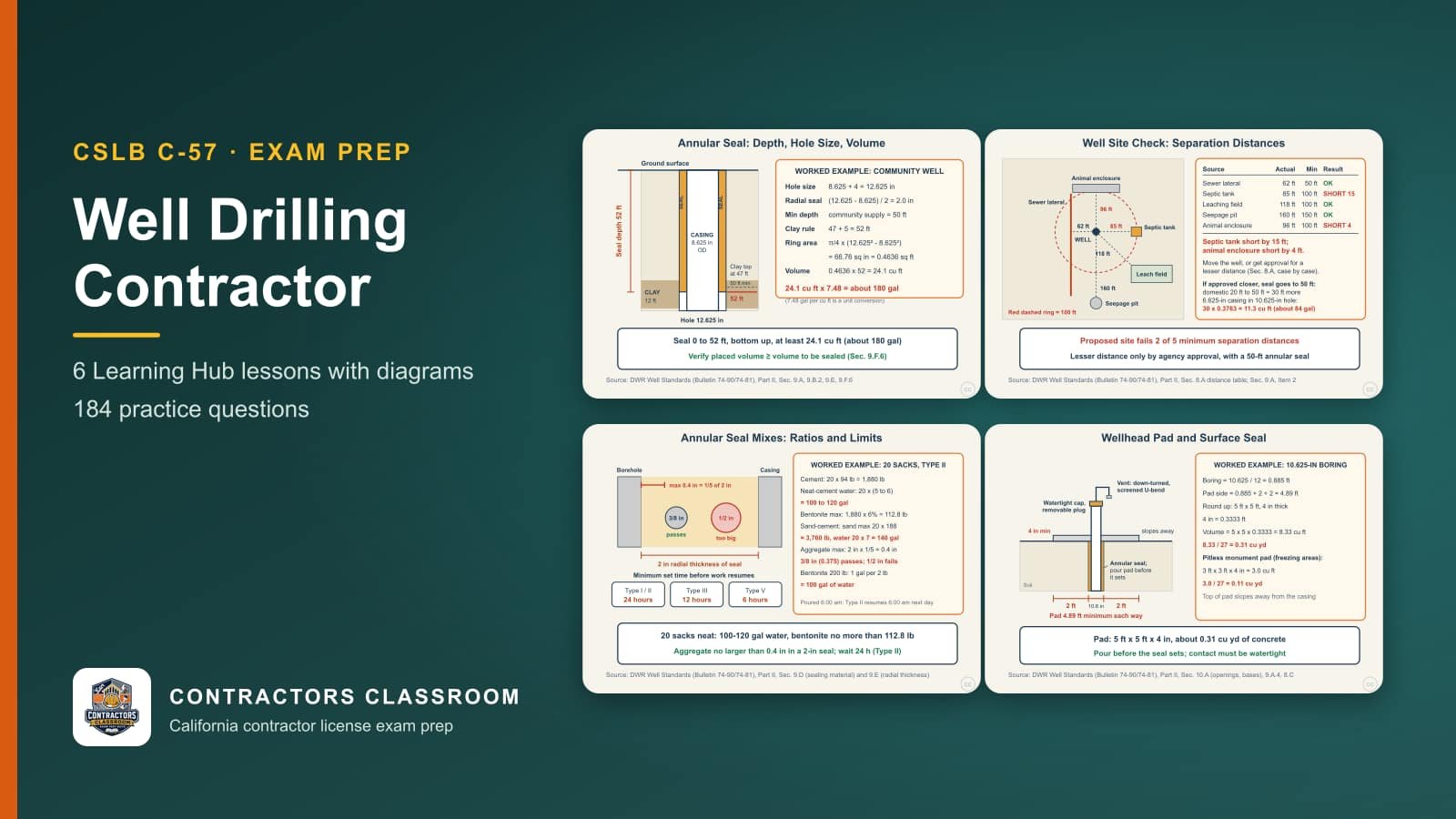
- Annular space
- The ring-shaped gap left between the outside of the pipe lining a well and the wall of the hole around it. Because it can carry surface water straight down along the casing, it is filled and sealed through the required interval, and the hole is drilled oversized to leave room for that fill.
- Annular seal
- Cement, concrete or bentonite placed in the annular space so contamination cannot travel down beside the casing. Its minimum depth depends on well use, it must be continuous, and the volume actually placed should at least match the volume of the space.
- Conductor casing
- A temporary or permanent outer pipe set through loose, caving ground at the top of a borehole to keep it from collapsing during drilling and sealing. When temporary, it is pulled back as the seal material is placed.
- Tremie pipe
- A pipe lowered to the bottom of an interval so grout or sealing material is delivered from the bottom upward. It prevents free-fall, bridging and dilution by water, which would leave voids or weak spots in the seal.
- Neat cement
- Portland cement mixed only with water, with no sand or aggregate, at a stated water-to-cement proportion per sack. It is a standard sealing material, and variations from the stated proportions need prior agreement from the enforcing agency.
- Centralizer
- A spring or rigid guide fastened to the casing that holds it in the middle of the borehole. It keeps an even thickness of seal material all the way around, which is why it is required unless removable tools center the casing.
- Pitless adapter
- A fitting bolted or welded to the casing below the frost line that carries water sideways out of the well and leaves the top clean. It removes the need for a pit or vault and lets the pump be pulled without opening the discharge line.
- Well screen
- A slotted or wire-wound section of casing set opposite the water-bearing layer. Its slot size is matched to the grain size of the formation or filter pack so water enters freely and sand stays out.
- Gravel pack
- Clean, sized gravel placed around a screen to increase its effective opening, filter out fine particles and stabilize the hole. It must come from a clean source, be washed and receive disinfectant as it is placed.
- Well development
- Working a new well with surging, jetting or pumping to remove drilling fluid and fines near the screen and open the formation. A well that is properly developed produces clear water at its best yield.
- Static water level
- The depth to water in a well when no pumping is occurring and levels have settled. It is the starting point for every drawdown reading and for measuring the water-filled length of casing.
- Drawdown
- How far the water level in a well drops below the static level while it is being pumped. It rises with pumping rate and is used with the yield to judge the well's performance and where to set the pump.
- Specific capacity
- The yield of a well per foot of drawdown, usually in gallons per minute. A decline in this figure over time signals a clogging screen or falling aquifer, so it is a basic measure of both performance and need for rehabilitation.
- Mud rotary drilling
- A method where a rotating bit cuts the hole while circulating drilling fluid carries cuttings up and holds the borehole open. The fluid must be clean enough not to contaminate the well and is removed during development.
- Hollow-stem auger
- A continuous-flight auger with an open center that lets samplers or casing pass through while the flights hold the hole open. It is common in shallow, unconsolidated ground for geotechnical and environmental borings, and its tools can center casing.
- Split-spoon sampler
- A tube that splits lengthwise, driven into the soil at the bottom of a boring to bring up a sample and a blow-count record. Geotechnical borings use it to learn soil layers and strength at set depths.
- Monitoring well
- A small-diameter well built to sample groundwater or measure its level, rather than to supply water. Environmental versions need clean construction, careful sealing and decontaminated tools so the sample represents the aquifer.
- Submersible pump motor
- A sealed electric motor mounted below the pump bowls and operated under water inside the casing. It depends on adequate flow past it for cooling, correct cable size and voltage, and proper control equipment to avoid burnout.
- Sounding tube
- A small pipe or access fixed beside the pump so a probe can measure water level without disturbing the equipment. The opening must be capped or plugged, since any hole at the wellhead can admit contaminants.