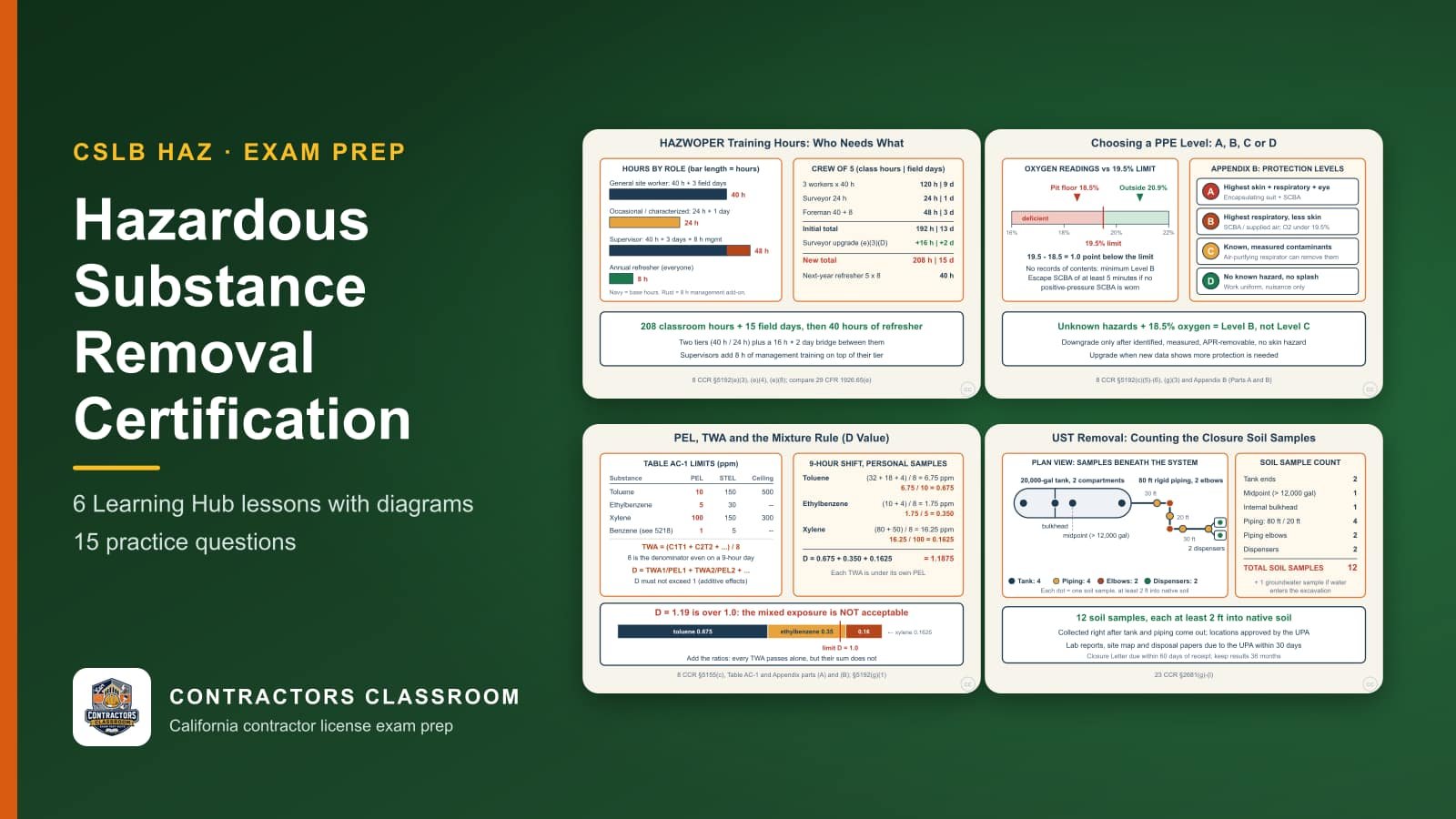
- HAZWOPER
- The nickname for the combined federal and state rule on hazardous waste site work and emergency response, which governs cleanup sites. It requires site characterization, tiered worker training, medical monitoring, protective equipment programs, decontamination, and emergency planning before and during field work.
- General site worker
- A laborer, equipment operator, or supervisor regularly exposed to site hazards. This role needs forty hours of off-site instruction plus three days working in the field under a trained supervisor, while occasional or fully characterized low-risk workers follow a shorter tier that can be upgraded.
- Level A protection
- The highest ensemble in the four-level scale: a fully encapsulating chemical suit with positive-pressure breathing air. It fits cases with a known substance demanding top skin, eye, and breathing protection, or confined spaces where lower levels are not yet justified.
- Level B protection
- Top-tier breathing protection paired with a lesser degree of skin protection, such as hooded chemical-resistant clothing. It is the minimum starting ensemble on a site with unidentified hazards, and it also applies when oxygen is low or vapors are not fully identified.
- IDLH atmosphere
- A condition immediately dangerous to life or health, where exposure could kill, cause irreversible harm, or prevent escape. Entry instruments look for it first, and its presence calls for positive-pressure breathing apparatus and an escape supply.
- Direct-reading instrument
- A portable meter or detector tube that shows results on the spot, such as combustible gas, oxygen level, or toxic vapor. During initial entry on an unknown site, readings guide whether the atmosphere is safe and which protective level to wear.
- Short-term exposure limit (STEL)
- A fifteen-minute average concentration that can never be topped at any point during the workday, even when the eight-hour average is acceptable. Each substance has its own value, and the STEL, the long-term limit, and any ceiling are all checked separately.
- Skin notation
- A mark beside a chemical in the exposure limit table showing it can get into the body by absorption through the skin, mucous membranes, or eyes as well as by breathing. For such substances, protective clothing matters even when air readings look fine.
- Eight-hour time-weighted average
- A single exposure figure found by multiplying each concentration by the hours spent at it, adding the products, and dividing by eight, whatever the actual shift length. It lets uneven exposures through the day be compared with the long-term limit.
- Mixture rule (D value)
- A check for combined exposure to substances with similar health effects: add each substance's average divided by its own limit, and the total must not exceed one. A result of one or less passes; above one means the mixture is overexposed.
- Unified Program Agency (UPA)
- The local environmental agency that administers the state tank program in its area. It accepts closure proposals, sets or accepts sample locations, receives the laboratory reports and drawings after removal, and issues the closure letter.
- Cleanup Oversight Agency
- The regulator that directs investigation and remediation once contamination is found. It is notified when free product appears and decides how far product removal must go, so a contractor must know who it is for each site.
- Closure soil sample
- A sample of native soil taken right after a tank or its piping leaves the ground, beneath each end of the tank, along pipe runs at set spacing, and under dispensers. Larger tanks also get a midpoint sample. Locations are agreed with the local agency.
- Chain of custody
- The paper trail documenting who held a sample from collection to the laboratory. A complete form, with signatures and times, is part of the reports submitted after closure and supports the credibility of the analytical results.
- Free product
- Fuel or another released liquid that exists as its own layer, for example floating on groundwater, instead of dissolved in water or absorbed in soil. Finding it triggers prompt agency notice, removal to the extent practicable, and a written report.
- Reportable release
- A leak that escapes secondary containment, cannot be stopped and cleaned up quickly, or is still under investigation hours after detection. It requires written notice to the local agency within one day and a first written report with the known details within five days.
- Temporary tank closure
- A status for a tank that has stopped storing product but will be reused, allowed for up to twelve months and extendable by the agency to a maximum of twenty-four. Fill points are locked, residues removed, and the tank is checked at regular intervals.
- Abandonment in place
- Closing a tank without lifting it: liquids are removed, piping is disconnected or capped, and the shell is packed full with a non-reactive solid material. The owner must keep a file noting how big the tank was, where it sits, and when it was closed.
- Inerting a tank
- Displacing flammable vapors from an emptied tank with a non-reactive material so the atmosphere inside cannot ignite or explode. It happens before the tank is cut, lifted, or moved, and it is paired with removing residual liquids and sludge.