California contractor licenses come in four families: Class A (general engineering), Class B (general building), Class B-2 (residential remodeling) and Class C (specialty, with 42 separate trades). (CSLB Get Licensed to Build, p. 33) The family you pick sets your trade exam, your experience requirement and the work you are allowed to contract for, so it pays to choose on purpose. Everything below comes from CSLB's own guide, Get Licensed to Build, and the 2026 License Law book, as printed in the editions we reviewed. Confirm current details with CSLB before you apply.
The four families at a glance
- Class A, General Engineering. Fixed works that call for specialized engineering knowledge and skill. (CSLB Get Licensed to Build, p. 11) The statute's list runs from irrigation, dams and levees to highways, sewers, bridges, pipelines and land leveling. (License Law Book 2026, B&P §7056)
- Class B, General Building. A structure that needs two or more unrelated building trades or crafts to build. (CSLB Get Licensed to Build, p. 11)
- Class B-2, Residential Remodeling. Nonstructural work on an existing residential wood frame structure, when the project needs three or more unrelated trades. (CSLB Get Licensed to Build, p. 11)
- Class C, Specialty. Work that takes special skill and centers on specialized trades or crafts. (CSLB Get Licensed to Build, p. 11)
Whichever you choose, CSLB expects at least four years of verifiable journey-level experience in that classification. (CSLB Get Licensed to Build, p. 11)
Class B: the two-trade rule and the framing exception
A B licensee is free to act as prime contractor or subcontractor on framing and carpentry work. (License Law Book 2026, B&P §7057(b)) Framing and carpentry do not count toward the two trades, though. For a prime contract involving other trades, the contract must call for at least two unrelated trades besides framing or carpentry, unless the B contractor also holds the matching specialty license or subcontracts that work to a licensed contractor. (License Law Book 2026, B&P §7057(b))
Two quick examples:
- A remodel with framing, drywall and painting has two unrelated trades besides framing, so it fits a B prime contract. (License Law Book 2026, B&P §7057(b))
- A job with framing and tile only has one trade besides framing. A B contractor can take it only by holding the tile classification or by subcontracting the tile to a licensed tile contractor. (CSLB Get Licensed to Build, p. 11)
A B contractor also may not contract for a project that includes a fire protection system or well drilling unless holding that classification or subcontracting to someone who does. (License Law Book 2026, B&P §7057(c))
Class B-2: what it covers and where it stops
A B-2 contract must include at least three unrelated trades, and the contractor may self-perform them or subcontract any of them. (License Law Book 2026, B&P §7057.5(b)) The statute's examples include drywall, finish carpentry, flooring, insulation, painting, plastering, roof repair, siding, tiling, and swapping fixtures such as faucets, outlets and fans. (License Law Book 2026, B&P §7057.5(b))
The limits matter just as much:
- No structural changes to load-bearing parts of the building, including footings, foundations, load-bearing walls and roof structures. (License Law Book 2026, B&P §7057.5(c))
- No project with fire protection, asbestos abatement or well drilling unless the contractor holds that classification or subcontracts it. (License Law Book 2026, B&P §7057.5(c))
- No installing, replacing or substantially altering electrical, mechanical or plumbing systems without the right license or a licensed subcontractor. Minor alterations to install fixtures are allowed when the contract has three trades. (License Law Book 2026, B&P §7057.5(c))
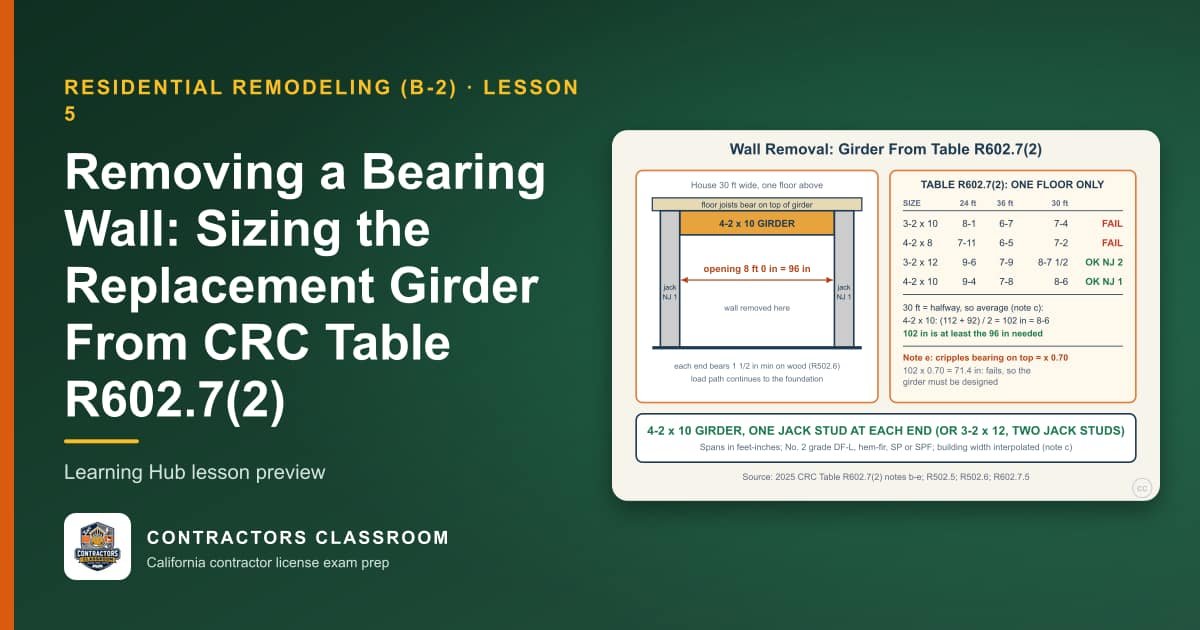
So removing a bearing wall is outside what a B-2 contractor may take on. If you want to see how that work is sized, read our lesson on removing a bearing wall.
Class C: one trade, defined in detail
CSLB's Description of Classifications defines each C trade. A few that people often confuse:
- C-10 Electrical covers placing, installing or connecting electrical wiring, fixtures, raceways and conduit, including solar photovoltaic cells. (CSLB Get Licensed to Build, p. 38)
- C-36 Plumbing covers water supply, waste disposal, gas piping and gas appliances, and equipment that heats water. (CSLB Get Licensed to Build, p. 42)
- C-9 Drywall covers hanging gypsum wallboard and the taping and texturing that follows. (CSLB Get Licensed to Build, p. 38)
- C-33 Painting and Decorating covers surface preparation and applying paints, wallcoverings and similar finishes. (CSLB Get Licensed to Build, p. 41)
Flooring and tile show how fine the lines are. C-15 Flooring covers carpet, resilient flooring and wood floors, but the definition excludes ceramic tile. (CSLB Get Licensed to Build, p. 39) C-54 Ceramic and Mosaic Tile covers glazed, ceramic, mosaic, quarry, paver and stone tile. (CSLB Get Licensed to Build, p. 44) On a job with new wood floors and a tiled shower, the floors point to C-15 and the shower to C-54.
A contractor licensed in one classification is barred from contracting in another field unless also licensed there or allowed under the regulation on incidental work. (License Law Book 2026, CCR §830) The C-61 Limited Specialty class covers specialty fields that the other C definitions do not, (CSLB Get Licensed to Build, p. 45) and CSLB tracks it through "D" subcategories. (CSLB Get Licensed to Build, p. 46) No trade exam is required for C-61. (CSLB Get Licensed to Build, p. 21)
Incidental and supplemental work
A specialty contractor may take a contract involving two or more crafts when the work outside the licensed craft is incidental and supplemental to the work the license covers. (License Law Book 2026, B&P §7059) The regulation treats other-classification work that way when it is essential to accomplish the work in the contractor's own classification. The contractor may use subcontractors or its own employees for that piece. (License Law Book 2026, CCR §831)
Which classifications may do solar work
The guide says only these classifications are currently approved for solar projects: (CSLB Get Licensed to Build, p. 12)
- A and B, for active solar projects
- C-4, for solar heating equipment tied to boiler and hot-water systems
- C-10, for any solar project that generates, transmits or uses electricity
- C-36, for solar equipment that heats water or other fluids
- C-46 Solar, for thermal and photovoltaic systems
- C-53, for solar heating in swimming pool projects
- C-61/D-35, for repairing existing solar pool heating systems
A C-46 licensee may not perform other building trades beyond what a solar installation requires. (CSLB Get Licensed to Build, p. 12) The guide also says to ask your local utility, the state utilities commission or the state energy commission which certifications a rebate program expects. (CSLB Get Licensed to Build, p. 12) If solar is your goal, start with our solar contractor exam prep.
How to choose
- Name your principal business. A specialty license fits a business built around one specialized trade or craft. (License Law Book 2026, B&P §7058)
- Count the trades on your typical contract. Two or more unrelated trades points to B. Three or more on existing residential wood frame work, without structural changes, points to B-2. (CSLB Get Licensed to Build, p. 11)
- Check your experience. You need four years of journey-level work in the classification within the 10 years before filing. (CSLB Get Licensed to Build, p. 7)
- Apply one classification at a time. When exams are required, CSLB accepts one classification per application, and you can add others after the license is issued. (CSLB Get Licensed to Build, p. 15) An existing licensee may add a classification by qualifying for it. (License Law Book 2026, B&P §7059)
- Plan the exams. You take the law and business exam plus a trade exam in the classification you applied for. (CSLB Get Licensed to Build, p. 23)
For general contracting, see the General Building exam prep and the Residential Remodeling exam prep.
Sources
Code sections and publications this article relies on, as printed in the editions we reviewed. Codes and CSLB procedures change: check the current text before you rely on a detail.
- CSLB, Get Licensed to Build: A Guide to Becoming a Licensed Contractor, page 33
- CSLB, Get Licensed to Build: A Guide to Becoming a Licensed Contractor, page 11
- California Contractors License Law & Reference Book, 2026 edition (CSLB), B&P Code section 7056
- California Contractors License Law & Reference Book, 2026 edition (CSLB), B&P Code section 7057(b)
- California Contractors License Law & Reference Book, 2026 edition (CSLB), B&P Code section 7057(c)
- California Contractors License Law & Reference Book, 2026 edition (CSLB), B&P Code section 7057.5(b)
- California Contractors License Law & Reference Book, 2026 edition (CSLB), B&P Code section 7057.5(c)
- CSLB, Get Licensed to Build: A Guide to Becoming a Licensed Contractor, page 38
- CSLB, Get Licensed to Build: A Guide to Becoming a Licensed Contractor, page 42
- CSLB, Get Licensed to Build: A Guide to Becoming a Licensed Contractor, page 41
- CSLB, Get Licensed to Build: A Guide to Becoming a Licensed Contractor, page 39
- CSLB, Get Licensed to Build: A Guide to Becoming a Licensed Contractor, page 44
- California Contractors License Law & Reference Book, 2026 edition (CSLB), CCR Code section 830
- CSLB, Get Licensed to Build: A Guide to Becoming a Licensed Contractor, page 45
- CSLB, Get Licensed to Build: A Guide to Becoming a Licensed Contractor, page 46
- CSLB, Get Licensed to Build: A Guide to Becoming a Licensed Contractor, page 21
- California Contractors License Law & Reference Book, 2026 edition (CSLB), B&P Code section 7059
- California Contractors License Law & Reference Book, 2026 edition (CSLB), CCR Code section 831
- CSLB, Get Licensed to Build: A Guide to Becoming a Licensed Contractor, page 12
- California Contractors License Law & Reference Book, 2026 edition (CSLB), B&P Code section 7058
- CSLB, Get Licensed to Build: A Guide to Becoming a Licensed Contractor, page 7
- CSLB, Get Licensed to Build: A Guide to Becoming a Licensed Contractor, page 15
- CSLB, Get Licensed to Build: A Guide to Becoming a Licensed Contractor, page 23
Every lesson and question we write is grounded in California code books and CSLB materials. How we build our lessons


