Every CSLB trade exam study guide prints a list of major sections with a percentage next to each one, and the guide marks those percentages as approximate. (CSLB Study Guide B) CSLB's own description of the guide is that it names the topic areas, includes sample questions, weights each content area and suggests what to read. (CSLB Get Licensed to Build, p. 24) That makes the percentages a useful starting point for a study plan. This article shows the numbers for three trades and one simple way to turn them into hours. The hour-splitting is our planning method, not a CSLB rule, and the exam itself can differ from any plan, so treat the weights as a guide to where to spend time.
The weights printed for B, C-36 and C-10
Here are the sections and percentages as printed in the study guides we reviewed. Each guide carries its own effective date, so check that you are using the edition that applies to your exam date.
General Building (B), for exams scheduled on or after January 1, 2025: (CSLB Study Guide B)
- Planning and Estimating: 15%
- Framing and Structural Components: 20%
- Core Trades: 30%
- Finish Trades: 20%
- Safety: 15%
Plumbing (C-36), for exams scheduled on or after March 1, 2025: (CSLB Study Guide C-36)
- Planning and Estimating: 22%
- Underground and Rough Systems: 22%
- Finish Plumbing Installations: 20%
- Service, Repair, and Remodel Plumbing Systems: 19%
- Safety: 17%
Electrical (C-10), for exams scheduled on or after June 1, 2024: (CSLB Study Guide C-10)
- Planning and Estimating: 28%
- Rough Wiring: 27%
- Finish Wiring and Trim: 11%
- Startup, Troubleshooting, and Maintenance: 16%
- Safety: 18%
Each list adds up to 100. Notice how different the shapes are. The B exam has one heavy section, Core Trades, at 30%. The C-36 exam is nearly flat, with every section between 17% and 22%. The C-10 exam leans toward planning and rough wiring, which together carry 55%.
Splitting a 10-hour study week in proportion
Here is a plain planning method: multiply your weekly study time by each section's percentage. Say you can study 10 hours a week, which is 600 minutes.
For C-10:
- Planning and Estimating: 28% of 10 hours is 2.8 hours.
- Rough Wiring: 27% is 2.7 hours.
- Finish Wiring and Trim: 11% is 1.1 hours, about 66 minutes.
- Startup, Troubleshooting, and Maintenance: 16% is 1.6 hours.
- Safety: 18% is 1.8 hours.
Those add up to 10.0 hours. For B, the same week becomes 1.5, 2.0, 3.0, 2.0 and 1.5 hours. For C-36 it becomes 2.2, 2.2, 2.0, 1.9 and 1.7 hours. The arithmetic is only a starting point, but it stops a common habit: spending most of the week on the part of the trade you already do all day.
A shorter week works the same way. With 6 hours available for the B exam, the split is 0.9, 1.2, 1.8, 1.2 and 0.9 hours, which is 6.0 in total. Core Trades still gets the biggest block, 1.8 hours, even though it covers seven different trades in the outline. (CSLB Study Guide B) That is a reminder that a heavy section is broad, so spread its hours across the listed topics instead of sinking them into one.
One more thing the numbers show. Safety is not a side topic. It is 15% of the B outline, 17% of C-36 and 18% of C-10, so it deserves roughly an hour and a half to nearly two hours of a 10-hour week. (CSLB Study Guide B) (CSLB Study Guide C-36) (CSLB Study Guide C-10)
Adjusting the plan to your weak spots
Proportional hours assume you are equally strong everywhere, which nobody is. A practical tweak is to hold back a flex pool before you split the week.
For example, with C-36 you might reserve 2 of your 10 hours. The remaining 8 hours split as 1.76 (Planning and Estimating), 1.76 (Underground and Rough Systems), 1.6 (Finish Plumbing), 1.52 (Service, Repair, and Remodel) and 1.36 (Safety), which totals 8.0. Then you spend the 2 flex hours on whichever section your last practice set showed to be weakest. (CSLB Study Guide C-36)
If you have already taken the exam once, the test center shows candidates who did not pass how they performed on each section, and CSLB notes that those sections match the Content of the Examination in the study guide. (CSLB Get Licensed to Build, p. 25) That is useful data on where to move your flex hours.
Use the listed reference books on purpose
Each guide ends with a resources list naming publications to study from. The lists differ by trade:
- The B guide lists several 2025 Title 24 code books, including the California Building Code, Residential Code and Electrical Code, plus construction texts such as Modern Carpentry. (CSLB Study Guide B)
- The C-36 guide lists the California Plumbing Code, Mechanical Code, Building Code and Green Building Standards Code, along with the Underground Service Alert guidelines. (CSLB Study Guide C-36)
- The C-10 guide lists the California Electrical Code, Building Code, Energy Code and Fire Code, plus the American Electricians' Handbook, Photovoltaic Systems and Ugly's Electrical References. (CSLB Study Guide C-10)
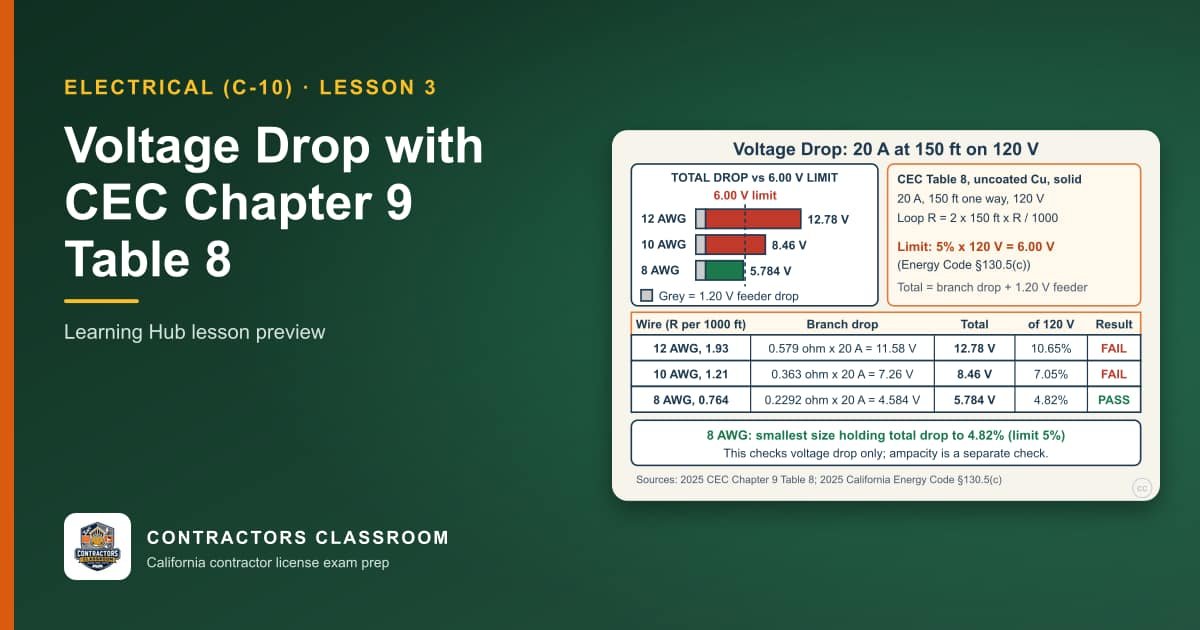
The guides do not say which book belongs to which exam section, so make your own map. Write each section name on a sheet, then note which listed book you would open to answer a question in that section. For example, a C-36 question about pipe sizing and venting, which falls under Planning and Estimating, points you toward the plumbing code. (CSLB Study Guide C-36) A C-10 question about electrical calculations, also under Planning and Estimating, is where a voltage drop practice problem such as our voltage drop lesson fits. (CSLB Study Guide C-10)
Remember that the exams are closed book, so the books are for building understanding, not for looking things up in the room. (CSLB Study Guide B)
Mistakes to avoid when planning around weights
- Treating approximate as exact. The guides label the percentages approximate, so a section at 11% is not a license to skip it. (CSLB Study Guide C-10)
- Ignoring the date on the guide. CSLB says exams are updated every five to seven years, so use the edition that matches your exam date. (CSLB Get Licensed to Build, p. 24)
- Studying only your daily work. A plumber who spends every hour on fixtures may be thin on safety or estimating.
- Skipping practice under exam conditions. Four choices, one best answer, no notes.
Ready to practice by trade? Start with the General Building contractor exam prep, the plumbing contractor license exam prep or the electrician contractor license exam prep.
Sources
Code sections and publications this article relies on, as printed in the editions we reviewed. Codes and CSLB procedures change: check the current text before you rely on a detail.
- CSLB official examination study guide, classification B
- CSLB, Get Licensed to Build: A Guide to Becoming a Licensed Contractor, page 24
- CSLB official examination study guide, classification C-36
- CSLB official examination study guide, classification C-10
- CSLB, Get Licensed to Build: A Guide to Becoming a Licensed Contractor, page 25
Every lesson and question we write is grounded in California code books and CSLB materials. How we build our lessons


