
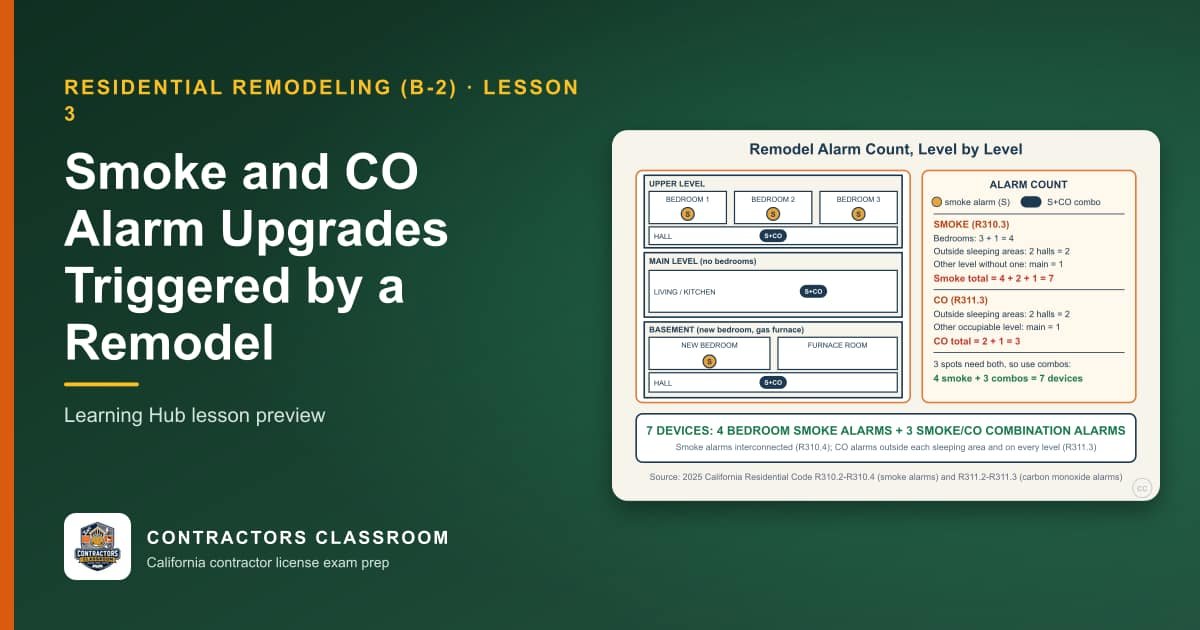
Under the 2025 California Residential Code, a smoke alarm goes in every sleeping room, outside each sleeping area, and on every other story of the dwelling unit, including basements. (2025 CRC §R310.3) Carbon monoxide alarms are required in dwelling units that have a fuel-fired appliance, a fireplace, or an attached garage opening into the home, and they go outside each sleeping area and on every occupiable level. (2025 CRC §R311.2.1) (2025 CRC §R311.3) Remodels can trigger both, depending on the scope of work.
Where smoke alarms go
Section R310.3 lists the locations.
- In each sleeping room. (2025 CRC §R310.3)
- In the area just outside each separate sleeping area, close to the bedrooms. (2025 CRC §R310.3)
- On each additional story, including basements and habitable attics, but not crawl spaces or uninhabitable attics. (2025 CRC §R310.3)
- At least 3 feet to the side of any bathroom door or opening where the bathroom has a tub or shower, unless that would block a required alarm location. (2025 CRC §R310.3)
- In both the bedroom hallway and a room that opens onto it, when that room's ceiling is at least 24 inches higher than the hallway's. (2025 CRC §R310.3)
- In the room that a sleeping loft opens to, near the loft. (2025 CRC §R310.3)
For split-level homes with no door between the levels, an alarm on the upper level can cover a lower level that is less than a full story below. (2025 CRC §R310.3)
Where not to put them
The code reproduces the location requirements of NFPA 72 as amended by the State Fire Marshal. The practical points are below.
- Keep alarms out of spaces where ambient conditions fall outside the manufacturer's limits, such as unfinished attics or garages where temperatures can drop below 40°F or pass 100°F. (2025 CRC §R310.3.3)
- Where a ceiling or exterior wall can run much warmer or cooler than the room, mount the alarm on an inside wall. (2025 CRC §R310.3.3)
- Stay at least 20 feet horizontally from a permanently installed cooking appliance, with a closer allowance of 10 feet for photoelectric alarms or ionization alarms that have a silencing switch. (2025 CRC §R310.3.3)
- Stay at least 36 inches from forced-air supply registers and from the tip of a ceiling paddle fan blade. (2025 CRC §R310.3.3)
- Place alarms where smoke rising in a stairway cannot be blocked from reaching them by a door or other obstruction, and put the alarm on the basement ceiling near the top of the basement stairs. (2025 CRC §R310.3.3)
Where carbon monoxide alarms go
Carbon monoxide alarms are required where the dwelling unit has a fuel-fired appliance or fireplace, or an attached garage that has an opening into the home. (2025 CRC §R311.2.1) The locations are:
- Outside each separate sleeping area, near the bedrooms. (2025 CRC §R311.3)
- On every occupiable level, including basements. (2025 CRC §R311.3)
- Inside a bedroom when a fuel-burning appliance sits in the bedroom or its attached bathroom. (2025 CRC §R311.3)
Alarms are installed and maintained following the manufacturer's published instructions. (2025 CRC §R311.3)
Combination alarms and listings
A combination smoke and carbon monoxide alarm may be used in place of either single alarm. (2025 CRC §R310.5) (2025 CRC §R311.4) Smoke alarms are listed to UL 217 and carbon monoxide alarms to UL 2034, and combination units carry both listings. (2025 CRC §R310.1.1) (2025 CRC §R311.1.1) The code also requires State Fire Marshal listing and approval for these devices. (2025 CRC §R310.1.1)
Worked example: a two-story home with an attached garage
A new two-story house has three bedrooms and a hallway upstairs, a living area and kitchen downstairs, no basement, a gas water heater and an attached garage with a door into the kitchen.
- Smoke alarms. Three bedrooms need one each, the upstairs hallway outside the sleeping area needs one, and the downstairs story needs one. (2025 CRC §R310.3) That is 3 + 1 + 1 = 5.
- Carbon monoxide alarms. The unit has a fuel-fired appliance and an attached garage opening into it, so alarms are required. (2025 CRC §R311.2.1) One goes outside the sleeping area upstairs and one on the occupiable level downstairs. (2025 CRC §R311.3) That is 2.
- Combine where locations overlap. The upstairs hall and the downstairs level each need both alarm types, so two combination units replace four single alarms. (2025 CRC §R310.5) The three bedrooms still take smoke-only alarms, because CO is not required inside them here.
- Total. Three smoke alarms plus two combination alarms is 5 devices instead of 7.
Interconnection and power
Where more than one smoke alarm is needed in a dwelling unit, they must be interconnected so one alarm sets off all of them, and the sound has to be clearly audible in every bedroom with the doors closed. (2025 CRC §R310.4) Carbon monoxide alarms follow the same principle, but wireless listed alarms count as interconnected when all of them sound together. (2025 CRC §R311.5)
Smoke alarms take primary power from the building wiring with a battery backup, give a low-battery signal, and are wired without a disconnect other than the overcurrent device. (2025 CRC §R310.6) Carbon monoxide alarms draw primary power from the building wiring where it comes from a commercial source, with a battery as the backup. (2025 CRC §R311.6)
Remodels, additions and repairs
When alterations, repairs or additions that require a permit occur, the dwelling unit gets smoke alarms located as for a new home. (2025 CRC §R310.2.2) For carbon monoxide, an addition to the dwelling or adding a fuel-burning heater, appliance or fireplace triggers new alarms. (2025 CRC §R311.2.2) Work limited to exterior surfaces, such as roofing, siding, windows, doors or a porch or deck, does not trigger new carbon monoxide alarms. (2025 CRC §R311.2.2)
Interconnection has several exceptions. Smoke alarms in existing areas need not be interconnected when the work does not remove interior wall or ceiling finishes and expose the structure, unless an attic, crawl space or basement gives easy access. (2025 CRC §R310.4) Likewise, battery-only alarms are permitted in several of those same low-impact cases. (2025 CRC §R310.6)
Putting it to use
Alarm counts show up in both new-home and remodel work, so they are worth practicing. The residential remodeling contractor exam prep page covers where alarm upgrades enter a remodel scope. Residential remodeling contractor exam prep A lesson counts alarms level by level in a remodel with a new basement bedroom. Smoke and CO alarm upgrades triggered by a remodel General building contractors can review the same rules through the general building exam prep. General building contractor exam prep
Sources
Code sections and publications this article relies on, as printed in the editions we reviewed. Codes and CSLB procedures change: check the current text before you rely on a detail.
- 2025 California Residential Code (CRC), Title 24 Part 2.5, Section R310.3
- 2025 California Residential Code (CRC), Title 24 Part 2.5, Section R311.2.1
- 2025 California Residential Code (CRC), Title 24 Part 2.5, Section R311.3
- 2025 California Residential Code (CRC), Title 24 Part 2.5, Section R310.3.3
- 2025 California Residential Code (CRC), Title 24 Part 2.5, Section R310.5
- 2025 California Residential Code (CRC), Title 24 Part 2.5, Section R311.4
- 2025 California Residential Code (CRC), Title 24 Part 2.5, Section R310.1.1
- 2025 California Residential Code (CRC), Title 24 Part 2.5, Section R311.1.1
- 2025 California Residential Code (CRC), Title 24 Part 2.5, Section R310.4
- 2025 California Residential Code (CRC), Title 24 Part 2.5, Section R311.5
- 2025 California Residential Code (CRC), Title 24 Part 2.5, Section R310.6
- 2025 California Residential Code (CRC), Title 24 Part 2.5, Section R311.6
- 2025 California Residential Code (CRC), Title 24 Part 2.5, Section R310.2.2
- 2025 California Residential Code (CRC), Title 24 Part 2.5, Section R311.2.2
Every lesson and question we write is grounded in California code books and CSLB materials. How we build our lessons


