CSLB C-12

Earthwork and Paving Contractor License Exam Prep (C-12)

Getting ready for the California earthwork and paving contractor license exam (CSLB C-12)? Study with 215 practice questions in 4 categories and 6 Learning Hub lessons, made for grading, excavation and paving contractors, with the Law and Business exam included.

One-time purchase, no subscription. Law & Business included.

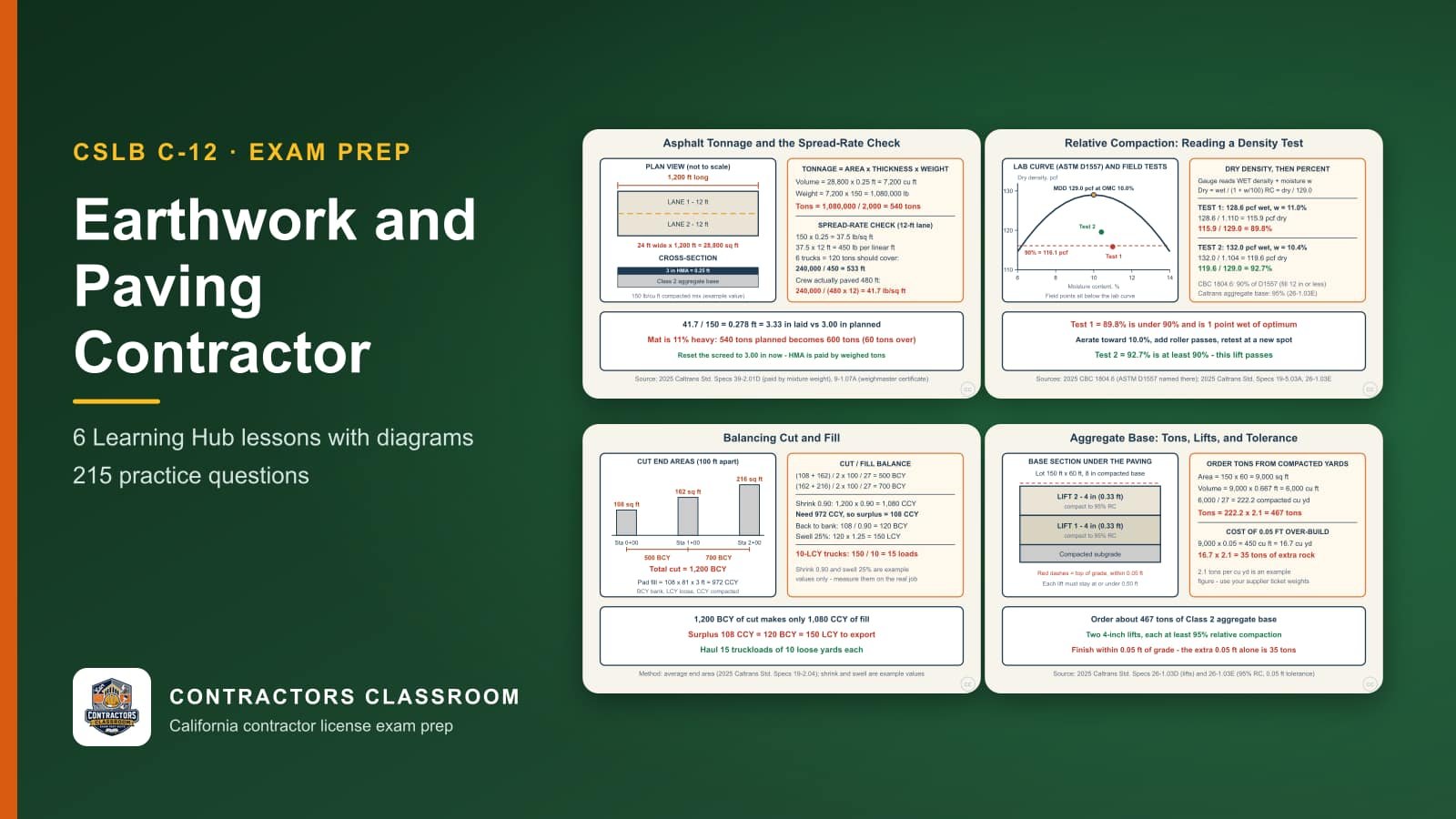
Diagrams from the C-12 earthwork and paving contractor lessons: Hot Mix Asphalt Tonnage and the Spread-Rate Check, Relative Compaction: Reading a Nuclear-Gauge Density Test, Balancing Cut and Fill: Bank, Loose, and Compacted Yards and Aggregate Base: Tons to Order, Lifts, and Grade Tolerance
215practice questions
4categories
6Learning Hub lessons
$249Law & Business included

What the exam covers: Earthwork and Paving (C-12)

The CSLB exam for the California earthwork and paving contractor license (C-12) is a closed-book, multiple-choice test. CSLB's official study guide divides it into four major sections and gives each an approximate weight: Planning and Estimating (about 20%), Earthwork and Grade Control (about 29%), Paving (about 30%), and Safety (about 21%).

Paving carries the most weight, about 30%, so it deserves roughly that share of your study time, with Earthwork and Grade Control next at about 29%.

Contractors Classroom turns that outline into 215 practice questions in 4 categories (Planning and Estimating, Excavation, Grading & Compaction, Asphalt Paving & Surfacing, and Cal-OSHA Excavation & Heavy Equipment Safety), plus 6 Learning Hub lessons with diagrams (such as "Hot Mix Asphalt Tonnage and the Spread-Rate Check" and "Relative Compaction: Reading a Nuclear-Gauge Density Test"). Law and Business, which most applicants take alongside their trade exam, is included at no extra charge.

Exam sections and approximate weights

  • Planning and Estimating~20%
  • Earthwork and Grade Control~29%
  • Paving~30%
  • Safety~21%

Practice question categories

  • Planning and Estimating50 practice questions
  • Excavation, Grading & Compaction50 practice questions
  • Asphalt Paving & Surfacing50 practice questions
  • Cal-OSHA Excavation & Heavy Equipment Safety65 practice questions

What the Earthwork and Paving Contractor exam covers, section by section

Planning and Estimating (~20%)

Every successful grading and paving job begins with a careful reading of the drawings and a look at the actual site. Existing utilities, drainage patterns, soil conditions, and access all affect method and cost. Estimators convert quantities of earth, aggregate, and asphalt into prices, and decide which machines, materials, and layout points are required before crews mobilize. Mistakes in the takeoff or in layout tend to be repeated across the entire project. Haul distances, import or export of soil, and whether rock or high groundwater is likely all change the equipment mix and the schedule, so they belong in the bid.

  • Studying drawings and specifications to understand the scope and tolerances
  • Walking the site to spot utilities, drainage, access, and obstructions
  • Calculating quantities, equipment hours, and labor into a competitive price
  • Setting reference points and stakes that guide the work
  • Choosing aggregates, asphalt, concrete, and machines suited to the project

Earthwork and Grade Control (~29%)

Pavement is only as good as the ground beneath it. Crews establish and check elevations with stakes and lasers, learn how different soils behave when wet or compacted, and excavate trenches safely. Fill is placed in controlled lifts and compacted, and the surface is shaped to drain and meet the planned slopes before any base or asphalt goes on. Careless compaction or grade errors show up later as settling, ponding, or cracking. Scrapers, graders, and rollers must work together, with moisture added or dried out of the soil so it compacts, and benchmarks rechecked after each lift of fill.

  • Using stakes, lasers, and levels to hold elevations and slopes
  • Recognizing clay, sand, rock, and groundwater conditions that affect stability
  • Digging trenches and excavations with proper support and spoil placement
  • Spreading and compacting fill layers, then trimming to the finished grade

Paving (~30%)

Paving covers a range of surfaces, from highways and residential driveways to commercial lots. Mix delivery, base preparation, spreading, rolling, and joint work all influence durability. Accessible routes, ramps, and stall layouts must meet disability requirements, while specialty surfaces and removal of failed pavement call for different methods and materials. Related items such as striping and curbs complete many jobs. Good compaction and smooth joints at the surface decide how long the finished pavement lasts. Tack coat between lifts, consistent paver speed, and rolling while the mat is still hot keep the surface dense and smooth, while saw-cut edges give patches clean, tight joints.

  • Building base and surface courses for streets, drives, and parking areas
  • Laying out accessible routes, ramps, and stalls to meet ADA rules
  • Working with specialty surfaces such as sealcoats, concrete, or decorative treatments
  • Cutting out and replacing failed pavement and breaking up old surfaces
  • Handling curbs, striping, drainage structures, and other finishing items

Safety (~21%)

Paving and grading take place around heavy equipment, hot material, open trenches, and passing traffic. Crews guard against cave-ins, burns, and struck-by incidents, and they follow rules for dust, runoff, and fuel or oil spills. Setting up signs, cones, and flaggers so motorists and pedestrians move safely past the work is a major responsibility. Pre-job planning for traffic and spill response is as essential as protective equipment. Trench shoring, spotters behind backing trucks, and respirators or water spray for dust round out the daily precautions around heavy haulers and compactors.

  • Preventing cave-ins, burns, and struck-by injuries around machinery and hot mix
  • Controlling dust, stormwater runoff, and spills that could harm surroundings
  • Setting up signs, cones, and flaggers to route vehicles safely past the work

Code books behind the Earthwork and Paving Contractor exam

The exam outline published for this trade lists these references.

  • 2025 California Building CodeFor earthwork and paving, the Building Code's soils and foundations provisions govern fill placement, compaction verified against a laboratory density, slope limits, and drainage away from structures. Its accessibility chapter also sets the rules for accessible routes, ramps and parking surfaces you pave. It is the code behind Earthwork and Grade Control and the accessibility topics in Paving.
  • CalDAG 2017: California Disabled Accessibility Guidebook, An Interpretive Manual and ChecklistThis guidebook explains the accessibility rules in plain language with checklists: stall and aisle sizes, curb ramps, running and cross slopes on walks, landings, and detectable warnings. A paving contractor uses it to lay out and finish driveways, lots and sidewalks so they can be used by everyone. It supports the ADA requirements topic in the Paving section.
  • Excavation and Grading Handbook, RevisedA practical field handbook on moving earth for building sites and roads: reading grading plans, setting stakes and slope lines, computing cut and fill volumes, choosing machines, compacting in layers, and handling trenches and drainage. It is the working reference behind Planning and Estimating (layout, quantities) and Earthwork and Grade Control.
  • Moving the Earth: The Workbook of ExcavationThis equipment-centered workbook teaches how machines and soils interact: production rates for dozers, scrapers, loaders and haul units, soil swell and shrinkage, rolling resistance and grade effects on haul roads, and cycle-time arithmetic. It feeds the equipment selection topics in Planning and Estimating and the excavation, fill and grading topics in Earthwork and Grade Control.
  • Permeable Interlocking Concrete PavementsThis design and construction manual covers pavements that let stormwater soak through joints into an open-graded stone reservoir. It describes the layered structure, bedding and joint stone, edge restraints, soil infiltration limits and maintenance. It is the reference for the specialty paving topic in the Paving section and touches the environmental impact items in Safety.
  • Caltrans Standard PlansThe Standard Plans are a set of typical detail sheets used on state work: curb and gutter, curb ramps, drainage inlets, trench and utility details, pavement joints and traffic control layouts. Learning to read them builds the drawing skills the exam expects in Planning and Estimating, Paving (roadways, driveways, parking lots) and the traffic control items in Safety.
  • Caltrans Standard SpecificationsThis is the written side of highway work: materials, workmanship, tolerances, testing frequencies, and how quantities are measured and paid for earthwork, aggregate base, hot mix asphalt, tack coat and concrete pavement. It is the reference behind Earthwork and Grade Control and Paving, and it also supports quantity reasoning in Planning and Estimating.
  • State of California Construction & Electrical Safety Orders (Cal/OSHA)The construction safety orders set the rules that matter in this trade: trench and excavation protection, underground utility awareness, operation of earthmoving and paving equipment, work near moving traffic, and dust or noise exposure. It is the reference behind the Safety section, including job site safety, environmental impact and traffic control.

Key terms for the Earthwork and Paving Contractor exam

Maximum dry density
The heaviest dry unit weight a soil can reach in a laboratory moisture-density test, in pounds per cubic foot. It is treated as 100 percent, and every field density result is compared to it, so a wrong lab reference ruins the whole compaction check.
Optimum moisture content
The water percentage at which a soil packs to its greatest density under a given compactive effort. Too dry and the grains resist rearranging; too wet and water fills the voids. Crews aerate or sprinkle fill to bring it close to this value before rolling.
Relative compaction
The field dry density expressed as a percentage of the laboratory maximum. Specifications name a minimum percentage for each zone of fill or base, and a result below it means the lift is rejected, reworked and retested before more material covers it.
Nuclear density gauge
A portable instrument that measures in-place wet density and moisture by sending radiation into the ground. Because it reports wet values, the operator or inspector converts to a dry basis before comparing with the laboratory maximum. Handling it requires trained, licensed personnel.
Bank cubic yard
A volume of soil measured in its natural, undisturbed state, which is how surveyors and plans count excavation. The same soil becomes more yards once dug and fewer once compacted, so every cut-and-fill comparison must first convert to a common state.
Swell factor
The percentage by which soil grows in volume when it is dug and loosened. It sets how many yards a truck must haul compared with the yards removed from the ground, and it varies with soil type, so on a real job it comes from soils data, not memory.
Average end area method
A way to compute earthwork volume by averaging the cross-section areas at two stations and multiplying by the distance between them, then dividing by twenty-seven for yards. It works segment by segment along a road or pad and is the standard check on cut and fill quantities.
Grade stake
A marked stake set by the surveyor or layout crew that shows the vertical distance to cut or fill to reach the planned elevation at that spot. The equipment operator and the grade checker read these marks constantly, so unreadable or disturbed stakes are reset before work continues.
Subgrade
The prepared natural or filled soil surface that carries the pavement structure. It must be compacted, trimmed to elevation and checked before base rock goes down, since a soft or uneven subgrade shows up later as ruts, cracking and uneven thickness above it.
Grading plane
The finished elevation surface on which the next paving layer will sit, within a stated vertical tolerance. Where asphalt is placed, the plane is held tightly, because a plane set high makes the mat thicker than planned, and each added fraction of an inch is paid for in tons.
Aggregate base
A layer of crushed, graded rock placed on the subgrade to spread traffic loads and drain water. It is designed in compacted thickness, ordered by the ton, and spread in layers whose maximum thickness is limited so the roller can reach the bottom of each one.
Lift
One layer of fill, base or asphalt placed and compacted before the next goes on. Limiting lift thickness lets the roller energy reach the bottom, and a failed density test on a lift is corrected before it is buried under another layer.
Leveling course
A thin asphalt or aggregate layer spread over an irregular surface to correct its profile, so the final pavement course goes on a base that is uniform in shape and thickness. Its job is to prepare the surface for the finish grade, not to add structural strength.
Hot mix asphalt
A paving mixture of graded aggregate and asphalt binder heated at a plant and placed while still hot. Temperature, timing, thickness and density all control quality, and on public work it is measured and paid by weighed tons, not by plan area.
Tack coat
A thin sprayed film of asphalt emulsion that glues a new asphalt layer to the surface beneath, including milled surfaces and the vertical faces of curbs and joints. Too little leaves layers that slip apart; too much makes the new mat unstable.
Residual rate
The amount of asphalt left on the pavement after the water in an emulsion has evaporated. Specifications state tack coat by this figure, so the crew must work backward through the emulsion's residue percentage and any dilution to find how much liquid the distributor should spray.
Weighmaster certificate
The weight ticket issued by a licensed weighmaster for each load of asphalt, base rock or similar material. Quantities paid by the ton come from these tickets, and they let a foreman compare tons delivered against feet paved to catch a mat that is too thick or too thin.
Material transfer vehicle
A machine that receives asphalt from trucks, remixes it and feeds the paver hopper so the paver can keep moving. It reduces stops, heat loss and temperature segregation, which are common causes of rough, uneven mats.
Screed
The floating, heated plate at the rear of an asphalt paver that strikes off the mix to the set thickness, width and cross slope. Adjusting it corrects the mat thickness while paving, which is why operators watch thickness checks while the mix is still hot.
Permeable interlocking pavers
Concrete units with open joints, set on bedding stone over a thick open-graded stone reservoir, so rain drains through the surface and into the ground or an underdrain. They suit parking areas and driveways where stormwater must be managed, and they depend on clean joint stone.

Where to spend practice time for the Earthwork and Paving Contractor exam

  • Asphalt tonnage and thickness controlPaving is about 30 percent of the exam, the largest single slice, and it covers roadways, driveways, lots, specialty paving and repair. Practice converting area and thickness to tons, then checking a day's paving by feet laid against tickets. Also sketch layer order, compare tack coat residual and spray rates, and recall how plant output and truck count limit the paver.
  • Accessibility, specialty paving and repairThe Paving section also reaches into accessibility rules, unusual paving systems, tearing out old pavement and repairing it. Sketch an accessible stall with its aisle, a curb ramp with landings and slopes, and a permeable paver section from subgrade to joint stone. Then practice how saw-cut edges, trench patches and pavement removal are planned, since these topics are broad and rarely repeat the same wording.
  • Compaction testing and soil behaviorEarthwork and Grade Control is about 29 percent of the exam, and soils and compaction sit at its center. Drill the laboratory curve, relative compaction arithmetic, wet-to-dry density conversion and the correction steps for a test that fails. Compare required percentages by zone, lift limits, and how moisture above or below optimum changes the fix, such as aerating or adding water.
  • Cut, fill and grade control mathGrade control, excavation, trenching and fill share the same large section, so quantity reasoning pays twice. Practice bank, loose and compacted yard conversions, average end area volumes, balancing cut against fill, importing or exporting soil, and counting truckloads in loose yards. Also rehearse reading a grade stake and a cross-section so the numbers connect to what the operator actually sees.
  • Trench, equipment and traffic safetySafety is about 21 percent of the exam and spans job site safety, environmental impact and traffic control. Review trench protection, spoil placement, utility locating, equipment backing and spotter practice, dust and storm water controls, and work-zone sign and cone layouts. Practice choosing the single best action in a scenario, because several answers usually sound plausible.
  • Reading plans and ordering base rockPlanning and Estimating is about 20 percent of the exam and covers plans, site conditions, layout, materials and equipment. Practice turning a road width, length and depth into compacted yards and then tons, rounding up to whole truckloads, and spotting hidden costs such as haul distance, rock, groundwater and utilities. Compare each quantity with what the specifications allow for lift thickness and grade tolerance.

Scenarios to talk through before the Earthwork and Paving Contractor exam

  • A density reading comes back lowA technician's gauge reading on a freshly rolled fill lift falls short of the required percentage, and the soil looks darker and wetter than the surrounding area. Which terms above apply, what number is the field result compared with, which direction should the moisture move, and what has to be settled before the next lift is spread?
  • The paver keeps stoppingMidway through a paving day the paver sits idle between loads while the plant reports steady output, and the mat shows cold ridges where it restarts. Think through trucks, transfer equipment and haul time: what would you calculate, which term describes the machine that smooths delivery, and what would you adjust first?
  • Cut does not balance fillThe grading plan shows more fill than the surveyor's cut quantities can supply, and the foreman proposes importing soil. In which volume states should each side be compared, how do swell and shrinkage change the answer, and how would you count the trucks needed if material must be brought in or hauled off?
  • More rock arrives than plannedDelivery tickets for aggregate base are running well above the tons you ordered for the lot, yet the plan area has not changed. Walk through where the extra weight could come from: thickness, lift sequence, wet loads, grade tolerance. Which tickets and checks would you review before accepting the next truck?
  • Tack coat before the overlayA milled street is ready for a new asphalt layer, and the distributor operator asks how much liquid to spray because the emulsion will be diluted with water. Which terms apply, what does the specification actually state, and how would you work backward to the spray quantity and confirm the result afterward?
  • An unmarked line in the trenchWhile trenching across a parking lot for new drainage, the excavator bucket exposes an unmarked pipe near the planned depth. Consider what stops, who is notified, how the walls of the trench and nearby traffic are controlled, and what records you would want before work resumes and the pavement is replaced.
  • A steep curb ramp at the entranceWhile forming a driveway entrance with a new curb ramp, the level shows the running slope and cross slope are steeper than the drawings call for, and a landing is too small. Which accessibility items are affected, what would you measure, and when is the right moment to correct it?
  • Pavers over clay soilA client wants permeable interlocking pavers in a parking bay, but test pits show slow-draining clay below the subgrade. Think about the reservoir layer, edge restraints, joint stone and any underdrain: how would the design change, what questions go back to the engineer, and how does this affect storm water on the site?

Learning Hub lessons

Each lesson has guided steps, a diagram, a worked example and a quick check inside the classroom.

Preview the lesson diagrams

  1. Hot Mix Asphalt Tonnage and the Spread-Rate CheckSteps: HMA Is Bought and Paid for by the Ton; Know the Unit Weight - and Label Your Assumption; The Tonnage Formula; The Spread-Rate Check: Pounds per Linear Foot; Act on the Difference While the Mat Is Hot; Thickness and Density Limits the Spec Prints
  2. Relative Compaction: Reading a Nuclear-Gauge Density TestSteps: The Lab Sets the 100 Percent; Know the Percentage the Spec Requires; Gauges Read Wet - Compare on the Dry Basis the Spec Names; Calculate Relative Compaction and Check Moisture; What to Do With a Failing Test
  3. Balancing Cut and Fill: Bank, Loose, and Compacted YardsSteps: One Pile of Dirt, Three Different Volumes; Measuring the Cut: Average End Area; Swell and Shrinkage Factors - Example Values Only; Run the Balance in Compacted Yards; Count Truckloads in Loose Yards
  4. Aggregate Base: Tons to Order, Lifts, and Grade ToleranceSteps: Designed in Compacted Yards, Bought by the Ton; Volume First, Then Weight; Lift Thickness Rule (Caltrans Section 26-1.03D); Compaction and Grade Tolerance (Section 26-1.03E); Over-Building Is Expensive
  5. Matching Paver Speed to Plant Output and Truck CountSteps: The Plant Sets the Pace, Not the Paver; Tons per Linear Foot of Mat; Paver Speed From Tons per Hour; How Many Trucks Keep the Paver Fed; Check the Run Against the Tickets
  6. Tack Coat: Residual Rate, Spray Rate, and DilutionSteps: Why and Where Tack Coat Goes; The Spec Is a Residual Rate; From Residual Rate to Spray Rate; Dilution Rules; Quantity: Area x Spray Rate, Paid on Residual

See the classroom in action

Frequently asked questions

How do I get a California earthwork and paving contractor license?

An excavation contractor or grading contractor who wants to contract independently applies under C-12. CSLB generally requires documented journey-level experience, a bond, and passing scores on both the Law and Business exam and the C-12 exam. Rules change, so confirm them with CSLB.

What does the earthwork and paving contractor exam ask about paving?

Paving is the heaviest part of the C-12 exam, at about 30%. Expect questions on building base and surface courses for streets, drives, and parking areas, laying out accessible routes, ramps, and stalls to meet ADA rules, and working with specialty surfaces such as sealcoats, concrete, or decorative treatments. Next in weight come earthwork and grade control (about 29%) and safety (about 21%).

What kinds of questions are on the earthwork and paving contractor exam?

The three sample questions in CSLB's C-12 study guide ask about tons of aggregate base for a road, what to do with a lumpy concrete load, and the purpose of a leveling course. Like every question on the exam, each has four choices and one best answer.

Which codes and books does the C-12 exam reference?

CSLB's C-12 study guide lists the 2025 California Building Code (Title 24), the Cal/OSHA safety orders (Title 8), and trade references such as CalDAG 2017, Excavation and Grading Handbook, Revised, and Moving the Earth: The Workbook of Excavation. Use them to study; the exam itself is closed-book.

Is the earthwork and paving contractor exam open book?

No. The C-12 study guide says no reference materials may be used, even though it names CalDAG 2017 and Excavation and Grading Handbook, Revised among the books to study from. A calculator is provided, and guessing is not penalized.

Can I take the earthwork and paving contractor exam outside California?

CSLB's exam FAQ says trade exams are given in California or Oregon only, so C-12 is not offered in other states, although Law and Business can be taken out of state. Check the current PSI list when you schedule.

How are the 215 C-12 practice questions organized?

They are split into 4 categories, largest first: Cal-OSHA Excavation & Heavy Equipment Safety (65), Asphalt Paving & Surfacing (50), Excavation, Grading & Compaction (50), and Planning and Estimating (50). Cal-OSHA Excavation & Heavy Equipment Safety holds about 30% of the questions. 6 Learning Hub lessons add diagrams and worked examples for the harder topics. The missed-question review collects every question you get wrong.

Is there a free trial for earthwork and paving contractor exam prep (C-12)?

Yes. The free C-12 preview opens the real classroom with no sign-up and gives you the first question from every C-12 category, including Cal-OSHA Excavation & Heavy Equipment Safety and Asphalt Paving & Surfacing, plus Law and Business. The full course is a one-time $249 purchase.

Is earthwork and paving contractor exam prep available in Spanish?

The website and the eight demo videos are available in Spanish. The classroom and the 215 C-12 practice questions are in English for now; translating the questions is not part of the course yet.

Ready to practice for real?

Try the real classroom free, no sign-up, or get the full course for your trade.

Independent exam preparation. Contractors Classroom is not affiliated with the Contractors State License Board, and no course can guarantee a passing result.


