- Acclimation
- Letting flooring sit in the room, in conditions close to those of normal occupancy, long enough to reach moisture balance before it is installed. Skipping it is a leading cause of later gaps, cupping, or buckling in wood and similar products.
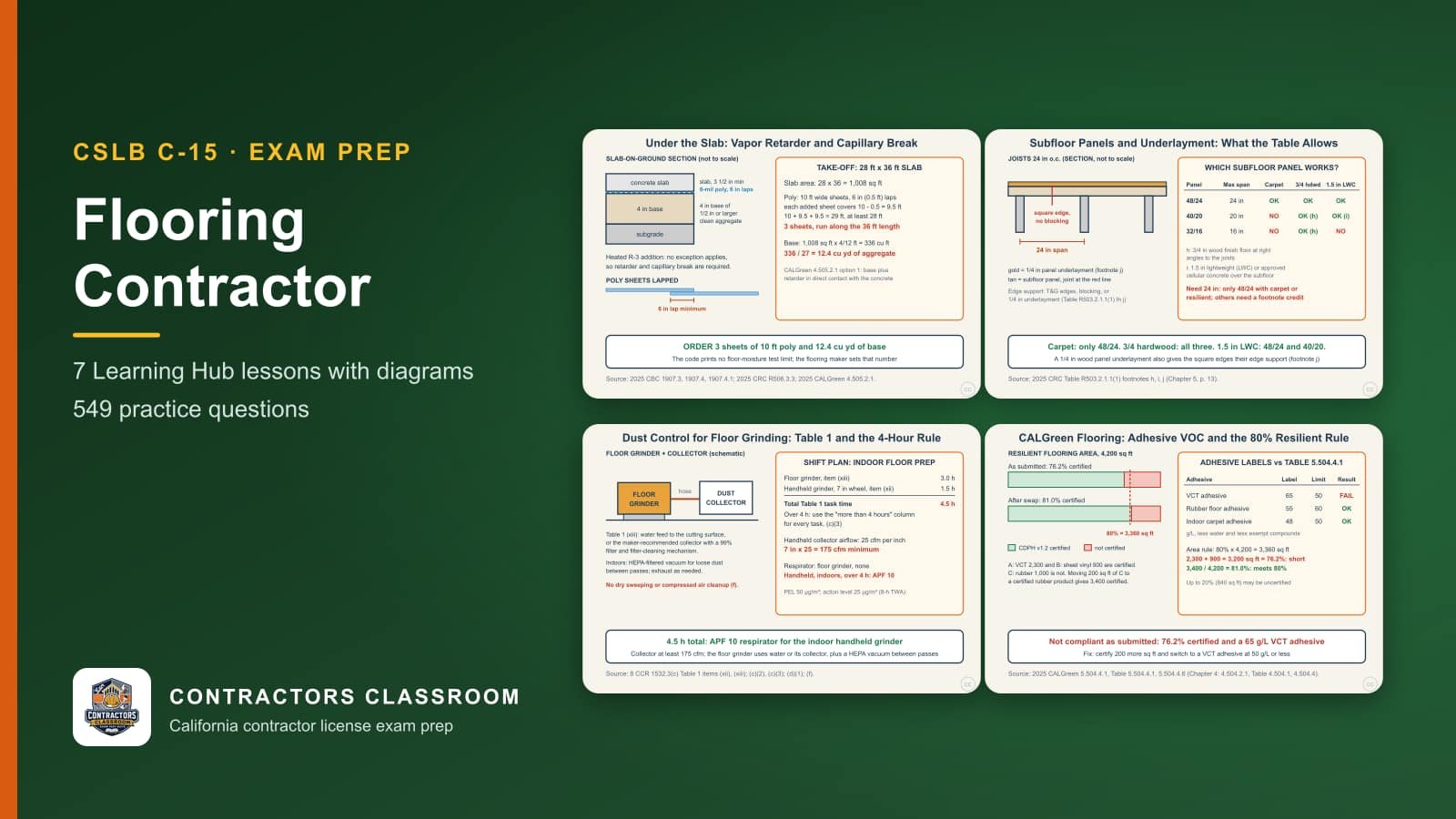
- Calcium chloride test
- A moisture test in which a dish of salt sits under a sealed dome on a concrete slab for a set period, and its weight gain shows how much vapor the slab emits. The result is an emission rate, which flooring makers compare against their limits.
- Relative humidity probe
- A sensor placed in a hole drilled partway into a slab to read the moisture inside the concrete rather than at its face. It is an alternative to surface tests, and flooring manufacturers state the reading they will accept.
- Moisture mitigation
- Treating a slab that is too damp for the chosen flooring, usually with a liquid barrier or other system, so vapor cannot damage adhesive or covering. It is a remedy applied after testing, not a substitute for testing, and the barrier maker's own conditions for slab dryness and surface profile still have to be met.
- Capillary break
- A bed of clean coarse aggregate beneath a slab that stops groundwater from wicking upward, working alongside the plastic vapor retarder. A flooring contractor cares because a slab built without them can keep sending moisture into flooring.
- Panel span rating
- A pair of numbers stamped on plywood or OSB, such as 32/16, indicating the widest rafter spacing and floor-joist spacing the panel suits. It decides whether a subfloor is stiff enough before a finish floor goes on.
- Critical radiant flux
- The flame-spread measurement for floor coverings, tested with a radiant panel and reported in watts per square centimeter. Results sort carpet and similar products into Class I or Class II, and the building type determines which class is needed where.
- Hang tag
- The label attached to floor-covering samples or rolls that names the manufacturer, style, and tested fire classification. Inspectors and owners look to it as proof that a carpet meets the required class for a corridor or stair.
- Breadth
- One strip of broadloom carpet cut from the roll to run the length of a room. The roll's width, not the room's area, controls how many breadths are required and where seams fall, so ordering is a layout problem first.
- Pattern repeat
- The distance after which a carpet's design starts over. Each breadth is cut long enough to slide the next one into register, so patterned carpet needs extra length, while plain carpet needs none.
- Tack strip
- A narrow wood strip studded with angled pins, fastened around a room's perimeter so stretched carpet can hook onto it. It sits a short distance from the wall to leave a channel where the carpet edge is tucked.
- Knee kicker
- A hand-positioned stretching tool with toothed head and padded end, struck with the knee to push carpet onto the tack strip. It is used with a power stretcher, which handles longer spans where a kicker cannot give enough tension.
- Seam sealer
- A liquid applied to cut carpet edges to stop fraying and lock the backing, or, on resilient sheet goods, a product that bonds the joint into a closed, waterproof line. Which kind a question means depends on the flooring family.
- Adhesive open time
- The window after spreading adhesive during which it is still ready to receive flooring. Setting too early traps solvent or moisture, while setting too late leaves a dried film that will not bond, so the product label's time and temperature matter.
- Trowel notch
- The shape and size of the teeth on a spreading trowel, which determine how much adhesive stays on the floor. Manufacturers specify the notch for each product, and a worn trowel quietly reduces coverage, which is why installers check the teeth and the transfer to the back of the flooring.
- Floor roller
- A heavy roller passed over resilient sheet goods and tile after setting to flatten the covering into the adhesive and push out air. Rolling in both directions and at proper timing is the standard way to seat a resilient floor.
- Expansion gap
- The deliberate space left between a floating or wood floor and walls or fixed objects, hidden by molding. Planks grow and shrink with humidity, and without room to move they push upward or open at the joints.
- Transition strip
- A trim piece that joins two floor surfaces at a doorway or change of material, covering the edge and managing height difference. Accessible routes limit how tall the step may be and require beveling beyond a small height.
- Walk-behind grinder
- A floor machine with diamond tooling used to level, clean, and profile concrete before coatings or flooring. It produces respirable silica, so it needs an integrated water feed or a dust collector, and the method used affects respirator requirements.
- Eighty percent rule
- The green building requirement that at least four-fifths of any area given a resilient finish use products certified for low emissions. It is counted by square footage, so a calculation using certified and uncertified areas is a typical question.