CSLB C-21

Building Moving and Demolition Contractor License Exam Prep (C-21)

Getting ready for the California building moving and demolition contractor license exam (CSLB C-21)? Study with 184 practice questions in 2 categories and 6 Learning Hub lessons, made for demolition and house-moving contractors, with the Law and Business exam included.

One-time purchase, no subscription. Law & Business included.

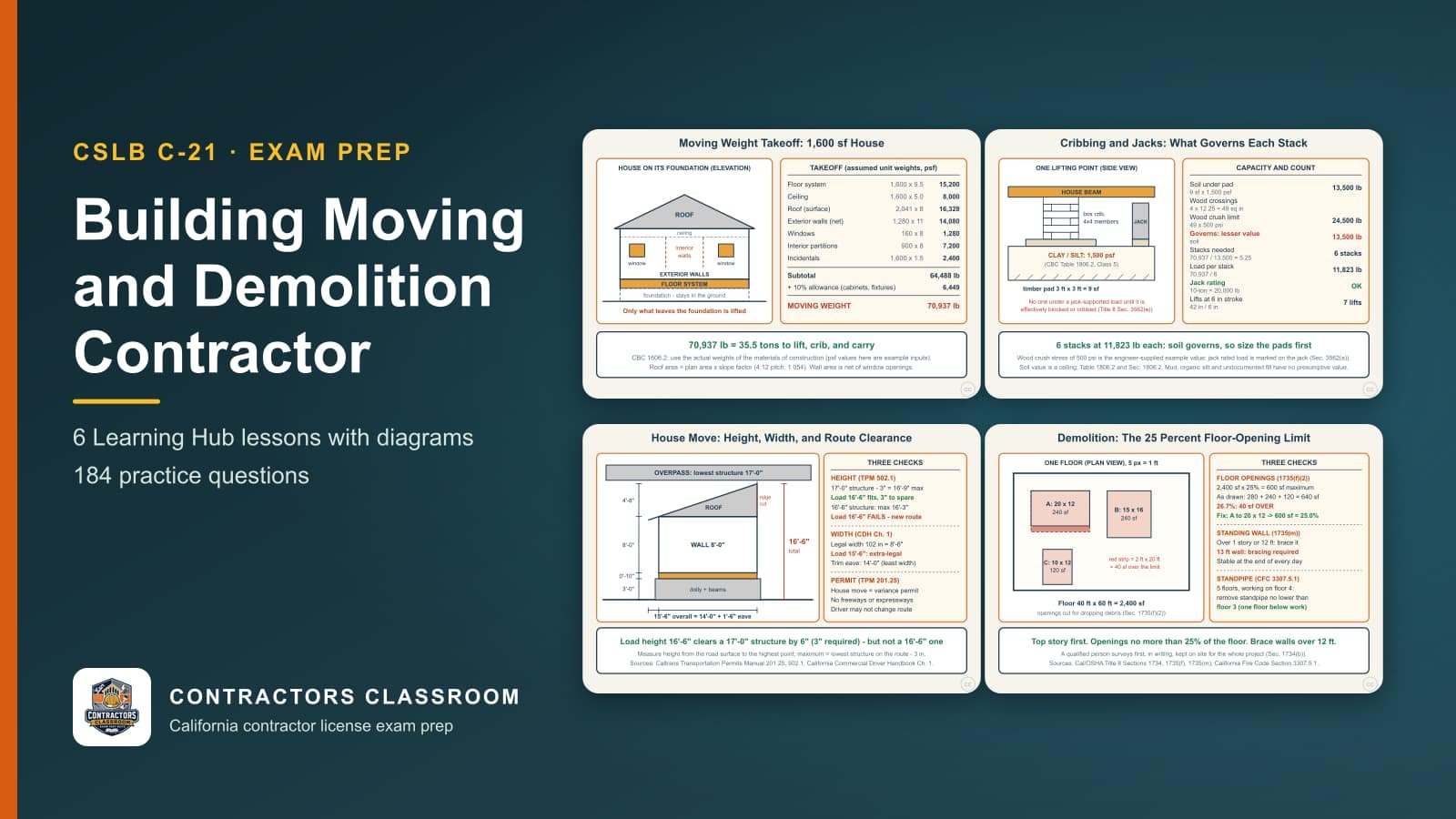
Diagrams from the C-21 building moving and demolition contractor lessons: Estimating the Weight of a House You Are Going to Move, Jacks, Cribbing, and Ground Bearing Under a Lifted House, House Moves: Height, Width, and Route Clearance and Demolition Order of Work: Survey, Utilities, Sequence, and the 25 Percent Rule
184practice questions
2categories
6Learning Hub lessons
$249Law & Business included

What the exam covers: Building Moving and Demolition (C-21)

The CSLB exam for the California building moving and demolition contractor license (C-21) is a closed-book, multiple-choice test. CSLB's official study guide divides it into five major sections and gives each an approximate weight: Planning and Estimating (about 25%), Project Preparation (about 20%), Building Moving (about 13%), Structure Demolition (about 21%), and Safety (about 21%).

Planning and Estimating carries the most weight, about 25%, so it deserves roughly that share of your study time, with Structure Demolition next at about 21%.

Contractors Classroom turns that outline into 184 practice questions in 2 categories (Planning and Estimating and Cal-OSHA Demolition Safety Orders (Article 31)), plus 6 Learning Hub lessons with diagrams (such as "Estimating the Weight of a House You Are Going to Move" and "Jacks, Cribbing, and Ground Bearing Under a Lifted House"). Law and Business, which most applicants take alongside their trade exam, is included at no extra charge.

Exam sections and approximate weights

  • Planning and Estimating~25%
  • Project Preparation~20%
  • Building Moving~13%
  • Structure Demolition~21%
  • Safety~21%

Practice question categories

  • Planning and Estimating75 practice questions
  • Cal-OSHA Demolition Safety Orders (Article 31)109 practice questions

What the Building Moving and Demolition Contractor exam covers, section by section

Planning and Estimating (~25%)

Demolition and building-moving work begins long before equipment arrives. The contractor studies drawings and reports to understand what is standing, what hazards are inside it, and whether the site is ready for crews and machinery. From there come decisions about methods and machines, followed by a cost estimate that accounts for labor, equipment, hauling, and disposal. Older buildings may hide fuel tanks, mechanical rooms, or sealed basements that change the plan, so walking the structure with the survey in hand is part of choosing excavators, grapples, and shears.

  • Reading drawings and specifications to understand the structure and scope of work
  • Reviewing survey reports on hazardous substances that must be handled before demolition proceeds
  • Checking access, utilities, and neighboring structures to confirm safe working conditions
  • Choosing the sequence, machinery, and tools that suit the structure and its surroundings
  • Pricing labor, equipment, hauling, and disposal so the bid covers the whole project

Project Preparation (~20%)

Preparation turns a plan into a site that is ready to work. An applicant needs to understand the approvals and notices that come before demolition begins, then bring crews, machines, and supplies to the property in an orderly way. Salvage and recycling goals shape how materials are separated later, and any hazardous materials must be taken out in a controlled manner so that demolition does not spread contamination. Silt fencing, water trucks for dust, and haul routes that avoid soft ground are put in place so heavy equipment can work without trouble.

  • Obtaining permits and giving required notices to agencies and neighbors before work starts
  • Scheduling crews and delivering machines, tools, and supplies so work proceeds without delays
  • Setting up plans to salvage, sort, and divert reusable or recyclable material from landfills
  • Taking out dangerous substances in a controlled way before general demolition begins

Building Moving (~13%)

Relocating a whole structure is a different discipline from knocking one down. The mover first prepares the building, disconnecting it from utilities and foundation, and then works out how heavy and how sound it is, because a weak frame can fail when lifted. Jacks, cribbing, and beams raise and lower the building, and dollies or trailers carry it along a planned route. Beams are threaded under the floor frame, and the structure is lifted in small increments so cribbing stacks can follow it up and the frame stays level.

  • Disconnecting services and getting the structure and its route ready to travel
  • Estimating load and judging whether framing can survive lifting and transport stresses
  • Using jacks, cribbing, and steel beams to lift, shift, and set a building down level
  • Supporting the structure on carriers and guiding it along the path under careful control

Structure Demolition (~21%)

Tearing a building down safely depends on order and control. Crews first isolate utilities, protect surroundings, and set up barriers. Small houses and taller buildings call for different approaches, since height changes how debris falls and how walls are brought down. As the structure comes apart, materials are sorted, hauled off, and the lot is cleaned up and filled so the ground is left stable. Long-reach excavators and hydraulic shears often take the upper floors first, with water sprayed to hold down dust, while the foundation and slabs are broken out last.

  • Disconnecting utilities, fencing the area, and protecting neighbors before the first wall comes down
  • Bringing down low and tall buildings in a controlled order that manages falling debris and stability
  • Sorting concrete, wood, metal, and other debris into streams suited for recycling or disposal
  • Loading debris and hauling it away without leaving mess on roads or neighbors
  • Raking the site clean, filling voids, and compacting soil so the lot is left stable

Safety (~21%)

Demolition combines falling masonry, unstable floors, dust, noise, heavy machines, and traffic, so safety planning covers both the crew and everyone beyond the fence. Workers need to recognize site hazards, look out for one another, and keep roads and pedestrians protected where trucks enter and leave. Protective equipment ties it all together, matched to the dust, debris, and sound levels of the task at hand. Spotters stay out of the swing radius of machines, and exclusion zones keep everyone clear of any wall that could fall.

  • Spotting structural, electrical, and falling-object hazards while keeping work areas orderly
  • Training and supervising crews, watching for fatigue, and reacting when conditions change
  • Directing trucks and public traffic around the site with signs, flaggers, and clear routes
  • Matching hard hats, respirators, hearing protection, and footwear to the hazards of each task

Code books behind the Building Moving and Demolition Contractor exam

The exam outline published for this trade lists these references.

  • 2025 California Building CodeTwo parts of the Building Code matter most here. The construction safeguards chapter sets pedestrian protection, barriers and covered walkways before demolition begins, and the structural loads and soils provisions explain actual material weights and presumptive ground bearing. It feeds Structure Demolition, Project Preparation and the weight and structural integrity topics in Building Moving.
  • 2025 California Green Building Standards CodeThe green code requires projects to recycle or salvage a stated share of nonhazardous construction and demolition waste, to keep a waste management plan, and to document the diversion by weight or volume. It is the reference behind Developing recycling plans in Project Preparation and the material separation topics in Structure Demolition.
  • California Commercial Driver HandbookThe driver handbook covers legal vehicle and load dimensions, axle and gross weight, air brakes, load securement, pre-trip checks, mountain driving and hazards on the road. A demolition or house-moving contractor draws on it for the transportation items, mainly Building Support and Transportation and Transporting materials and debris.
  • California Vehicle CodeThe Vehicle Code sets the maximum width, height, length and gross weight of vehicles and loads, and explains when a special transportation authorization is needed for anything larger. It governs how debris trucks are loaded and how a structure rides on public roads, feeding the transportation and traffic control topics in Building Moving and Safety.
  • NDA Demolition Safety ManualThis industry manual explains how experienced demolition firms organize work: surveying a structure, shutting down utilities, choosing mechanical or manual methods, sequencing removal, handling hazards and keeping the public safe. It is the practical reference behind Structure Demolition and Safety, and behind the job method choices in Planning and Estimating.
  • State of California Construction & Electrical Safety Orders (Cal/OSHA)The construction safety orders include a dedicated demolition article covering the written survey, utility shutoff, floor openings, wall bracing, chutes and protection of workers below. They also address jacks, cribbing and hazardous substances. This is the reference for the Safety section and much of Structure Demolition and Building Moving.
  • Storm Water ProgramThe state water board's program explains how sites keep sediment, concrete wash, fuel and debris out of storm drains and waterways. For demolition and moving sites it informs erosion and sediment controls, stockpile and washout practices, and cleaning and backfilling the lot. It supports Project Preparation and the site cleanup topics in Structure Demolition.
  • Transportation Permits ManualThis state highway manual describes how oversize and overweight moves are authorized, how dimensions are reduced to their least size, vertical clearance to structures, signing, escorts, daylight and weather limits, and special rules for moving buildings. It is the reference behind Permitting and notification and the route and transportation topics in Building Moving.

Key terms for the Building Moving and Demolition Contractor exam

Pre-demolition survey
A written evaluation, made before workers start by a qualified person, of how sound the structure's frame is and whether any adjoining building could be affected. It looks for the chance of unplanned collapse, and its findings drive shoring, sequence and what must be corrected before the first cut.
Hazardous materials survey
An inventory of materials such as asbestos insulation, lead paint, fuel tanks and chemical residue found in a building. It is reviewed while the job is being priced and its materials are removed or controlled first, under their own rules, before general demolition.
Demolition shear
A hydraulic jaw attachment on an excavator that cuts steel beams, pipe and rebar. It lets crews dismantle a frame from a distance, reduces torch work and is chosen when the structure includes heavy steel members.
Grapple attachment
A clawed attachment for an excavator or loader used to pick, sort and load demolition debris. It makes separation of wood, metal and concrete practical on site and helps load trucks without hand labor.
Free-standing wall
A tall wall left unsupported after floors and roof have been removed. Beyond a set height it needs lateral bracing unless an engineer shows it can stand alone, and it has to be stable whenever the crew goes home for the day.
Standpipe
A vertical fire-service water pipe inside a building. During demolition it stays usable by firefighters and may be taken down with the structure, but only a limited number of floors below the level being removed.
Covered walkway
A protected sidewalk passage under a canopy built to carry a stated live load, with minimum width, clear height and lighting. It is one of several levels of pedestrian protection, selected from the work's height and how close it sits to the property boundary.
Debris chute
An enclosed inclined tube that drops waste from upper floors to a container below. Openings that are loaded by equipment need bumpers, and steep chutes need to be fully enclosed so material cannot leave the intended path.
Debris landing area
The ground zone where material falls through floor openings or chutes. It is fenced or barricaded back from the edge of the opening above, marked with warnings at every floor and kept free of people.
Waste management plan
A written plan listing which materials will be diverted from landfill, whether they are sorted on site or mixed, which facilities will accept them and how waste will be reduced. Its tickets prove the diversion percentage.
Diversion rate
The share of nonhazardous waste, counted in one consistent unit, that is recycled or salvaged rather than landfilled. A code threshold applies unless a stricter local ordinance sets a higher one, and excavated soil is treated separately.
Deconstruction
Taking a building apart in careful stages to recover reusable fixtures, lumber, metals and masonry rather than crushing everything. It takes more labor than mechanical demolition but raises salvage value and diversion.
Needle beam
A heavy steel beam passed through openings cut in the foundation or floor system to carry a building during raising and moving. Together with the main beams it spreads the structure's weight to the jacks and dollies.
Moving dolly
A wheeled carriage set under the support beams so a lifted structure can roll to the truck or onto the route. Its capacity must exceed the load on it, and the whole assembly adds to the height of the move.
Cribbing
Stacks of timber laid in alternating layers to hold a lifted load while people work beneath. The jack does the lifting; the stack carries the load and is only as strong as its crossings and the ground below.
Lifting point
A planned location where a jack and beam attach to the structure. Splitting the building's weight evenly among these locations gives each jack and stack its share of the weight, and that share has to stay below the rating marked on the jack.
Presumptive bearing value
A code-listed safe pressure a given soil type can carry without a special study, expressed in pounds per square foot. It is a ceiling, and very soft or undocumented fill gets no presumptive value, which governs how large cribbing pads must be.
Oversize load
A vehicle and cargo wider, taller or longer than the standard legal limits. A house on dollies is one, so it moves only on an authorized route, with warning signs, escorts as required, and within daylight and visibility limits.
Least dimension
The smallest size a load can be reduced to before being moved. Authorizations are issued for that reduced size, so roof overhangs, chimneys and projections are cut or removed first, and the true widest point is then measured.
Abrasive cut-off saw
A gas or electric saw with a spinning abrasive wheel for cutting steel beams and pipe. It throws sparks and fragments, so it calls for a face shield and gloves, and brings fire risk wherever flammable debris is present.

Where to spend practice time for the Building Moving and Demolition Contractor exam

  • Surveys, methods and tonnage estimatesPlanning and Estimating is about 25 percent of the exam, the largest slice. Practice reading a hazardous materials survey, selecting machines such as shears and grapples for a given structure, and turning floor area and a pounds-per-square-foot rate into tons of debris. Then convert tons into truckloads, rounding up, and think through access, utilities and neighbors that change the method.
  • Notification, mobilization and recycling plansProject Preparation is about 20 percent and links paperwork to field readiness: notifications, mobilizing labor and equipment, developing recycling plans and removing hazardous materials. Practice the order of these steps, what a waste management plan must contain, how diversion is calculated in a single unit, and which materials are handled separately from the general waste stream.
  • Demolition sequence and structural stabilityStructure Demolition is about 21 percent and covers site preparation, single and multi-story removal, material separation, hauling and backfilling. Rehearse the top-down order, limits on floor openings, wall bracing, handling of utilities and standpipes, and how loads stored on weakened floors are controlled. Sketch a sequence for a two-story frame building from survey to final backfill.
  • Protecting the public and the crewSafety is about 21 percent and includes job site safety, personnel safety, traffic controls and protective gear. Practice choosing the level of sidewalk protection from work height and distance to the lot line, recalling canopy and chute requirements, matching protective equipment to tools such as cut-off saws, and setting traffic control where trucks enter and leave.
  • Weight, jacks, cribbing and ground bearingBuilding Moving is about 13 percent, but its calculations chain together. Practice totaling a house's moving weight from material weights, dividing by lifting points, comparing the load to jack ratings, then checking ground pressure under each pad and wood crushing at crossings. The weaker of the two limits sets how many stacks you need and how many lift cycles the job takes.
  • Route clearances and transport rulesMoving a building depends on the road as much as the jacks. Practice stacking up total height from the pavement, subtracting required clearance from the lowest overhead structure, and measuring the true widest point. Review the signs, daylight and visibility rules for oversize loads, why wind can force a postponement, and how weight limits convert debris tons into whole truck trips.

Scenarios to talk through before the Building Moving and Demolition Contractor exam

  • The survey flags a weak floorA written survey of a two-story frame building notes a sagging second floor and a cracked chimney. Before anyone cuts or removes anything, what must be corrected, who decides, and how does this change the sequence, the machines you choose and the way you keep checking the structure as work proceeds?
  • Wrapped pipes nobody reportedWhile walking an older building with the hazardous materials survey in hand, you find wrapped pipes and ducts that the report did not mention. Think about who is notified, what stops, how the job plan and price change, and what must be finished before general demolition may begin.
  • Sidewalk beside a tall jobThe building to be demolished sits close to a busy sidewalk and the lot line. How do you decide between rails, a barrier, or a barrier with a covered walkway, what must the canopy provide, and when must this protection be in place relative to the first cut?
  • Dropping debris from upper floorsThe crew wants to open holes in the third floor and let debris fall to a landing area rather than rent an enclosed chute. What limits apply to the openings, how would the landing area be controlled and signed, and which alternatives would you weigh for steep or long drops?
  • A tall brick wall at day's endAfter the roof and floors are gone, one tall masonry wall remains standing alone as the shift ends and wind is picking up. Consider the bracing options, who might confirm the wall can stand unsupported, what the crew must leave stable, and what you would check on arriving the next morning.
  • Recycling goal on a small houseThe owner wants most of a demolished house kept out of the landfill. Discuss how you would build a waste management plan, whether to count by weight or volume, what separate handling is needed for hazardous items, and how you would document the diversion afterward for the building department.
  • Lifting a house onto beamsA single-story house is about to be raised onto needle beams, and the engineer's weight number is higher than your own quick estimate. Think through the lifting points, jack ratings, cribbing stacks and the soil under the pads. Which is likely to limit the lift, and why must anyone working below wait?
  • A route with a low bridgeA moved house on dollies must cross a bridge with posted clearance on its planned route. Walk through how the total height is stacked up, which reduction steps come first, what clearance margin the authorizing agency expects, and what other limits such as signs, daylight and wind could change your schedule.

Learning Hub lessons

Each lesson has guided steps, a diagram, a worked example and a quick check inside the classroom.

Preview the lesson diagrams

  1. Estimating the Weight of a House You Are Going to MoveSteps: Why the Weight Number Comes First; The Code Rule: Use Actual Weights; Count Only What Leaves the Foundation; Measure the Right Area for Each Assembly; Add What the Table Misses, Then Convert to Tons
  2. Jacks, Cribbing, and Ground Bearing Under a Lifted HouseSteps: Jacks Lift, Cribbing Holds; Turn the House Weight into a Point Load; The Ground Under the Pad Usually Governs; Check the Wood at the Crossings; Take the Lesser Value, Then Count the Stacks
  3. House Moves: Height, Width, and Route ClearanceSteps: Know the Legal Limits You Are Exceeding; A House Move Is a Variance Permit; Permits Are Written for the Least Dimension; Stack Up the Height from the Road Surface; Apply the 3-Inch Rule, Then Check Signs and Weather
  4. Demolition Order of Work: Survey, Utilities, Sequence, and the 25 Percent RuleSteps: The Written Survey Comes Before Any Worker Starts; Utilities, Chemicals, and Asbestos Are Handled First; Fix What the Survey Found Before You Cut; Work Top Down and Keep Floor Openings Small; Brace Tall Walls and Protect the Standpipe
  5. Protecting the Public and Workers Below: Table 3306.1, Canopies, and Drop ZonesSteps: Pedestrian Protection Goes Up Before the First Cut; Reading Table 3306.1; What Each Type of Protection Must Be; Protect the People Working Below the Demolition; Chutes and Drop Zones
  6. Demolition Debris: Tons, the 65 Percent Diversion Rule, and TruckloadsSteps: Turn Floor Area into Tons of Debris; What the 65 Percent Rule Says; Count the Diversion by Weight, Not a Mix of Methods; The Waste Stream Reduction Alternative; Convert Tons to Truckloads Within the Weight Limit

See the classroom in action

Frequently asked questions

How do I get a California building moving and demolition contractor license?

A demolition contractor or house mover who wants to contract independently applies under C-21. CSLB generally requires documented journey-level experience, a bond, and passing scores on both the Law and Business exam and the C-21 exam. Rules change, so confirm them with CSLB.

What does the building moving and demolition contractor exam ask about planning and estimating?

Planning and Estimating is the heaviest part of the C-21 exam, at about 25%. Expect questions on reading drawings and specifications to understand the structure and scope of work, reviewing survey reports on hazardous substances that must be handled before demolition proceeds, and checking access, utilities, and neighboring structures to confirm safe working conditions. Next in weight come structure demolition (about 21%) and safety (about 21%).

What kinds of questions are on the building moving and demolition contractor exam?

The three sample questions in CSLB's C-21 study guide ask about what to do when wind makes a moved structure sway, the tonnage of debris from a demolition, and the protective gear for a cut-off saw on steel. Like every question on the exam, each has four choices and one best answer.

Which codes and books does the C-21 exam reference?

CSLB's C-21 study guide lists the 2025 California Building and Green Building Standards Codes (Title 24), the Cal/OSHA safety orders (Title 8), and trade references such as California Commercial Driver Handbook, California Vehicle Code, and NDA Demolition Safety Manual. Use them to study; the exam itself is closed-book.

Is the building moving and demolition contractor exam open book?

No. The C-21 study guide says no reference materials may be used, even though it names California Commercial Driver Handbook and California Vehicle Code among the books to study from. A calculator is provided, and guessing is not penalized.

Can I take the building moving and demolition contractor exam outside California?

CSLB's exam FAQ says trade exams are given in California or Oregon only, so C-21 is not offered in other states, although Law and Business can be taken out of state. Check the current PSI list when you schedule.

How are the 184 C-21 practice questions organized?

They are split into 2 categories, largest first: Cal-OSHA Demolition Safety Orders (Article 31) (109) and Planning and Estimating (75). Cal-OSHA Demolition Safety Orders (Article 31) holds about 59% of the questions. 6 Learning Hub lessons add diagrams and worked examples for the harder topics. The missed-question review collects every question you get wrong.

Is there a free trial for building moving and demolition contractor exam prep (C-21)?

Yes. The free C-21 preview opens the real classroom with no sign-up and gives you the first question from every C-21 category, including Cal-OSHA Demolition Safety Orders (Article 31) and Planning and Estimating, plus Law and Business. The full course is a one-time $249 purchase.

Is building moving and demolition contractor exam prep available in Spanish?

The website and the eight demo videos are available in Spanish. The classroom and the 184 C-21 practice questions are in English for now; translating the questions is not part of the course yet.

Ready to practice for real?

Try the real classroom free, no sign-up, or get the full course for your trade.

Independent exam preparation. Contractors Classroom is not affiliated with the Contractors State License Board, and no course can guarantee a passing result.


