CSLB C-23

Ornamental Metal Contractor License Exam Prep (C-23)

Getting ready for the California ornamental metal contractor license exam (CSLB C-23)? Study with 184 practice questions in 2 categories and 6 Learning Hub lessons, made for ornamental metal fabricators, with the Law and Business exam included.

One-time purchase, no subscription. Law & Business included.

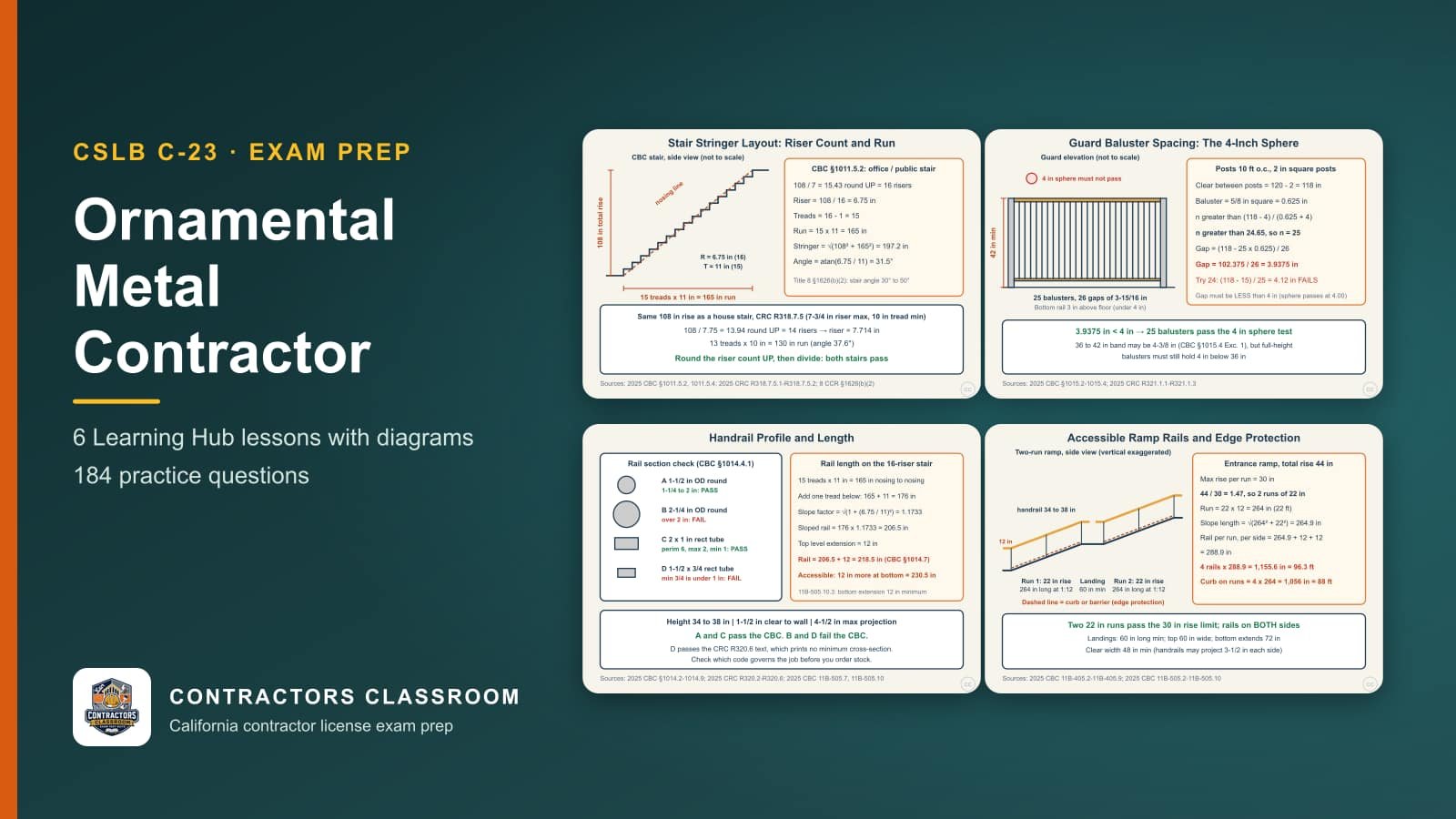
Diagrams from the C-23 ornamental metal contractor lessons: Stair Stringer Layout: Riser Count, Tread Run, and Uniformity, Guard Height and Baluster Spacing: The 4-Inch Sphere, Handrail Profile, Clearance, and Extensions and Accessible Ramp Rails: Rise, Landings, Extensions, and Edge Protection
184practice questions
2categories
6Learning Hub lessons
$249Law & Business included

What the exam covers: Ornamental Metal (C-23)

The CSLB exam for the California ornamental metal contractor license (C-23) is a closed-book, multiple-choice test. CSLB's official study guide divides it into five major sections and gives each an approximate weight: Planning and Estimating (about 23%), Fabrication (about 21%), Installation (about 20%), Finishes and Repairs (about 14%), and Safety (about 22%).

Planning and Estimating carries the most weight, about 23%, so it deserves roughly that share of your study time, with Safety next at about 22%.

Contractors Classroom turns that outline into 184 practice questions in 2 categories (Planning and Estimating and Cal-OSHA Hot Work & Welding Safety), plus 6 Learning Hub lessons with diagrams (such as "Stair Stringer Layout: Riser Count, Tread Run, and Uniformity" and "Guard Height and Baluster Spacing: The 4-Inch Sphere"). Law and Business, which most applicants take alongside their trade exam, is included at no extra charge.

Exam sections and approximate weights

  • Planning and Estimating~23%
  • Fabrication~21%
  • Installation~20%
  • Finishes and Repairs~14%
  • Safety~22%

Practice question categories

  • Planning and Estimating75 practice questions
  • Cal-OSHA Hot Work & Welding Safety109 practice questions

What the Ornamental Metal Contractor exam covers, section by section

Planning and Estimating (~23%)

Ornamental metalwork starts with understanding what the customer or designer wants and what the location allows. The contractor reviews drawings and requirements, develops or refines a design for railings, gates, or stairs, and visits the site to check conditions that could affect fit or installation. Material lists, cut sheets, and a cost calculation follow so fabrication can begin with fewer surprises. Details such as post spacing, picket gaps, and handrail height get sketched or modeled, and a field measurement of the opening or stair run prevents expensive shop rework.

  • Going over drawings, owner wishes, and written requirements to understand what must be built
  • Developing designs for gates, railings, and similar pieces that balance appearance, strength, and function
  • Examining access, existing structures, and ground conditions that may affect fit or installation
  • Ordering stock, preparing cut lists, and setting up the shop for efficient production
  • Totaling material, labor, finish, and delivery expenses into a price that covers the work

Fabrication (~21%)

In the shop, raw bar, tube, and plate become finished components. Metal is cut to length and shape, jigs hold parts in position so repeated pieces match, and bending, rolling, or hammering gives the product its curves and details. Parts are then joined by welding or with fasteners. Good fabrication relies on accurate layout and controlled heat, since warping and weak joints are hard to correct afterward. Clamps, tack welds, and layout tables hold scrolls and pickets square before final welds are run, and grinding then smooths the joints so the finish will sit evenly.

  • Using saws, shears, torches, or other cutting tools to produce clean, accurate pieces from stock
  • Making fixtures that hold parts square and repeatable while they are assembled
  • Bending, rolling, and shaping metal into scrolls, arcs, and other decorative forms
  • Joining components by welding, bolting, or riveting while keeping heat distortion under control

Installation (~20%)

Installation moves the work from shop to site, where nothing is quite as drawn. Posts are set into dug holes or anchored to existing surfaces, and the panels, rails, and gates that hang from them must end up plumb, level, and secure. Stair components bring added demands for even step height and spacing. Smaller items, such as trim pieces or accessories, round out the job and call for steady, careful fitting. Where digging is not practical, base plates are drilled and anchored into concrete with expansion or epoxy anchors, and shims fine-tune plumb before final tightening.

  • Digging holes for posts, then aligning and securing them in concrete or on existing structures
  • Hanging fence sections, mounting railings, and adjusting gates so they swing and latch correctly
  • Fastening stair stringers and treads so steps are even, solid, and comfortable to climb
  • Fitting extra items such as brackets, trim, and accessories that complete the finished installation

Finishes and Repairs (~14%)

A finish protects metal and gives it its final look, but only if the surface underneath is ready. Cleaning, grinding, and removing rust or mill scale come first, followed by primer, paint, powder coating, or another coating applied evenly. Over time, fences and railings suffer from weather, impact, and wear, so spotting cracks, loose joints, and damaged coatings and restoring them is a regular part of the work. Hot-dip galvanizing, powder coating, and paint systems each need their own surface prep, and touch-up of weld areas matters because bare steel rusts first at those spots.

  • Cleaning and smoothing metal surfaces, then applying primers and coatings that adhere and last
  • Looking over existing work for rust, cracks, and loose connections, then repairing and refinishing it

Safety (~22%)

Ornamental metalwork exposes people to sparks, fumes, hot metal, grinding dust, noise, and heavy awkward pieces. Personal safety covers eye and face protection, gloves, hearing and breathing protection, and sensible clothing. At job sites, crews also watch for trenches, overhead lines, bystanders, and uneven ground. Long, heavy items must be lifted, strapped, and hauled so they do not injure anyone or shift on the road. Welding screens protect nearby workers from arc flash, fire watches follow torch work, and spreader bars or lift straps help move long gates safely.

  • Wearing protective gear and following safe practices when welding, cutting, and grinding
  • Keeping installation sites orderly, marked off, and free of hazards from other work or the public
  • Lifting, securing, and driving long or heavy products so loads stay stable in transit

Code books behind the Ornamental Metal Contractor exam

The exam outline published for this trade lists these references.

  • 2025 California Building CodeThe building code supplies the rules that ornamental metal products must meet where they protect people: guard heights, opening limits, handrail shape and continuity, stair geometry, ramp rails, and the loads guards must resist. It is the main reference for the Installation section on fences, railings, gates and staircases, and for design-related questions in Planning and Estimating.
  • 2025 California Fire CodeThe fire code addresses fire department access and egress where ornamental metal is involved: gates across access roads, emergency opening provisions, key boxes, clearances and the way fences and gates may or may not obstruct exits. It supports the questions on gate installation and site conditions in Installation and the job-site evaluation part of planning.
  • AWS A3.0 Standard Welding Terms and DefinitionsThis glossary standardizes the language of welding: joint types, weld types, positions, discontinuities, processes and parts of a weld. It is useful because many exam questions use exact terms such as groove, fillet, root, toe or bead, and understanding them helps with the Fabrication section on welding and mechanical applications.
  • California Commercial Driver HandbookAlthough written for licensed truck drivers, this handbook teaches safe vehicle inspection, cargo securement, weight and balance, and load behavior on the road. An ornamental metal shop hauls long rails, gates and stair parts to job sites, so it feeds the loading and transporting material part of the Safety section.
  • California Vehicle CodeThe vehicle code covers legal limits for loads on public roads: width, length, overhang, projecting-load flags, securement and permit requirements for oversize loads. A fabricator delivering a long fence section or a full stair needs these limits, which is why the code is listed for the transporting items under Safety.
  • Modern WeldingA comprehensive textbook for welders that explains arc and gas processes, joint design, metal properties, blueprint and symbol reading, inspection and safe practice. For ornamental work it covers the cutting, forming and joining of steel, stainless and aluminum, so it is the general reference behind the Fabrication section and the welding portion of Safety.
  • State of California Construction & Electrical Safety Orders (Cal/OSHA)The construction safety orders include the rules for welding and cutting, fire watch, ventilation of fumes, gas cylinders, power tools, material handling and working on stairs and elevated surfaces. They feed the Safety section, about 22 percent of the exam, and the safe-practice items repeated within Fabrication and Installation.
  • Welding Handbook, Volume 2 - Part 1: Welding ProcessesThe engineering-level reference on arc welding processes explains shielded metal, gas metal, gas tungsten, flux-cored and related methods, along with equipment, shielding gases, filler metals, parameters and applications. It is the detailed source behind process-selection and equipment questions under Fabrication, and it clarifies why different metals are welded differently.

Key terms for the Ornamental Metal Contractor exam

Magnetic drill
A portable drilling machine with an electromagnetic base that clamps itself to steel, allowing clean, accurate holes in beams, plates and heavy tube at a job site. It is the preferred field tool for heavy-gauge steel because it needs no drill press.
Fabrication jig
A fixture that holds parts at their correct positions while they are tacked and welded, so identical pickets, panels or gate frames come out square and the same size. Building a jig carefully repays itself on repeat items.
Tack weld
A short, temporary weld that holds parts in alignment before the final welds are made. Tacks should be sound enough to stay in the finished joint, and their placement affects distortion and the order in which the weldment is finished.
Weld distortion
Warping, bowing or angular pull in metal caused by uneven heating and cooling around a weld. Thin tube and flat bar are especially prone, so sequencing welds, clamping and balancing heat on both sides are practical controls.
Gas metal arc welding
A process that feeds a continuous wire electrode through a gun while a shielding gas protects the pool. Often called MIG, it is fast and well suited to shop fabrication of railings and gates in mild steel.
Gas tungsten arc welding
A precise process using a non-consumable tungsten electrode and inert shielding gas, with filler added by hand. Often called TIG, it produces clean, finish-ready welds on stainless steel, aluminum and thin ornamental parts.
Shielding gas
The gas, such as argon or a mixture with carbon dioxide, that flows around the arc to keep air from contaminating the molten metal. The wrong gas or a draft that blows it away causes porosity and weak welds.
Pneumatic cutting chisel
An air-driven handheld tool that drives a chisel to cut sheet metal, rivets or bolts. Its bit should be inspected for cracks before each use, because a fractured chisel can break apart and send pieces at the operator.
Stair stringer
The inclined structural member, often a channel or plate, that supports treads and risers on a metal staircase. Its layout, built from total rise and run, must give identical steps and is attached to landings and floors.
Riser and tread
The vertical height and horizontal depth of each step. Uniformity from top to bottom is critical because people expect a consistent rhythm, and the code limits how much the dimensions may differ within a flight.
Baluster
A vertical infill member, such as a picket or bar, placed between posts or rails to keep openings small. Spacing is laid out so no opening exceeds the code limit, and equal spacing looks better than squeezing the last gap.
Four-inch sphere rule
The test that a four-inch ball must not pass through any opening in a guard, intended to stop a small child from slipping through. It drives picket spacing, and there are limited exceptions in specific places.
Graspable handrail
A rail whose profile the hand can wrap around, typically round or oval with a specified size range, so a person can grip and pull when losing balance. Flat bars and large shapes must meet alternate rules.
Post base plate
A steel plate welded to the bottom of a railing post and bolted or anchored to the slab or stair. Because guards must resist push loads at the top, the plate and its anchors resist overturning, not just hold the post upright.
Hot-dip galvanizing
A coating process that immerses cleaned steel in molten zinc, leaving a bonded layer that protects against rust, even at edges and holes. Fabrication details like vent holes and welded closures must allow zinc and air to flow.
Zinc-rich primer
A paint loaded with zinc dust, used to protect bare steel or to repair spots where galvanizing was burned off by welding or damaged in transit. It gives sacrificial protection but must be applied on a properly prepared surface.
Powder coating
A finish in which dry charged powder is sprayed on a grounded part and baked into a hard, uniform film. It resists chipping better than ordinary paint, but the metal needs proper cleaning and pretreatment for adhesion.
Abrasive blasting
Cleaning or profiling metal by propelling grit or shot at the surface to remove mill scale, rust and old coatings. It gives paint or powder a surface to grip, and it releases dust that calls for containment and respiratory control.
Bevel
An angled edge ground or cut on a piece of metal to leave room for weld metal to reach the root of a thick joint. Skipping the bevel gives a weld that sits on the surface rather than fusing through the thickness.

Where to spend practice time for the Ornamental Metal Contractor exam

  • Planning and cost math (23 percent)Planning and Estimating is the biggest block at about 23 percent and includes calculations. Practice linear footage times pounds per foot, adding material and shipping costs, counting pickets or balusters from run length and spacing, and totaling stringers, posts and hardware. Study how to read a drawing's gauges, tube sizes and finish notes before pricing.
  • Safety (22 percent) in a hot, heavy shopSafety is about 22 percent, and the practice categories lean toward welding, cutting and hot work. Review fire watch, fume control, cylinder handling, grinder and chisel inspection, hearing and eye protection, and moving long, heavy steel. Think of each tool and process and ask what injury it creates and what control prevents it.
  • Fabrication: cutting, forming, welding (21 percent)Fabrication covers cutting metals, building jigs, forming and welding or fastening. Compare cutting methods and when each suits thick or thin stock, how bending radii affect tubing, what jigs accomplish, and how welding processes differ for steel, stainless and aluminum. Practice spotting causes of distortion and porosity.
  • Installation: posts, rails, gates, stairs (20 percent)Installation spans digging post holes and setting posts, fences, railings and gates, and staircases with stringers and treads. Practice stair layout from total rise, handrail and guard height and clearance rules, the four-inch opening limit, post anchorage, and gate hardware. Sketch a flight and a rail run, labeling each dimension from memory.
  • Guard and handrail loadsStructural load rules for guards and handrails sit between design and installation topics and are easy to overlook. Learn the concept of a concentrated push at the top rail and a distributed load, and how those loads become forces at post bases. You do not need to design them; you need to know why base plates, bolt sizes and spacing matter.
  • Finishes and repairs (14 percent)Finishes and Repairs is the smallest section but includes concrete facts about coatings. Compare galvanizing, zinc-rich primer, paint and powder coat by where each is used, how the surface must be prepared, how damaged zinc is touched up, and what inspection looks for. Practice naming the defects of poor preparation, such as peeling and early rust.

Scenarios to talk through before the Ornamental Metal Contractor exam

  • Laying out a steel stairYou must fabricate a steel stair between two floors of a building. Talk through how you find the number of risers from the total height, how treads follow, how each step stays uniform, and what you check for headroom and handrail height. Which dimension errors would show up only after the stringers are already welded?
  • Decorative balcony guardA balcony guard design uses wide decorative scrolls between the posts. Consider the four-inch sphere rule, baluster spacing, the guard's required height, and how the post base plate must resist a push at the top. What would you adjust on the drawing, and which part of the design would you question before cutting any steel?
  • Drilling heavy steel in the fieldA plate has to be drilled at the site, far from the shop and with no drill press. Think about a magnetic drill, setup on clean steel, the cutting fluid, chip control and a pneumatic chisel for trimming. What would you inspect on each tool before use, and why does the condition of the chisel matter so much?
  • Welding rail near combustiblesA railing must be welded on a porch with wood decking and stored materials close by. Consider fire watch, removing or shielding combustibles, gas cylinder handling, ventilation of fumes and what protection the welder needs. What would you set up before the first tack, and how long would you stay on watch afterward?
  • Galvanized railing with burned spotsA galvanized railing arrives and, after fitting, welding at the posts burns away the zinc in several spots. Discuss surface preparation, zinc-rich primer, the finish that goes over it and how you inspect the repair. Which choices would you make differently next time when planning the order of finishing and welding?
  • Gate across an access roadA customer asks for a swinging steel gate across a private road that fire trucks may need. Reason through the fire code's access expectations, emergency opening provisions, clear width, hardware and how the gate could block egress. What would you ask the owner or the fire authority before fabricating it?
  • Delivering long railing sectionsPrefabricated railing sections are longer than your truck bed. Think about how they are stacked, padded and tied down, the flags or limits for a projecting load, the driver's pre-trip checks and how the sections will be unloaded. What could damage the finish in transit, and who is at risk during unloading?
  • Thin tube pulling out of squareA gate frame made from thin square tube keeps coming out twisted after welding. Compare how a jig, tack welds, welding sequence and the choice between wire and tungsten processes can reduce weld distortion. What would you change in the shop setup, and what would you measure before the frame leaves for finishing?

Learning Hub lessons

Each lesson has guided steps, a diagram, a worked example and a quick check inside the classroom.

Preview the lesson diagrams

  1. Stair Stringer Layout: Riser Count, Tread Run, and UniformitySteps: Layout Is Arithmetic, Not Guesswork; Pick the Riser and Tread Limits for the Building; Count Risers: Divide, Round Up, Divide Again; Keep Every Riser and Tread Uniform; Check Rise, Width, Headroom, and Angle
  2. Guard Height and Baluster Spacing: The 4-Inch SphereSteps: When a Guard Is Required; Guard Height; The 4-Inch Sphere and Its Exceptions; Lay Out Balusters Between Posts; Two Layout Traps
  3. Handrail Profile, Clearance, and ExtensionsSteps: Where Handrails Are Required; Height and Lateral Position; The Graspable Profile (Type I); Clearance, Continuity, and Brackets; Extensions at the Top and Bottom
  4. Accessible Ramp Rails: Rise, Landings, Extensions, and Edge ProtectionSteps: Slope and Rise Decide the Number of Runs; Landings Set the Rail Breaks; Handrails on Both Sides With 12-Inch Extensions; Edge Protection on the Open Sides; Takeoff: Rail Length per Run
  5. Guard and Handrail Loads: 200 lb, 50 plf, and the Post BaseSteps: What the Code Says a Guard Must Resist; Infill and the Exceptions; Turn Loads Into a Post-Base Moment; Turn the Moment Into Bolt Tension; Construction-Period Railings Have Their Own Test
  6. Caltrans Railing Steel: Galvanizing Schedule, Coating Check, and Tubular-Rail FitSteps: Where Sections 75 and 83 Apply; Pick the Galvanizing Specification; Prep and Hardware Rules; Check the Coating and Repair Damage; Tubular Railing Fit and Tolerances

See the classroom in action

Frequently asked questions

How do I get a California ornamental metal contractor license?

An ornamental ironworker or metal railing installer who wants to contract independently applies under C-23. CSLB generally requires documented journey-level experience, a bond, and passing scores on both the Law and Business exam and the C-23 exam. Rules change, so confirm them with CSLB.

What does the ornamental metal contractor exam ask about planning and estimating?

Planning and Estimating is the heaviest part of the C-23 exam, at about 23%. Expect questions on going over drawings, owner wishes, and written requirements to understand what must be built, developing designs for gates, railings, and similar pieces that balance appearance, strength, and function, and examining access, existing structures, and ground conditions that may affect fit or installation. Next in weight come safety (about 22%) and fabrication (about 21%).

What kinds of questions are on the ornamental metal contractor exam?

The three sample questions in CSLB's C-23 study guide ask about the preferred portable drill for heavy steel, the material cost of steel tubing including shipping, and why a pneumatic chisel is inspected before use. Like every question on the exam, each has four choices and one best answer.

Which codes and books does the C-23 exam reference?

CSLB's C-23 study guide lists the 2025 California Building and Fire Codes (Title 24), the Cal/OSHA safety orders (Title 8), and trade references such as AWS A3.0 Standard Welding Terms and Definitions, California Commercial Driver Handbook, and California Vehicle Code. Use them to study; the exam itself is closed-book.

Is the ornamental metal contractor exam open book?

No. The C-23 study guide says no reference materials may be used, even though it names AWS A3.0 Standard Welding Terms and Definitions and California Commercial Driver Handbook among the books to study from. A calculator is provided, and guessing is not penalized.

Can I take the ornamental metal contractor exam outside California?

CSLB's exam FAQ says trade exams are given in California or Oregon only, so C-23 is not offered in other states, although Law and Business can be taken out of state. Check the current PSI list when you schedule.

How are the 184 C-23 practice questions organized?

They are split into 2 categories, largest first: Cal-OSHA Hot Work & Welding Safety (109) and Planning and Estimating (75). Cal-OSHA Hot Work & Welding Safety holds about 59% of the questions. 6 Learning Hub lessons add diagrams and worked examples for the harder topics. The missed-question review collects every question you get wrong.

Is there a free trial for ornamental metal contractor exam prep (C-23)?

Yes. The free C-23 preview opens the real classroom with no sign-up and gives you the first question from every C-23 category, including Cal-OSHA Hot Work & Welding Safety and Planning and Estimating, plus Law and Business. The full course is a one-time $249 purchase.

Is ornamental metal contractor exam prep available in Spanish?

The website and the eight demo videos are available in Spanish. The classroom and the 184 C-23 practice questions are in English for now; translating the questions is not part of the course yet.

Ready to practice for real?

Try the real classroom free, no sign-up, or get the full course for your trade.

Independent exam preparation. Contractors Classroom is not affiliated with the Contractors State License Board, and no course can guarantee a passing result.


