CSLB C-43

Sheet Metal Contractor License Exam Prep (C-43)

Getting ready for the California sheet metal contractor license exam (CSLB C-43)? Study with 184 practice questions in 2 categories and 8 Learning Hub lessons, made for sheet metal workers, with the Law and Business exam included.

One-time purchase, no subscription. Law & Business included.

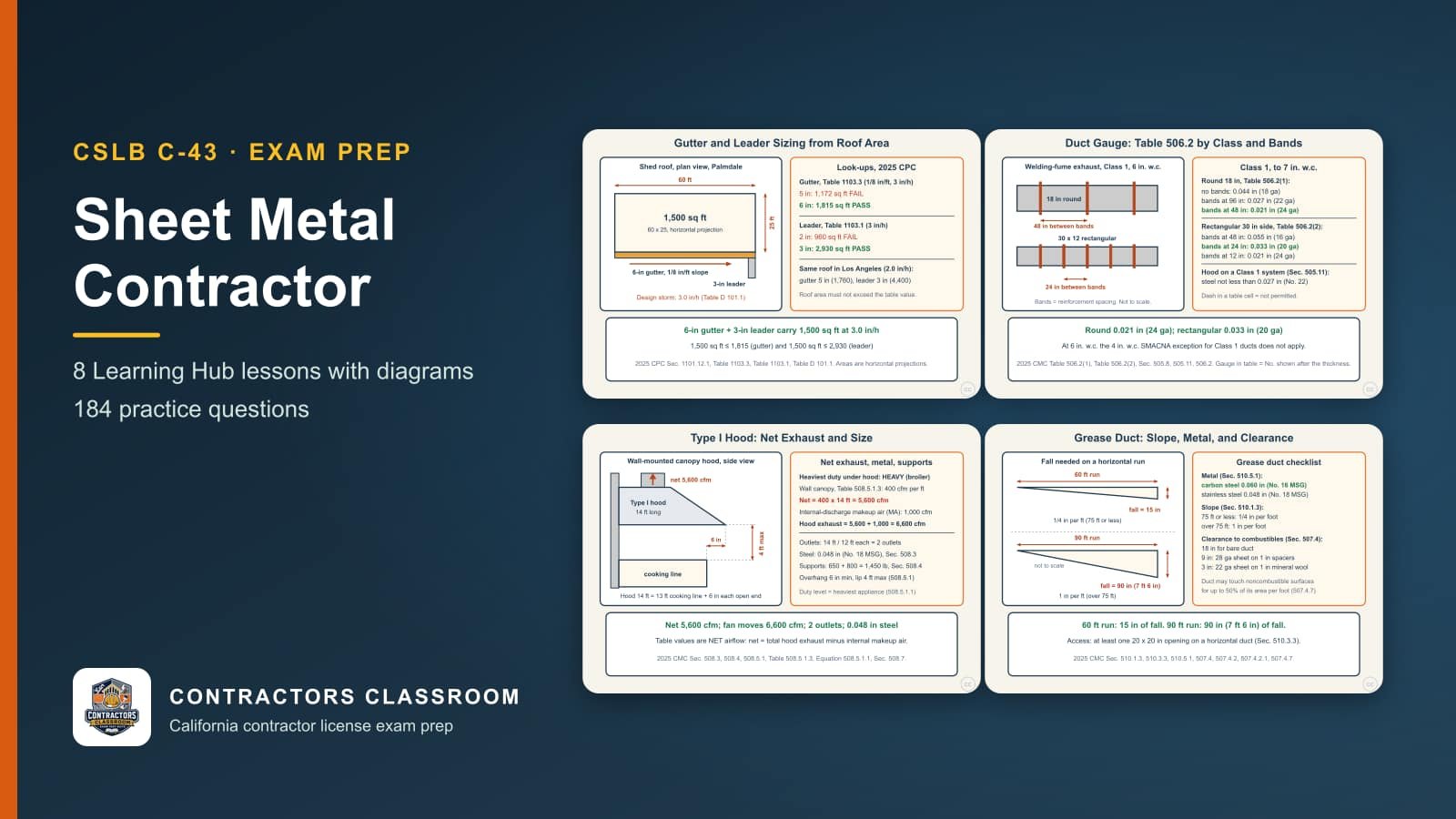
Diagrams from the C-43 sheet metal contractor lessons: Sizing Gutters and Leaders: CPC Tables 1103.3 and 1103.1, Product-Conveying Duct Gauge: CMC Tables 506.2(1) and 506.2(2), Type I Kitchen Hoods: Metal, Overhang, and Net Exhaust (CMC 508) and Grease Duct: Gauge, Slope, Access, and Clearance (CMC 510 and 507.4)
184practice questions
2categories
8Learning Hub lessons
$249Law & Business included

What the exam covers: Sheet Metal (C-43)

The CSLB exam for the California sheet metal contractor license (C-43) is a closed-book, multiple-choice test. CSLB's official study guide divides it into four major sections and gives each an approximate weight: Planning and Estimating (about 21%), Fabrication (about 23%), Installation (about 34%), and Safety (about 22%).

Installation carries the most weight, about 34%, so it deserves roughly that share of your study time, with Fabrication next at about 23%.

Contractors Classroom turns that outline into 184 practice questions in 2 categories (Planning and Estimating and Cal-OSHA Metal Shearing & Fall Safety), plus 8 Learning Hub lessons with diagrams (such as "Sizing Gutters and Leaders: CPC Tables 1103.3 and 1103.1" and "Product-Conveying Duct Gauge: CMC Tables 506.2(1) and 506.2(2)"). Law and Business, which most applicants take alongside their trade exam, is included at no extra charge.

Exam sections and approximate weights

  • Planning and Estimating~21%
  • Fabrication~23%
  • Installation~34%
  • Safety~22%

Practice question categories

  • Planning and Estimating75 practice questions
  • Cal-OSHA Metal Shearing & Fall Safety109 practice questions

What the Sheet Metal Contractor exam covers, section by section

Planning and Estimating (~21%)

Sheet metal projects start on paper. The plans reveal duct runs, flashing details, gauges and finishes, and a visit to the site shows access, clearances and conflicts the drawings may have missed. From there the contractor designs how pieces will be built and joined, then totals metal, fasteners, shop hours and installation labor into a cost that holds up when the work begins. Takeoffs usually separate galvanized, stainless and aluminum stock, since each carries a different price and workability. Allowances for scrap from cutting transitions, elbows and roof panels keep the bid from running short once the first sheets are sheared.

  • Reading drawings and specifications for metal type, gauge, finish and required details
  • Walking the site to check access, measurements and obstructions that affect fabrication
  • Working out how components will be formed, joined and supported to meet the intended function
  • Adding up material, shop time, installation labor and overhead into a reliable price

Fabrication (~23%)

In the shop, flat sheet becomes useful parts. Fabricators lay out dimensions on the metal, develop patterns for fittings with angles and curves, then cut, bend, roll and form pieces to those lines. Seams and joints are finished by welding, soldering or mechanical fastening, depending on the metal and the job. Accuracy at the layout stage saves hours of correction at the bench and in the field. Shears, brakes, slip rolls and plasma tables each suit particular thicknesses, so the choice of machine affects edge quality and speed. Burrs are removed and seams checked for squareness before parts leave the bench, because a slightly twisted elbow is hard to hang.

  • Developing patterns and marking dimensions so cut pieces fit together without rework
  • Cutting, bending, rolling and forming metal with shop machines and hand tools
  • Joining seams by welding, soldering or mechanical fastening suited to the metal and use

Installation (~34%)

Installation moves the shop's work onto the building, beginning with checking the surfaces, layout lines and support points. Gutters and downspouts must pitch toward outlets, flashings must direct water out over lower layers, and hoods must carry exhaust cleanly outside. Roof panels, siding and trim are fastened to allow for expansion. Specialty items, such as custom caps or architectural pieces, call for careful measuring and finishing on site. Sealant, rivets, hangers and straps are matched to the metal so dissimilar materials do not corrode each other at contact points. Roof penetrations, curbs and cap flashings are the places where careful lapping and sealing decide whether the building stays dry.

  • Verifying substrates, layout lines and supports before any piece is hung or fastened
  • Hanging gutters and downspouts with proper pitch so rainwater leaves the building
  • Setting flashings at roof edges, walls and openings so water sheds outward
  • Mounting exhaust hoods and ductwork that vent fumes, heat or grease safely
  • Fastening metal roofing, siding and panels, plus custom trim and one-off specialty pieces

Safety (~22%)

Sheet metal has sharp edges, heavy sheets and noisy, hot processes, so protection starts with the worker: gloves, eye and ear gear and correct lifting. Shops need guarded machines, orderly floors and ventilation when welding or soldering. Out in the field, the main concerns are heights and moving loads, which call for sound rigging, signals between crew and operator, and clear zones below any lift. Cuts come quickly from sheet edges, so hand protection and careful carrying through doorways and stairwells matter. Roof work adds wind catching large panels, which can pull a worker off balance, so panels are controlled with tag lines and never handled alone in gusts.

  • Wearing gloves, eye and hearing protection and lifting awkward sheets without injury
  • Guarding machines, ventilating welding fumes and keeping shop and site floors clear
  • Rigging heavy ducts and panels correctly and keeping people out from under suspended loads

Code books behind the Sheet Metal Contractor exam

The exam outline published for this trade lists these references.

  • 2025 California Mechanical CodeThe mechanical code is the rulebook behind a large part of Installation, the heaviest section at about 34 percent of the exam. For sheet metal it covers hoods and kitchen exhaust, grease duct construction and clearances, clothes dryer exhaust, the metal thickness of product-conveying ducts, and the way ductwork is supported and sealed. Expect lookups of thickness, length, slope, and clearance, plus questions about which system must stay separate from other ventilation, so it also supports the fabrication of hoods and ducts.
  • Architectural Sheet Metal ManualPublished by SMACNA, this manual is the trade's guide to weatherproof metalwork: gutters, downspouts, flashings, copings, roof edges, and metal roof and wall panels, with details on seams, expansion, fasteners, and compatible metals. It is the reference behind the gutters, flashings, and metal roofs and siding topics in Installation, and behind seam and joint choices in Fabrication, where the right fold or lap depends on the metal and on how much movement the assembly must absorb.
  • HVAC Duct Construction Standards - Metal and FlexibleThis SMACNA standard shows how sheet metal ductwork is built and supported: gauge by duct size and pressure class, reinforcement, joints and seams, hangers, and sealing. It is the reference behind duct fabrication and layout in Fabrication, hanger and support questions in Installation, and cost items in Planning and Estimating such as metal weight and fittings, and in recalling why heavier gauges and closer reinforcement are needed as ducts grow wider or operate under higher pressure.
  • State of California Construction & Electrical Safety Orders (Cal/OSHA)California's Title 8 safety regulations, printed with the General Industry volume, are the reference behind the Safety section, about 22 percent of the exam. For sheet metal shops they set guarding on shears and press brakes, safe-distance rules for safeguarding devices, material handling, hoisting and rigging, and protection when working on roofs and at height, including welding and soldering fumes, noise, and lifting sheet metal by hand or crane.

Key terms for the Sheet Metal Contractor exam

Stretch-out
The flat width of metal needed to form a profile, found by adding every face, bend, and return of the finished shape. It drives how many sheets a gutter or flashing run requires, which makes it central to both fabrication layout and material ordering.
Ogee gutter
A rain gutter whose face has a flowing S-shaped curve, common on older and residential buildings and sold by its nominal size. It is formed on a roll former or by hand and capped with end pieces fixed using a snap-lock punch. Nominal sizes such as five inches are common in exam problems.
Leader
The vertical pipe that carries roof water from a gutter down to grade or a drain, also called a downspout. Its size comes from the roof area it serves and local rainfall, and it may be aluminum, galvanized steel, or copper.
Projected roof area
The plan-view area of a roof plane, measured horizontally rather than along the slope. Gutter and leader tables are entered with this number, and a wall that drains onto the roof adds a share of its area.
Cornice brake
A bench machine with a long clamping bar and folding leaf that bends sheet metal into straight-sided shapes such as flashings, trim, and downspouts. It makes sharp, accurate folds along the full bar length, though it cannot make rolled shapes, and the candidate should know which seam types it suits.
Lock seam
A joint made by folding the edges of two metal pieces so they hook together and are then pressed flat. It is strong enough for a fabricated downspout and is chosen over a plain butt or lap joint where the seam must hold itself.
Standing seam
A raised, folded joint between metal roof panels that keeps fasteners out of the water path. It allows roofs of very low slope, and the panels are clipped so they can expand and contract without tearing.
Pattern development
Drawing the flat shape of a fitting, such as an elbow, transition, or cone, so it can be cut and rolled or folded into three dimensions. Careful development is what keeps a complex fitting from needing rework.
Sheet gauge
A numbering scheme for metal thickness in which a bigger number means thinner sheet, and the same number differs between steel, galvanized, and nonferrous metals. Code tables list required thickness in both inches and gauge.
Galvanic corrosion
Accelerated attack on one metal where it touches a different metal in the presence of water. Choosing compatible metals and fasteners, for instance for copper roofs or aluminum gutters, prevents early failure, which is why fastener material is specified to match the roofing.
Cricket
A small peaked piece of sheet metal built behind a chimney or wide roof penetration that sheds water around it. It prevents ponding on the high side, and wider penetrations call for one, covered in sheet metal with the joints properly flashed.
Product-conveying duct class
A grouping of exhaust ducts by what they carry, from light fumes and fine dust to heavy abrasive material. The class, along with negative pressure and reinforcement spacing, selects the minimum metal gauge.
Type I hood
A commercial kitchen hood over equipment that gives off grease and smoke. It must be built of heavy steel or stainless with liquid-tight seams, overhang the cooking surface, and exhaust a minimum airflow per foot set by the heaviest appliance below.
Net exhaust airflow
The air a hood actually removes from the room, equal to the total the hood pulls minus whatever replacement air is supplied from within the hood itself. The fan has to be sized for the net requirement plus internal makeup air.
Liquid-tight weld
A continuous external weld on every seam, joint, and collar of a grease duct or hood so no grease can leak out. Bolts, screws, and tack welds do not meet this standard, and the same welded construction applies to the duct-to-hood connection.
Clearance to combustibles
The air space between a hot duct and nearby wood or other burnable material. The distance depends on the material, and spaced noncombustible sheet metal or mineral wool can reduce it, provided the air gap and the thickness of the shield are kept as the code specifies.
Dryer transition duct
The short listed connector between the dryer and the fixed rigid exhaust duct. It is not a substitute for the rigid metal run, which must be smooth inside, free of screws that catch lint, and kept within a maximum length that shrinks when extra elbows are added.
Point of operation
The spot on a shear, press brake, or similar machine where the knives or dies work on the metal. Guards must keep hands out of that zone, with opening sizes that grow wider only as distance from it increases, and a guard that can be removed only with a tool.
Safety distance
The minimum spacing between a sensing or two-hand control device and a press brake's danger zone, calculated from how fast a hand moves and how long the machine takes to stop. As brakes wear, stopping time grows, so the required distance grows with it.

Where to spend practice time for the Sheet Metal Contractor exam

  • Installation breadth and metal roofsInstallation is the largest section at about 34 percent of the exam and spans gutters, downspouts, flashings, kitchen hoods, exhaust work, metal roofing, siding, and specialty items. Compare roof panel seam types and the minimum slope each tolerates, match fasteners to the metal, and sketch flashing at walls, valleys, and penetrations. Breadth matters here, so cycle through every topic.
  • Gutter and leader sizingDrainage questions reward arithmetic you can do from memory of the method. Practice finding projected roof area, adding a share for a wall that drains onto the roof, reading rainfall for the city, and choosing the smallest gutter diameter or leader size whose table value covers the area. Then revisit the permitted metals and the protection and cleanout rules.
  • Kitchen hoods, grease ducts, and dryer ventsThese exhaust systems combine thickness, length, slope, and clearance numbers, so they reward side-by-side comparison. Build a table of metal gauges for hoods versus grease ducts, the slope rules by run length, the access opening sizes, and the dryer duct length with its deduction for extra elbows. Include which systems must stay independent of other ventilation.
  • Layout, seams, and joining methodsFabrication is about 23 percent and covers layout and pattern production, processing metal, and welding, soldering, and mechanical assembly. Practice stretch-out calculations and how many sheets a run needs, then match each job to a seam, fastener, solder, or weld and name the machine that makes it. Review which metals take solder, which need welding, and which pairs cause galvanic trouble.
  • Machine guarding and hoistingSafety is about 22 percent and is one of the two practice categories in this course. Rehearse guard opening size versus distance for shears, the device types accepted on press brakes, the stopping-time formula for sensing devices, and what a daily check of treadle controls looks for. Add rigging basics: sling angles, load limits, and keeping people out from under suspended sheets.
  • Plans, metal quantities, and pricingPlanning and Estimating is about 21 percent and also forms one of the two practice categories. Practice reading ducts, flashings, gauges, and finishes from a drawing, tallying sheets by stock size after allowing for scrap, and separating metals that cost differently. Total shop hours, field labor, and materials into one price, and check the sheet-count math twice.

Scenarios to talk through before the Sheet Metal Contractor exam

  • Replacing the gutter on a shopA single roof plane drains to one gutter run on a shop. How do you get the projected roof area, which rainfall value is used, how does gutter slope affect the size, and how do you choose the leader? Which metals are accepted outdoors, and what do you plan for cleanouts?
  • Hood over a restaurant cooking lineA restaurant line holds fryers, a griddle, and an under-fired broiler beneath one wall-mounted canopy hood. Which appliance sets the duty level, how far must the canopy overhang, and how do you turn the table values into net exhaust? What does the label need to state, and how is makeup air counted?
  • Routing a grease duct past wood framingA kitchen exhaust duct must leave the hood, run horizontally, and rise outside a building with wood joists nearby. How do metal thickness, weld type, slope, drains, and access openings change with run length? What clearance to combustibles applies, how could it be reduced, and why must the system stay independent?
  • Venting a dryer in a laundry closetA laundry closet leaves only a winding path to the outside wall. How do you count the equivalent run when elbows are added, what happens when the layout is too long, and what limits the transition duct? Where may the exhaust end, which damper is used, and why are screws inside the duct a problem?
  • Quoting a low-slope metal roofOn a gently pitched building, the owner asks for the cheapest lapped metal roof available. Compare seam types against slope, decide whether a sealant or a standing seam changes the answer, and match fasteners to the metal. How would galvanic corrosion and crickets enter the discussion, and how would you plan hoisting panels safely to the roof?
  • Fabricating a transition fittingThe shop must build a transition between a round and a rectangular exhaust duct for light fumes. How do you pick duct class and gauge, develop the pattern, and choose between welding, soldering, and mechanical seams? How many sheets does the run need after allowing for scrap, and how does stretch-out figure in?
  • Inspecting a squaring shearBefore the shift, a lead hand inspects the squaring shear. Which part is the point of operation, how do guard height and opening size relate to distance, and what makes a guard acceptable? Think about the treadle, the return spring, who is exposed, and what to do if a guard has been removed.
  • Fitting a light curtain to a press brakeA shop adds a light curtain to a press brake. What do you need to measure before choosing the mounting distance, why does the answer change as brakes wear, and what device checks stopping performance? Which other safeguarding devices are accepted, and which machines cannot use a presence-sensing device?

Learning Hub lessons

Each lesson has guided steps, a diagram, a worked example and a quick check inside the classroom.

Preview the lesson diagrams

  1. Sizing Gutters and Leaders: CPC Tables 1103.3 and 1103.1Steps: Size by Storm and Roof Area, Not by Habit; Measure the Projected Roof Area; Pick the Gutter from Table 1103.3; Pick the Leader from Table 1103.1; Metal, Protection, and Cleanouts
  2. Product-Conveying Duct Gauge: CMC Tables 506.2(1) and 506.2(2)Steps: Classify the Duct First; Read Round Duct Gauge in Table 506.2(1); Read Rectangular Duct Gauge in Table 506.2(2); Know When the Table Does Not Apply, and the Add-Ons; Hoods Have Their Own Thickness
  3. Type I Kitchen Hoods: Metal, Overhang, and Net Exhaust (CMC 508)Steps: Where a Type I Hood Is Required; Build It: Metal, Welds, and Supports; Size the Canopy: Overhang and Height; Pick the Duty Level and Read the Table; Net Exhaust, Outlets, and the Label
  4. Grease Duct: Gauge, Slope, Access, and Clearance (CMC 510 and 507.4)Steps: A Grease Duct Stands Alone; Metal and Welds; Slope, Drains, and No Traps; Access Openings and Supports; Clearance to Combustibles and Enclosures
  5. Clothes Dryer Exhaust Duct: Length, Elbows, and Metal (CMC 504.4)Steps: Rigid Metal, Smooth, No Lint Catchers; Size and Metal Thickness; The Length Limit and the Elbow Deduction; Termination, Transition Duct, and Makeup Air; Common Exhaust and Multistory Risers
  6. Metal Roof Panels: Minimum Slope, Materials, and Fasteners (CBC 1507.4)Steps: Which Code Section Applies; Minimum Slope Depends on the Seam; Material Standards: Table 1507.4.3; Fasteners: Match the Metal; Flashing, Crickets, and Metal Shingle Valleys
  7. Metal Shear Guarding: the 3/8-Inch Rule and Table G-3 (8 CCR 4227, 4186)Steps: Why the Shear Is Guarded at the Point of Operation; Metal Shears: Section 4227; Table G-3: Opening Size Grows with Distance; What a Good Guard Looks Like; Controls, Sharpness, and Repairs
  8. Press Brake Safeguarding: Safety Distance Ds = 63 x Ts (8 CCR 4214, 4208)Steps: What the Press Brake Orders Cover; The Devices Section 4214 Allows; The Safety Distance Formula; Rules for Presence-Sensing Devices; Stopping Time Changes, So the Distance Changes

See the classroom in action

Frequently asked questions

How do I get a California sheet metal contractor license?

A sheet metal worker or ductwork installer who wants to contract independently applies under C-43. CSLB generally requires documented journey-level experience, a bond, and passing scores on both the Law and Business exam and the C-43 exam. Rules change, so confirm them with CSLB.

What does the sheet metal contractor exam ask about installation?

Installation is the heaviest part of the C-43 exam, at about 34%. Expect questions on verifying substrates, layout lines and supports before any piece is hung or fastened, hanging gutters and downspouts with proper pitch so rainwater leaves the building, and setting flashings at roof edges, walls and openings so water sheds outward. Next in weight come fabrication (about 23%) and safety (about 22%).

What kinds of questions are on the sheet metal contractor exam?

The three sample questions in CSLB's C-43 study guide ask about how many metal sheets a run of gutter takes, which tool attaches a gutter end cap, and which seam suits a downspout. Like every question on the exam, each has four choices and one best answer.

Which codes and books does the C-43 exam reference?

CSLB's C-43 study guide lists the 2025 California Mechanical Code (Title 24), the Cal/OSHA safety orders (Title 8), and trade references such as Architectural Sheet Metal Manual and HVAC Duct Construction Standards - Metal and Flexible. Use them to study; the exam itself is closed-book.

Is the sheet metal contractor exam open book?

No. The C-43 study guide says no reference materials may be used, even though it names Architectural Sheet Metal Manual and HVAC Duct Construction Standards - Metal and Flexible among the books to study from. A calculator is provided, and guessing is not penalized.

Can I take the sheet metal contractor exam outside California?

CSLB's exam FAQ says trade exams are given in California or Oregon only, so C-43 is not offered in other states, although Law and Business can be taken out of state. Check the current PSI list when you schedule.

How are the 184 C-43 practice questions organized?

They are split into 2 categories, largest first: Cal-OSHA Metal Shearing & Fall Safety (109) and Planning and Estimating (75). Cal-OSHA Metal Shearing & Fall Safety holds about 59% of the questions. 8 Learning Hub lessons add diagrams and worked examples for the harder topics. The missed-question review collects every question you get wrong.

Is there a free trial for sheet metal contractor exam prep (C-43)?

Yes. The free C-43 preview opens the real classroom with no sign-up and gives you the first question from every C-43 category, including Cal-OSHA Metal Shearing & Fall Safety and Planning and Estimating, plus Law and Business. The full course is a one-time $249 purchase.

Is sheet metal contractor exam prep available in Spanish?

The website and the eight demo videos are available in Spanish. The classroom and the 184 C-43 practice questions are in English for now; translating the questions is not part of the course yet.

Ready to practice for real?

Try the real classroom free, no sign-up, or get the full course for your trade.

Independent exam preparation. Contractors Classroom is not affiliated with the Contractors State License Board, and no course can guarantee a passing result.


