CSLB C-45

Sign Contractor License Exam Prep (C-45)

Getting ready for the California sign contractor license exam (CSLB C-45)? Study with 259 practice questions in 3 categories and 7 Learning Hub lessons, made for sign installers, with the Law and Business exam included.

One-time purchase, no subscription. Law & Business included.

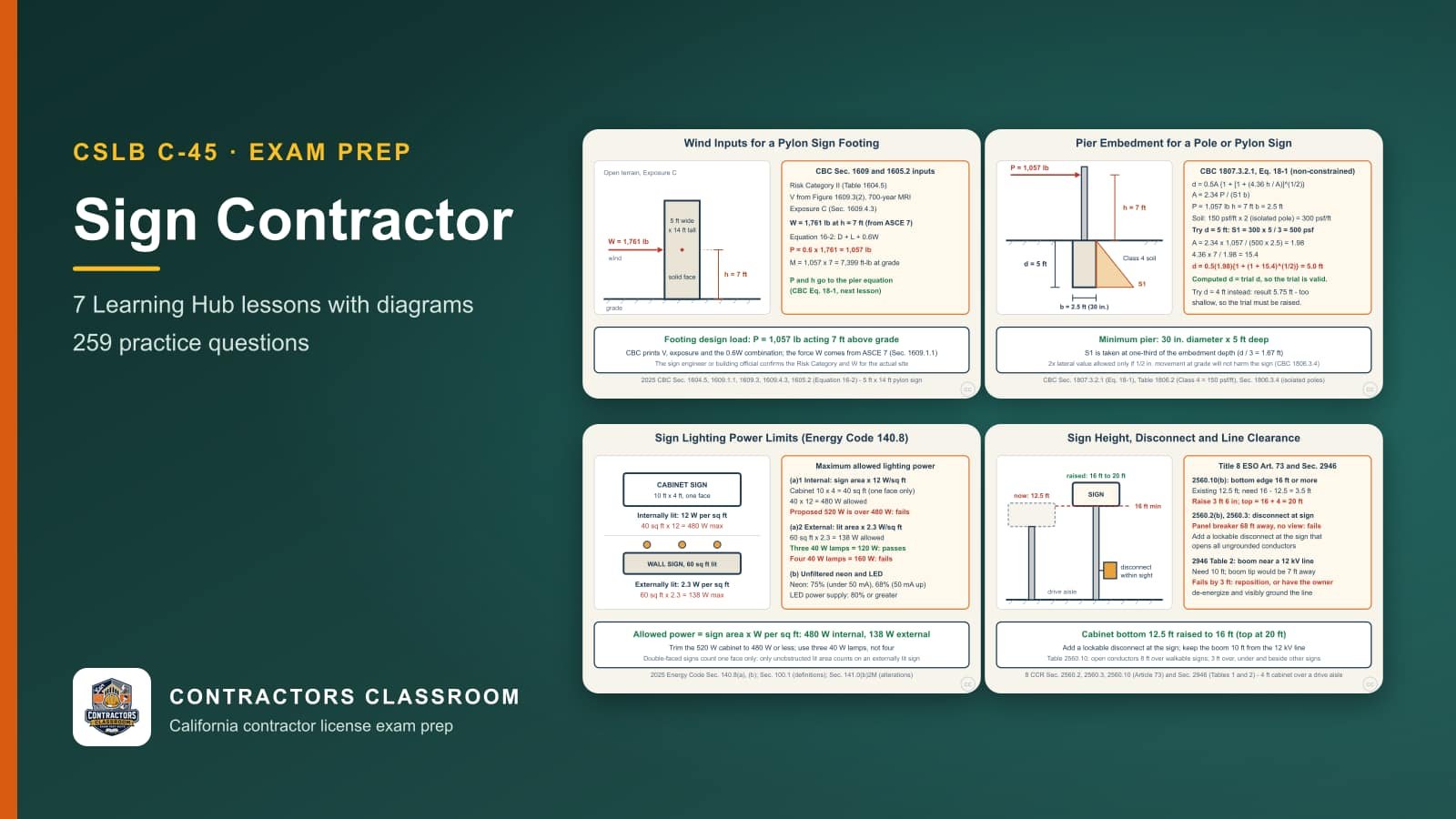
Diagrams from the C-45 sign contractor lessons: Wind Inputs and Footing Load for a Sign (CBC 1609, 1605.2), Pier Embedment Depth for a Pole or Pylon Sign, Sign Lighting Power Limits (Energy Code Sec. 140.8) and Sign Disconnect, Height, and Line Clearance (Title 8 ESO)
259practice questions
3categories
7Learning Hub lessons
$249Law & Business included

What the exam covers: Sign (C-45)

The CSLB exam for the California sign contractor license (C-45) is a closed-book, multiple-choice test. CSLB's official study guide divides it into five major sections and gives each an approximate weight: Planning and Estimating (about 22%), Sign Design and Fabrication (about 20%), Sign Installation (about 26%), Testing, Maintenance, and Troubleshooting (about 16%), and Safety (about 16%).

Sign Installation carries the most weight, about 26%, so it deserves roughly that share of your study time, with Planning and Estimating next at about 22%.

Contractors Classroom turns that outline into 259 practice questions in 3 categories (Planning and Estimating, Sign Foundations & Structural Support, and Cal-OSHA Aerial Lift & Electrical Safety), plus 7 Learning Hub lessons with diagrams (such as "Wind Inputs and Footing Load for a Sign (CBC 1609, 1605.2)" and "Pier Embedment Depth for a Pole or Pylon Sign"). Law and Business, which most applicants take alongside their trade exam, is included at no extra charge.

Exam sections and approximate weights

  • Planning and Estimating~22%
  • Sign Design and Fabrication~20%
  • Sign Installation~26%
  • Testing, Maintenance, and Troubleshooting~16%
  • Safety~16%

Practice question categories

  • Planning and Estimating75 practice questions
  • Sign Foundations & Structural Support75 practice questions
  • Cal-OSHA Aerial Lift & Electrical Safety109 practice questions

What the Sign Contractor exam covers, section by section

Planning and Estimating (~22%)

A sign project begins with what the sign must do and where it will stand: its size, visibility and the rules that apply to that location. Drawings and specifications are checked against the engineering and design, along with the parts that make up the sign. Electrical needs and accessibility requirements are worked out early, and then materials, labor and equipment are priced so the bid covers the whole job.

  • Matching size, placement and lighting to local sign rules and the client's purpose
  • Reading plans and specifications to confirm dimensions, mounting and structural expectations
  • Choosing sign engineering and components such as cabinets, faces, supports and illumination
  • Planning power supply, circuits and accessible mounting so the sign meets electrical and ADA needs
  • Calculating materials, labor hours and equipment such as lifts or cranes for an accurate bid

Sign Design and Fabrication (~20%)

Fabrication turns a design into a physical sign. Patterns guide the cutting of faces, channel letters and cabinet panels, which are then assembled into finished units. Lighting choices shape the build: fluorescent, LED and high-intensity discharge systems each need their own wiring and housing, while neon requires glass bending and careful electrical work. Digital displays add electronic modules and controllers to the shop's list of skills.

  • Drawing patterns and cutting sign faces from plastic, metal or vinyl to match the artwork
  • Forming channel and reverse channel letters with returns, backs and mounting hardware
  • Building and assembling cabinets, frames and enclosures that hold lighting and wiring
  • Mounting LED, fluorescent and high-intensity discharge lamps with matching drivers and ballasts
  • Bending neon tubing and integrating digital display modules into finished signs

Sign Installation (~26%)

Installation starts in the shop with prewiring, which makes field hookup faster and safer. On site, crews dig for pole and monument footings, set the concrete and allow it to cure before mounting the structure. Building-mounted signs require secure anchoring to the wall or fascia. The job ends with making electrical connections, checking for tight terminations and confirming the sign powers up as designed.

  • Wiring transformers, power supplies and lamp holders in the shop before the sign goes out
  • Digging footing holes and pouring concrete to the depth the design calls for
  • Standing poles and monuments plumb and level on cured footings with secure fasteners
  • Anchoring wall, canopy and fascia signs into solid backing with the right hardware
  • Making grounded, weatherproof connections to the power supply and verifying operation

Testing, Maintenance, and Troubleshooting (~16%)

A finished sign still has to prove itself. Testing checks that every circuit, lamp and control behaves properly, and troubleshooting traces failures such as dark letters, flicker or tripped breakers to a specific part. Repair and routine maintenance keep signs bright and safe, from replacing failed lamps and power supplies to cleaning and resealing. Good work here depends on knowing which meters, hand tools and lifts suit each task.

  • Checking circuits, lamps and controls, then tracing dark sections or flicker to a failed part
  • Replacing worn lamps, power supplies and seals, and cleaning faces to restore appearance
  • Selecting meters, hand tools and access equipment suited to the sign and location

Safety (~16%)

Sign work mixes high-voltage power, heights and heavy overhead loads, so hazard awareness is part of every task. Electrical safety means de-energizing and verifying circuits before touching them. Workers wear appropriate protective gear and follow Cal/OSHA workplace rules, handle paints, solvents and neon materials with care, and use cranes and ladders only with proper setup. Roadside installations add the need to guide traffic and protect crews and passers-by.

  • Locking out and testing circuits, since sign transformers and neon can deliver dangerous shocks
  • Choosing eye, hand, head and fall protection suited to each task
  • Following Cal/OSHA workplace rules that apply to sign construction, installation and service
  • Handling paints, solvents, glass tubing and other hazardous materials with proper storage and disposal
  • Setting up cranes and ladders correctly and using cones or flaggers around traffic

Code books behind the Sign Contractor exam

The exam outline published for this trade lists these references.

  • 2025 California Building CodeFor sign contractors the building code governs structure and public safety: wind design for pole, pylon and wall signs, foundation and pier requirements, how far a sign may project over a sidewalk, plastics used in sign faces, and accessibility rules for tactile signs. It feeds Planning and Estimating and Sign Installation.
  • 2025 California Electrical Code (especially Article 600)The electrical code is the heart of the trade, and the sign article is its specialty chapter. It covers disconnects, branch circuits, grounding, neon and LED sources, wiring methods inside signs, and field-installed skeleton tubing. It feeds the electrical requirements, prewiring, connections and testing topics across several sections.
  • 2025 California Energy CodeThe Energy Code limits how much power sign lighting may use, differently for internally lit and externally lit signs, and sets efficiency and control expectations for neon and LED. It supports the sign criteria and component selection topics in Planning and Estimating and the fabrication choices in Sign Design and Fabrication.
  • California Vehicle CodeThe vehicle code matters for the transport side of sign work: loading and hauling sign components, trucks and boom equipment on public roads, parking and stopping at work sites and safe setups near traffic. It is the reference behind the transportation and traffic control bullet in the Safety section.
  • Neon Installation GuideA field guide for neon and cold-cathode work: tube supports and sockets, high-voltage cable, transformer connection and grounding, wiring clearances and typical faults. Candidates use it for neon design and fabrication topics and for testing and troubleshooting a lit sign that has gone dark.
  • State of California General Industry & Electrical Safety Orders (Cal/OSHA)With the Construction Safety Orders, this Title 8 set covers sign-specific electrical rules, work near overhead lines, cranes and boom trucks, ladders and aerial lifts, hazardous materials, and personal protection. It is the reference behind the Safety section and behind safe installation practices.
  • Underwriters Laboratories (UL) 48: Standard for Electric SignsThe product safety standard for electric signs and their construction: enclosures, wiring, markings, lamp and ballast arrangements and the tests a sign must pass to be listed. It tells a fabricator how to build a compliant sign and supports Sign Design and Fabrication, plus the inspection of signs in Testing and Maintenance.
  • Underwriters Laboratories (UL) 2161: Standard for Neon Transformers and Power SuppliesThis standard covers the power sources for neon and similar tubing: output voltage and current ratings, construction, grounding and protective features. It explains how to match a transformer to its tubing and why a listed unit is expected, which supports neon fabrication and troubleshooting.

Key terms for the Sign Contractor exam

Channel letters
Individually built three-dimensional letters with a back, sides called returns and a translucent face, usually lit from inside. They are the signature product of storefront signage, and their materials and wiring are both exam topics.
Reverse channel letters
Letters with an opaque face and an open back that light the wall behind them, producing a halo effect. They are mounted off the wall on spacers so that light can spread, and their LED placement differs from front-lit letters.
Letter return
The side wall of a channel letter that gives it depth. Aluminum returns resist corrosion better than sheet steel, which is one reason fabricators choose them for outdoor, long-lasting signs.
Sign cabinet
The box-like enclosure that holds lamps, LED modules, power supplies and wiring behind a flat face. Its construction affects weather sealing, drainage, heat, service access and the weight the supports must carry.
Letter raceway
A metal channel mounted on a wall that carries power wiring and power supplies for channel letters attached to it. It lets the letters mount without penetrating the wall at every character and keeps electrical parts accessible.
Pier footing
A drilled hole filled with concrete that anchors a pole or pylon sign. Its depth and diameter come from the wind overturning force and the soil, not from guesswork, and the pole is set on or in it with anchor bolts.
Exposure category
A letter classification of the terrain around a sign, from sheltered urban ground to open flat country. Open terrain raises the wind pressure used in design, so it directly changes the footing and pole requirements.
Neon transformer
A high-voltage power source, rated in kilovolts and milliamperes, that strikes and runs neon tubing. It must be matched to the tube length and gas, listed, and mounted with correct grounding and cable.
GTO cable
Insulated high-voltage wire used between a neon transformer and the tube electrodes. Its insulation rating must meet or exceed the transformer output, and it needs protective sleeving and careful routing.
LED sign power supply
The unit that converts line voltage to the low DC the LED modules use, available as constant-voltage or constant-current types. Selecting the wrong type or undersizing the unit shortens module life and causes flicker or failure.
Fluorescent sign ballast
A device that starts a fluorescent lamp and then limits the current through it. A failed ballast is a common cause of a dark cabinet, so testing it is part of sign troubleshooting.
Sign disconnect
A switch that cuts power from all ungrounded conductors to a sign so it can be serviced safely. Either it sits where the sign can be seen from it, or it can be padlocked in the open position, and every sign needs one.
Light-transmitting plastic
Translucent sheet such as acrylic or polycarbonate used for sign faces, classified by how it burns. The code limits its use and size on certain buildings, so the burn classification must be known before specifying it.
Foam plastic sign
A sign built from lightweight cellular plastic, popular for carved or dimensional lettering. Because it is combustible, the building code restricts where it can be used, especially on covered mall storefronts.
Tactile characters and Braille
Raised letters and Braille placed on signs that identify permanent rooms and spaces, so a person who cannot see can read them by touch. The code sets finish, stroke, spacing and mounting height and location.
Internally illuminated sign
A sign whose light source is inside the face, such as a lit cabinet or channel letters. The Energy Code caps its lighting power per square foot of sign area, using a different limit than for externally lit signs.
Projecting sign over right-of-way
A sign that hangs from a building into the public sidewalk airspace. The code controls its minimum clearance above grade and how far it may extend, so it can't hit pedestrians or vehicles.
Electronic message display
A sign of LED pixels driven by a controller that changes copy or images. Its fabrication, cooling, data wiring and brightness control are separate from static signs and part of the digital display topics.
Boom truck
A truck with a crane-style arm that sets poles and lifts sign sections. Working it near overhead conductors requires minimum clearances and a spotter, because contact with a line can energize the whole machine.

Where to spend practice time for the Sign Contractor exam

  • Sign installation from footing to powerSign Installation is the biggest section at about 26 percent, spanning prewiring of components, digging and pouring footings, pole and monument structures, wall-mounted building signs and the final electrical hookup. Practice a full installation sequence in order, from layout and pier to setting and plumbing the pole, and review how wiring is run and tested at each stage.
  • Planning, codes and area mathAt about 22 percent, Planning and Estimating covers sign criteria and codes, plans, engineering and design, components, electrical requirements, accessibility and material, labor and equipment quantities. Practice area calculations with mixed inches and feet, and reading a plan to list the parts, lamp type and electrical supply a sign needs.
  • Design and fabrication choicesSign Design and Fabrication is about 20 percent and covers patterns, faces, channel and reverse channel letters, cabinets, assembly, fluorescent, LED, HID and neon, plus digital displays. Compare metals and plastics for corrosion and weight, fastener sizes, and how each light source is powered, and list the failure points of each. Keep a chart of each source's driver or ballast.
  • Wind loads and foundationsStructural support questions appear in both planning and installation. Learn what drives a wind load: wind speed, exposure category, risk category and the sign's area and height above ground. Then connect that load to pier depth and diameter, soil type and anchor bolts. Practice setting up the steps in order before doing arithmetic.
  • Testing, repair and troubleshootingAbout 16 percent of the exam is testing, maintenance and troubleshooting of lit signs. Think symptom first: an unlit section, flicker, a tripped breaker or a buzzing transformer. Match each to a likely failed part, such as a ballast, power supply, lamp, socket or damaged high-voltage cable, and to the tool that confirms it. Write the sequence down.
  • Safety with cranes, lifts and power linesSafety is about 16 percent: electrical hazards, protective equipment, hazardous materials, cranes and ladders, and transportation with traffic control. Review the clearance rules for boom trucks near overhead conductors, the steps to isolate a sign before work and the practices for loading and hauling heavy components.

Scenarios to talk through before the Sign Contractor exam

  • A pole sign footingA client wants a tall pole sign beside an open lot. List the wind inputs you need, including the exposure category, and explain how they lead to a footing load. How would soil conditions change the pier depth and diameter, and what would you confirm before drilling? Explain what you would do if the soil is worse than expected.
  • Channel letters on a storefrontA restaurant orders lit channel letters for a stucco wall. Decide between raceway mounting and direct mounting, which metal to choose for the returns, where the power supplies and disconnect should be, and what you would check before closing the letters. Explain what you would label inside the letters for the next technician.
  • A dark neon signA neon sign has gone dark in the middle of a run. Set out your testing order across the transformer, high-voltage cable, electrode housings and tubing, what safety steps come before touching anything, and which findings would mean replacing the transformer rather than a section of tube. Explain what you would do before restoring power.
  • Setting a pole near overhead linesYour crew arrives to set a pole with a boom truck and finds overhead conductors across the lot. What clearances and spotter arrangements apply, who should be contacted, how do you protect the crew if the boom touches a line, and would you move the job? Explain how you plan the job so nobody stands near the load.
  • A sign over the sidewalkA shop owner wants a projecting blade sign hung from a second-floor wall over a public sidewalk. What does the code control about height above the walk and how far the sign may reach, what loads must the wall bracket carry, and who else has to sign off? Explain what drawings or details you would prepare.
  • Plastics at a mall storefrontA shop inside an enclosed shopping center asks for a lit sign with a foam plastic backing and an acrylic face. Which code limits apply to foam and to light-transmitting plastic, what documentation should show the burn classification, and what alternative would you propose if the design cannot comply? Explain what you would tell the tenant before fabrication starts.
  • Retrofitting LEDs in a cabinetAn old fluorescent cabinet sign is being converted to LED modules. Reason through the power supply type and size, the lighting power limit per square foot for an internally lit sign, how to find the face area, and what you would remove or label in the old wiring. Explain how you would present your wattage calculation to a reviewer.
  • A room identification signA school needs permanent room signs with raised letters and Braille. Think about where the sign goes relative to the door, how high it is mounted, finish and contrast for the characters, and how you would verify each sign before leaving the building. Explain what you would measure with a tape before ordering.

Learning Hub lessons

Each lesson has guided steps, a diagram, a worked example and a quick check inside the classroom.

Preview the lesson diagrams

  1. Wind Inputs and Footing Load for a Sign (CBC 1609, 1605.2)Steps: Why Wind Governs, and What the CBC Gives You; Step 1: Risk Category and the Right Wind Map; Step 2: Read V, and Convert Only When Required; Step 3: Exposure Category; Step 4: From Wind Force to Footing Load
  2. Pier Embedment Depth for a Pole or Pylon SignSteps: Why a Sign Pier Is Not Just a Hole Full of Concrete; The Embedment Equation (CBC Equation 18-1); Find S1 from Table 1806.2 and the Isolated-Pole Rule; Solve by Trial Depth; Check the Result and Know the Limits
  3. Sign Lighting Power Limits (Energy Code Sec. 140.8)Steps: Where Sign Lighting Is Regulated; Name the Sign Type First (Section 100.1 Definitions); Internally Illuminated: 12 Watts per Square Foot; Externally Illuminated: 2.3 Watts per Square Foot; Unfiltered Neon and LED: Section 140.8(b) Efficiency; Alterations and Relocations (Section 141.0(b)2M)
  4. Sign Disconnect, Height, and Line Clearance (Title 8 ESO)Steps: A Disconnect on Every Sign (8 CCR Section 2560.2); Within Sight, or Lockable (Section 2560.3); Bottom Edge 16 Feet Above Vehicle Areas (Section 2560.10(b)); Clearance From Open Conductors (Table 2560.10); Setting Poles and Using Boom Trucks Near Overhead High-Voltage Lines (Section 2946)
  5. Accessible Signs: Tactile Letters, Braille and Character Height (CBC 11B-703)Steps: When 11B-703 Applies to Your Sign; Raised Characters (Section 11B-703.2); Braille (Section 11B-703.3); Mounting Height and Location (Section 11B-703.4); Visual Characters and Table 11B-703.5.5
  6. Signs Over the Public Right-of-Way (CBC Chapter 32)Steps: What the Code Says About Signs in General (CBC 3107.1); Below 8 Feet: Not Allowed (Section 3202.2); 8 to 15 Feet: Two-Thirds of the Sidewalk (Section 3202.3.1); 15 Feet or More Above Grade (Section 3202.3.3); Drainage and Loads
  7. Plastic Sign Faces and Mall Storefront Signs (CBC 402.6.4, 2606, 2611)Steps: Why the CBC Regulates Sign Plastics; Light-Transmitting Plastic: CC1 and CC2 (Section 2606.4); Plastic Signs on a Mall Storefront (Section 402.6.4); Foam Plastic Signs (Section 402.6.4.5); Interior Light-Transmitting Plastic Signs (Section 2611)

See the classroom in action

Frequently asked questions

How do I get a California sign contractor license?

A sign installer or sign maker who wants to contract independently applies under C-45. CSLB generally requires documented journey-level experience, a bond, and passing scores on both the Law and Business exam and the C-45 exam. Rules change, so confirm them with CSLB.

What does the sign contractor exam ask about sign installation?

Sign Installation is the heaviest part of the C-45 exam, at about 26%. Expect questions on wiring transformers, power supplies and lamp holders in the shop before the sign goes out, digging footing holes and pouring concrete to the depth the design calls for, and standing poles and monuments plumb and level on cured footings with secure fasteners. Next in weight come planning and estimating (about 22%) and sign design and fabrication (about 20%).

What kinds of questions are on the sign contractor exam?

The three sample questions in CSLB's C-45 study guide ask about why aluminum suits channel letters, which screw has the thickest shaft, and the square footage of a long, narrow sign. Like every question on the exam, each has four choices and one best answer.

Which codes and books does the C-45 exam reference?

CSLB's C-45 study guide lists the 2025 California Building, Electrical, and Energy Codes (Title 24), the Cal/OSHA safety orders (Title 8), and trade references such as Neon Installation Guide, UL 48 (electric signs), and UL 2161 (neon transformers and power supplies). Use them to study; the exam itself is closed-book.

Is the sign contractor exam open book?

No. The C-45 study guide says no reference materials may be used, even though it names Neon Installation Guide and UL 48 (electric signs) among the books to study from. A calculator is provided, and guessing is not penalized.

Can I take the sign contractor exam outside California?

CSLB's exam FAQ says trade exams are given in California or Oregon only, so C-45 is not offered in other states, although Law and Business can be taken out of state. Check the current PSI list when you schedule.

How are the 259 C-45 practice questions organized?

They are split into 3 categories, largest first: Cal-OSHA Aerial Lift & Electrical Safety (109), Planning and Estimating (75), and Sign Foundations & Structural Support (75). Cal-OSHA Aerial Lift & Electrical Safety holds about 42% of the questions. 7 Learning Hub lessons add diagrams and worked examples for the harder topics. The missed-question review collects every question you get wrong.

Is there a free trial for sign contractor exam prep (C-45)?

Yes. The free C-45 preview opens the real classroom with no sign-up and gives you the first question from every C-45 category, including Cal-OSHA Aerial Lift & Electrical Safety and Planning and Estimating, plus Law and Business. The full course is a one-time $249 purchase.

Is sign contractor exam prep available in Spanish?

The website and the eight demo videos are available in Spanish. The classroom and the 259 C-45 practice questions are in English for now; translating the questions is not part of the course yet.

Ready to practice for real?

Try the real classroom free, no sign-up, or get the full course for your trade.

Independent exam preparation. Contractors Classroom is not affiliated with the Contractors State License Board, and no course can guarantee a passing result.


