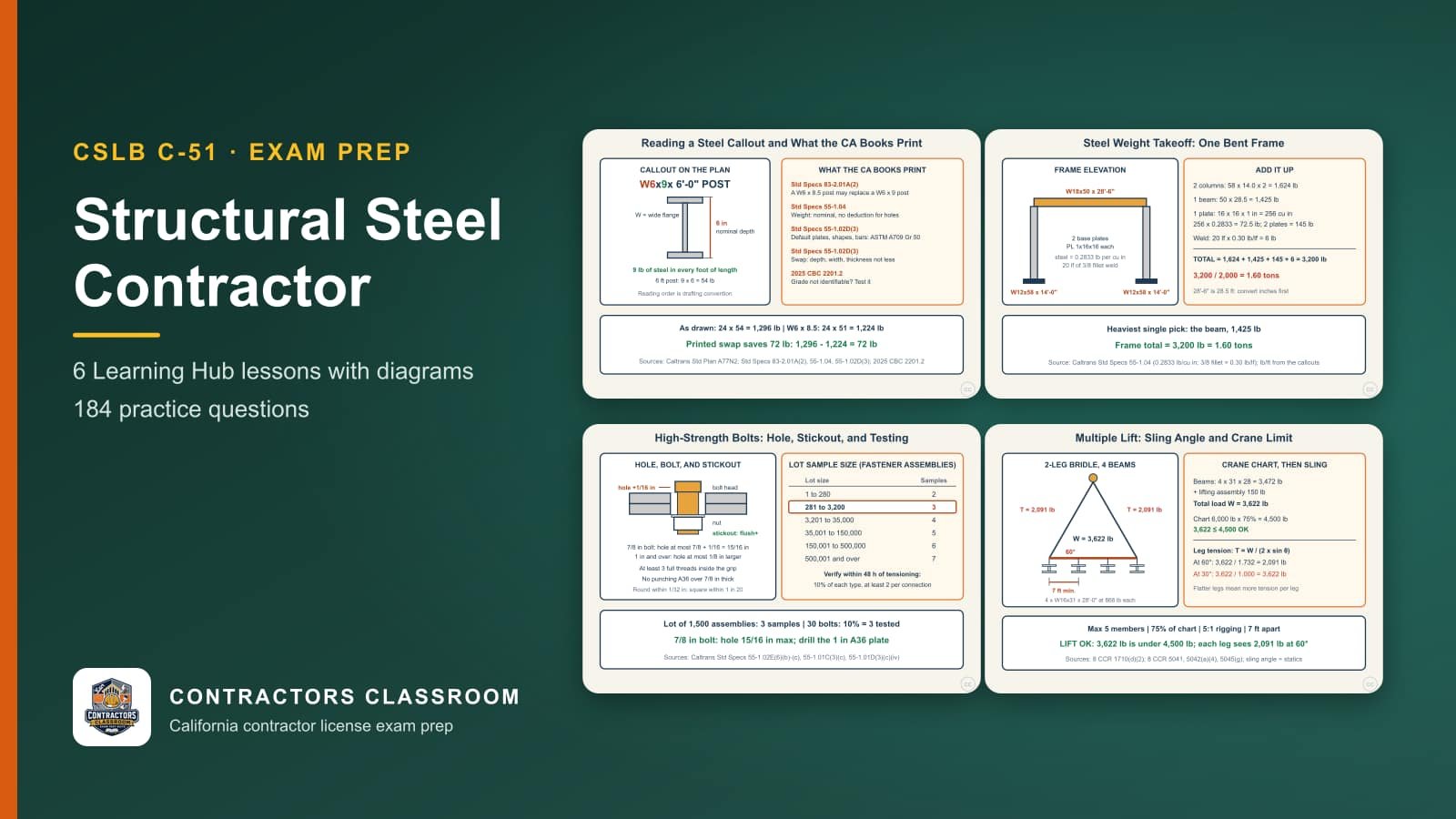
- Wide-flange shape
- The familiar I-shaped rolled steel section with parallel flanges, named by its nominal depth and weight per foot. Reading a designation such as depth followed by pounds per foot tells you what to order, how much it weighs and how to rig it.
- Base plate
- The flat steel plate welded to the bottom of a column that spreads its load onto the concrete foundation and receives the anchor rods. Setting it level and on the right bearing material is a key step before columns are plumbed.
- Anchor rod
- A threaded rod cast or drilled into foundation concrete to hold a column base. Its projection, location and nuts must match the drawings, and the concrete must be strong enough before erection loads it.
- Continuity plate
- A stiffener welded between a column's flanges, level with a beam flange, in a moment connection so the column web and flange do not buckle or distort under the beam's force. It is the plate most associated with rigid frames.
- Moment connection
- A beam-to-column joint designed to resist rotation and transfer bending, not just shear, so the frame resists lateral loads such as earthquakes. It uses bolted or welded flanges, and workmanship on it is closely inspected.
- Shear tab
- A single plate welded to a support and bolted to a beam web, carrying vertical reaction but little moment. Simple and common, it lets the erector hang a beam quickly and secure it with a few bolts before final tightening.
- Snug-tight
- The condition reached when plies are in firm contact, typically after a few impacts of an impact wrench or the full effort of a worker using an ordinary spud wrench. Many connections only require this, while others need pretension.
- Turn-of-nut method
- A way to pretension a high-strength bolt by first snugging it, match-marking the nut, then rotating a prescribed fraction of a turn that depends on bolt length. Proper marks make the work verifiable by inspection.
- Direct tension indicator
- A hardened washer with small protrusions that flatten as a bolt is tightened, so a feeler gauge shows whether required clamping force was reached. It makes pretension measurable at the joint without special torque equipment.
- Faying surface
- The contact surface between two plies joined by bolts or welds. Its coating, paint, oil or rust condition can change friction in a slip-critical joint, so surfaces are prepared and kept clean according to the connection type.
- Welding procedure specification
- A written recipe for making a weld: process, filler metal, joint design, position, preheat, current and travel details. It must be backed by qualification data unless it falls under a prequalified category in the welding code.
- Procedure qualification record
- The documented test evidence showing that a given welding procedure actually produces a sound weld, listing parameters used and mechanical test results. A non-prequalified procedure specification is paired with one.
- Complete joint penetration weld
- A groove weld that fills the full thickness of the joint so the weld carries the same stress as the base metal. It often needs backing, back-gouging and ultrasonic or other testing, especially in moment connections.
- Fillet weld
- A roughly triangular weld joining two surfaces at right angles, such as a tab to a beam web. Its size is measured by leg length, and undersized or poorly fused fillets are among the most common field defects.
- Weld symbol
- The shorthand mark on a drawing that tells a welder what to make: a reference line carrying the weld type, size and length, an arrow pointing to the joint, optional field-weld flag and a tail for notes.
- Camber
- A slight upward curve built into a beam in the shop so that it flattens to level when the expected dead load is applied. The ironworker needs to set it with the curve up, or the floor will sag further.
- Sling angle
- The angle between a sling leg and the horizontal. The flatter the angle, the greater the tension in each leg for the same load, so a low angle can overload a sling even though the load is well within the hook's capacity.
- Controlled decking zone
- A defined area, in a building under construction, where decking crews work with limited fall-protection rules while following strict limits on size, access and training. It is a narrow exception used only for initial deck laying.