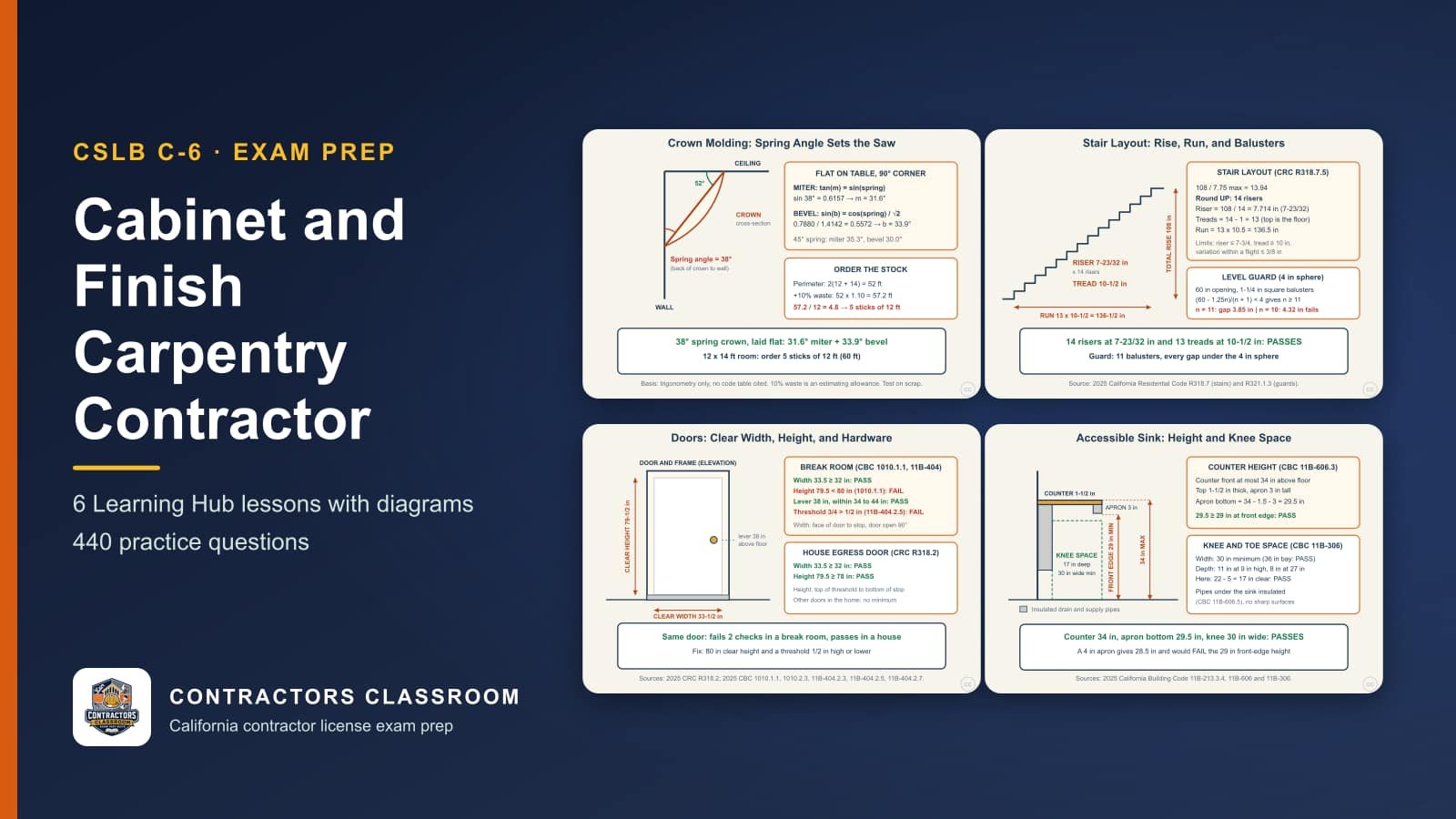
- Spring angle
- The angle at which crown molding tilts out from the wall as it leans toward the ceiling. Knowing it is the first step in finding saw settings, because the same profile cut for a different spring angle will not close at the corner.
- Compound miter
- A cut made with the saw's miter angle and bevel angle set at the same time. Crown molding laid flat on the table needs one at each corner, with the left and right settings mirrored for inside and outside corners.
- Coped joint
- An inside-corner joint where the end of one molding is cut to the profile of the other. Unlike two mitered ends, it stays tight when the wall is slightly out of square or the wood shrinks with the seasons.
- Total rise
- The full vertical distance from one finished floor to the next. Dividing it by a whole number of risers gives each riser height, and all risers must come out essentially equal so the stair is safe.
- Tread nosing
- The rounded front edge of a stair tread that overhangs the riser below. It gives the foot extra room, but the amount of projection and the edge profile are limited so toes do not catch.
- Baluster sphere test
- A check that openings in a guard or stair railing are small enough that a ball of the code-specified diameter cannot pass through. It keeps young children from slipping through the spaces between balusters.
- Clear door width
- The unobstructed opening taken from the open door's face to the stop on the far side, not the width of the slab. Codes specify minimum clear widths, so a carpenter checks the actual opening after hardware and trim go on.
- Knee and toe clearance
- The open space under an accessible sink or work surface where a seated person's knees and feet fit. Cabinet fronts and bases must be left out or made removable in that zone so a wheelchair can roll in.
- Aisle clearance
- The minimum open floor width between facing cabinet runs or between a counter and an appliance in an accessible kitchen. It leaves enough room for a wheelchair to turn and for doors to swing open.
- Composite wood formaldehyde limit
- California's cap on formaldehyde released by particleboard, medium-density fiberboard and hardwood plywood. Panels must be labeled as compliant, and the cabinetmaker keeps the supplier paperwork to prove it.
- Low-VOC adhesive
- A glue or contact cement whose volatile organic compound content stays under the grams-per-liter limit set by air-quality rules. Choosing it affects odor, indoor air quality and whether the product may be used at all in the region.
- Pressure bar
- The part of a planer that bears down on the stock just beyond the cutterhead. It keeps the board flat against the bed and reduces chatter and snipe, so a worn or misadjusted bar leaves a rippled surface.
- Brad-point bit
- A twist drill with a sharp center spur and two scoring edges. The spur locates the hole exactly and the edges slice the fibers cleanly, which makes it the preferred choice for dowel and shelf-pin holes.
- Board foot
- A unit of lumber volume equal to a piece one foot long, one foot wide and one inch thick. Boards are priced by it, and calculations add a waste allowance because defects and trimming reduce usable stock.
- Face frame
- A frame of stiles and rails fastened to the front of a cabinet box. It stiffens the cabinet, hides the plywood edges and gives hinges a surface to mount to, which differs from frameless construction.
- Frameless cabinet
- A cabinet box with no face frame, where doors overlay the panel edges directly. It gives slightly wider drawer openings and relies on precise edge-banded panels and hinge hardware adjusted after hanging.
- Scribe
- To mark a panel or filler strip to match the shape of an uneven wall or floor, then trim to the line. Scribing closes gaps that a straight cut could never hide in a house that is not perfectly plumb.
- Stile and rail door
- A door built from vertical stiles and horizontal rails around a floating center panel. The panel is left free to expand and contract with humidity, which prevents splitting of the joints.
- Woodwork quality grade
- A tier such as economy, custom or premium that describes how carefully material is selected, joined and finished. A project specifies one grade, and the cabinet shop must meet every requirement of that tier.