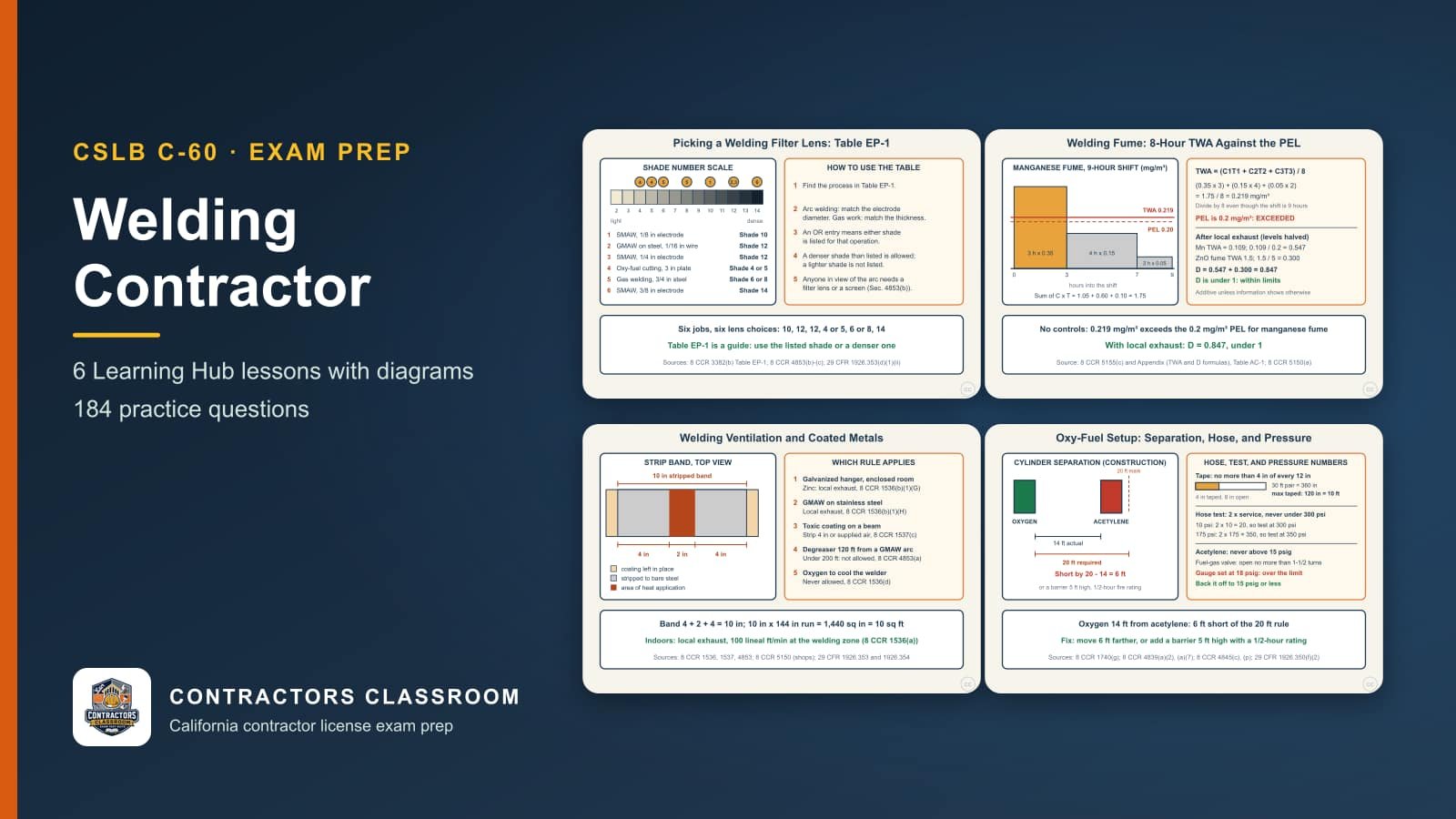
- Filter lens shade
- A number that tells how dark a welding lens is. Higher numbers block more light, and the right number depends on the process and the current, or on metal thickness in gas work. Anyone who can see the arc needs suitable protection.
- Stickout
- The length of wire that extends beyond the contact tip toward the work in wire-feed welding. It changes heating of the wire, arc stability, penetration and spatter, so operators hold it steady and adjust it on purpose.
- Shielded metal arc welding
- Stick welding with a flux-coated rod that melts into the joint while the coating burns to form shielding gas and a slag layer. It is portable and works outdoors, but needs slag removal between passes.
- Gas metal arc welding
- A process that feeds solid wire continuously through a gun while a shielding gas covers the pool. It is fast and clean, but drafts can blow the gas away, so it is best used indoors or with wind screens.
- Flux-cored arc welding
- Welding with a tubular wire filled with flux, either self-shielded or used with added gas. It deposits metal quickly and handles thick plate, but makes more fume and spatter and leaves slag.
- Gas tungsten arc welding
- A precise process using a non-consumable tungsten electrode and an inert gas, with filler rod added by hand when needed. It makes clean welds on thin material and non-ferrous metals, but is slower than wire processes.
- Preheat and interpass temperature
- Preheat is warming the base metal before welding to slow cooling and lower cracking risk, while interpass temperature is the metal's temperature between passes. Thick or hardenable steel makes both important.
- Fillet weld
- A weld with a roughly triangular cross-section that joins two surfaces at an angle, as in T-joints and lap joints. Its size is measured by leg length, and the throat is the effective strength dimension.
- Groove weld
- A weld made in a shaped opening between two members, usually in butt joints. The groove shape, root opening and number of passes are planned so the weld penetrates the full thickness when required.
- Welding symbol
- A standardized drawing mark on a reference line with an arrow, tail and weld shapes that tells a welder joint type, size and process. Sides of the line matter: arrow side and other side mean different things.
- Low-hydrogen electrode
- A stick electrode whose coating introduces very little hydrogen into the weld, such as the E7018 type. It must be kept dry in a warm holding oven, because absorbed moisture leads to cracking in the weld and nearby metal.
- Shielding gas
- Argon, carbon dioxide, helium or a blend that flows around the arc to keep air from the molten pool. The mix changes arc feel, spatter and penetration, and a draft or empty cylinder shows up as defects.
- Porosity
- Small gas pockets trapped in a weld, caused by dirty metal, moisture, drafts or failed gas coverage. It weakens the weld and is one of the first defects checked when a bead looks pitted.
- Undercut
- A groove melted into the base metal beside a weld that was not refilled, typically from too much current or too fast travel. It creates a stress point that can start a crack.
- Brazing
- Joining metals by melting a filler that flows into a close joint by capillary action, with the base metals staying solid. It needs clean surfaces, flux and the right clearance, and relies on heat control rather than melting the parts.
- Flashback arrestor
- A safety device fitted to torch or regulator lines that stops a flame from running back into the hose and regulator. It works with check valves, and both must be present and functioning for oxy-fuel work.
- Time-weighted average exposure
- A welder's fume exposure averaged over an eight-hour shift, found by weighting each concentration by its duration. The result is compared with the allowable limit, and when two fumes are present their fractions are added.
- Duty cycle
- The share of a ten-minute period that a welding machine can deliver its rated current without overheating. A lower cycle at higher amperage means more cool-down time, so choosing a machine for heavy work depends on it.
- Kerf
- The width of metal removed by a cutting torch or plasma arc. Cut quality is judged by its width, squareness and slag, and layouts must allow for kerf so parts come out to size.
- Spark test
- A quick way to tell steels apart by grinding a sample and watching the sparks, since carbon content changes their length and shape. It helps identify an unknown metal before choosing a filler or procedure.