CSLB C-61

Limited Specialty Contractor License Exam Prep (C-61)

Getting ready for the California limited specialty contractor license exam (CSLB C-61)? Study with 184 practice questions in 2 categories and 6 Learning Hub lessons, made for specialty trade contractors, with the Law and Business exam included.

One-time purchase, no subscription. Law & Business included.

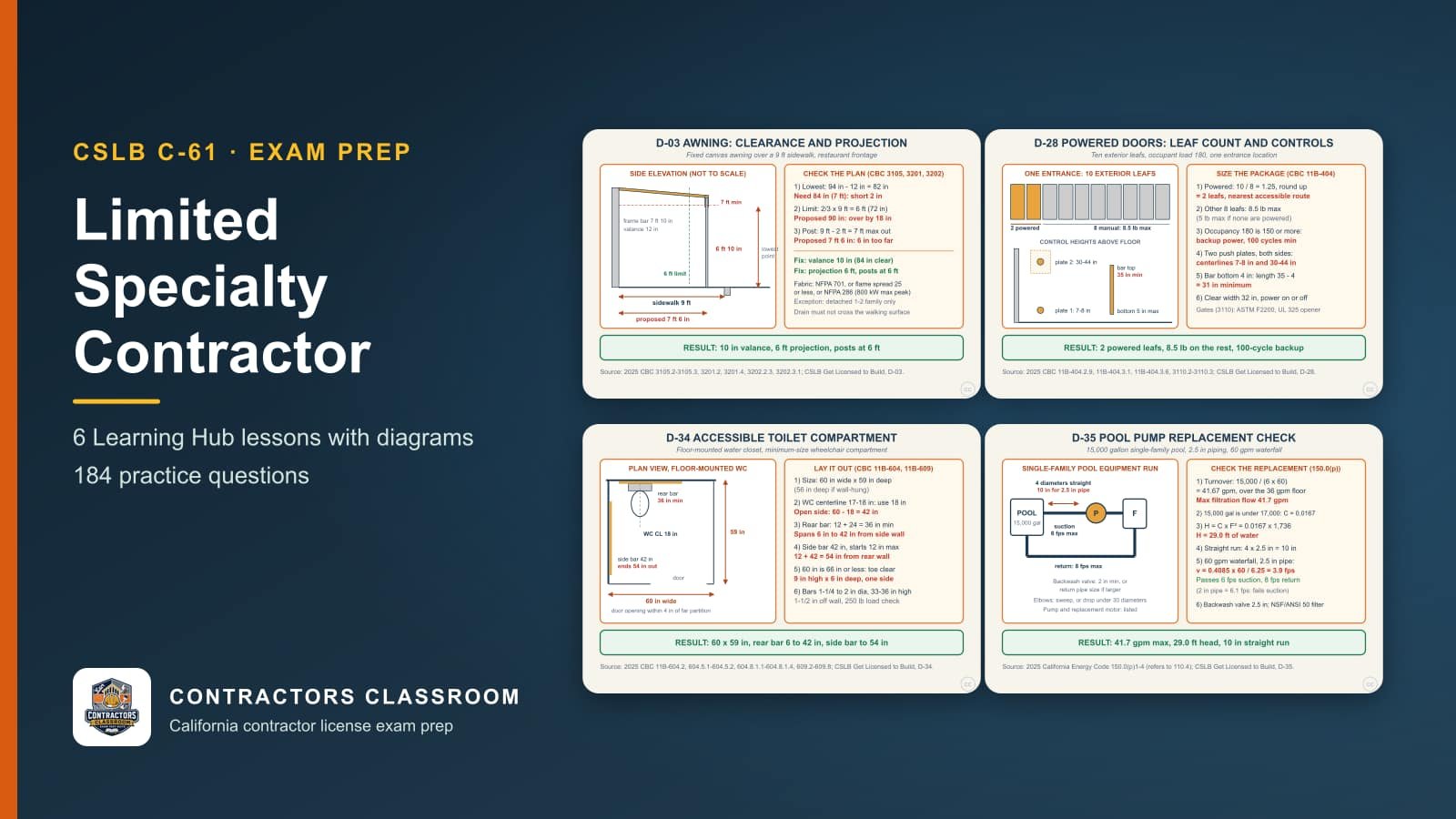
Diagrams from the C-61 limited specialty contractor lessons: D-03 Awnings: Clearance, Projection and Fabric Rules, D-28 Powered Doors and Automatic Gates: Leaf Count, Controls and Backup Power, D-34 Toilet Partitions: Accessible Compartment Size, Door and Grab Bar Layout and D-35 Pool Pumps: Filtration Flow Limit, System Head and Piping Rules
184practice questions
2categories
6Learning Hub lessons
$249Law & Business included

What the exam covers: Limited Specialty (D-Series) (C-61)

The CSLB exam for the California limited specialty contractor license (C-61) is taken at a testing center as a multiple-choice test. CSLB publishes the topics and weights of each exam in its official study guide, and the guide for this classification should be your outline for deciding what to study first.

Because CSLB does not publish a separate weighted outline for this classification, Contractors Classroom organizes the practice questions into the categories listed below, so you can find the areas where you miss the most questions and spend your time there.

Work through one category at a time, use the missed-question review to see which topics keep costing you points, and return to your weakest category until the answers feel automatic.

Contractors Classroom turns that outline into 184 practice questions in 2 categories (Planning and Estimating and Cal-OSHA Title 8 Jobsite Safety), plus 6 Learning Hub lessons with diagrams (such as "D-03 Awnings: Clearance, Projection and Fabric Rules" and "D-28 Powered Doors and Automatic Gates: Leaf Count, Controls and Backup Power"). Law and Business, which most applicants take alongside their trade exam, is included at no extra charge.

Practice question categories

  • Planning and Estimating75 practice questions
  • Cal-OSHA Title 8 Jobsite Safety109 practice questions

What the Limited Specialty Contractor exam covers, section by section

Planning and Estimating practice questions

Limited specialty work covers many small, very different trades under one license class, so the questions in this category deal with the part every job shares: working out what the project requires before anyone orders material or schedules a crew. Expect the kind of thinking a contractor does at the kitchen table, turning a described scope into quantities, labor and a price that holds up.

  • Reading a scope of work closely enough to see what the job actually includes
  • Turning measurements into material quantities and a realistic cost
  • Allowing for labor, equipment and waste before quoting a price

Cal-OSHA Title 8 jobsite safety practice questions

The second category gathers questions on safe work practices under California's workplace safety regulations for construction. It is the larger of the two, which makes sense for a license class whose members range from sign installers to tree workers, since the hazards change from one specialty to the next while the habits of protecting people on a site stay the same.

  • Recognizing hazards on a job site before they hurt someone
  • Choosing and using protection that suits the task at hand
  • Knowing what a contractor must do to keep workers and the public safe

Six specialty topics in the Learning Hub

Because the limited specialty class spans so many trades, the Learning Hub does not try to cover all of them; it teaches six representative topics in depth, each from a different D-series classification. Together they show how a specialty rule is read, applied to a drawing or a measurement, and checked.

  • Awnings (D-03): how much clearance and projection are allowed, and what the fabric must satisfy
  • Powered doors and automatic gates (D-28): leaf count, controls and backup power
  • Toilet partitions (D-34): the size of an accessible compartment, its door and its grab bar layout
  • Pool pumps (D-35): filtration flow limits, system head and piping rules
  • Scaffolding (D-39) and tree service (D-49): duty class, load and plank span, then felling notch, climbing line and power-line limits

How the limited specialty license is organized

The C-61 classification works as an umbrella. Under it, CSLB lists a series of numbered D-classifications, each describing one narrow kind of work, from awnings and signs to pool equipment, scaffolding and tree care. A contractor is licensed in the particular specialty that matches the work performed, so two applicants holding the same C-61 license class can spend their days doing completely different jobs. That variety is the reason this course pairs a shared core of planning and safety questions with a handful of closer looks at individual specialties, instead of pretending that one trade vocabulary fits them all.

  • A broad license class that groups many narrow specialties under one heading
  • Numbered D-classifications that name the specific work a contractor is licensed to do
  • A shared base of estimating and jobsite-safety knowledge that applies in every specialty

Key terms for the Limited Specialty Contractor exam

Awning valance
The hanging fabric or metal flap along an awning's front edge. It counts as part of the awning when clearance above a sidewalk is measured, so the lowest point, valance included, is what gets compared with the minimum height the code requires over a public walkway. Installers therefore check this lowest edge, not the top of the frame, before committing to a mounting height.
Sidewalk projection limit
A cap on how far a low awning may reach out over a public walk, set as a share of the sidewalk's width measured from the building. Supporting columns must also stay back from the curb line, so planning starts with measuring the walk. The limit applies to awnings under a stated height above the walk, so a higher awning is judged by a different test.
Awning fabric flame test
One of the accepted fire tests an awning covering must pass, such as a vertical flame propagation test, a low flame-spread rating, or a room-corner burn. A canvas or vinyl fabric needs documentation showing it met one of them. Paperwork from the fabric maker, not appearance or thickness, shows which test was passed, so the installer keeps it with the job file.
Powered door leaf
A single door panel that opens by motor. Accessibility rules count the panels at an entrance, and a set proportion being powered lets the remaining manual panels avoid the lowest opening-force requirement, so counting leaves matters. A retail entrance with several exterior leafs is the typical setting for this counting problem, and fractions of eight count as a full group.
Push plate pair
Two activation buttons installed at different heights on each side of a powered door, so the control can be reached from a wheelchair and by someone standing. Sensing devices or bars can serve instead, but both sides need a control. Heights are specified to the centerline of each plate, so measure to the middle of the plate rather than to its edge.
Backup cycling
A rule that a powered entrance in a busy building must keep working through a power failure, using a battery or generator able to open and close the door a minimum number of times. It applies above a set occupant load. Each powered door also needs an entrance sign mounted on it or next to it, so signage belongs on the same checklist.
Vehicular gate listing
Automatic gate openers must be tested and listed to a recognized safety standard, and the gate itself built to a separate standard for automated gates. California's code names these standards but prints no dimensions, so the numbers live in the standards. A candidate should know which standard covers the gate's construction and which covers the opener, even though the code gives no figures.
Wheelchair accessible compartment
A toilet stall sized so a wheelchair user can enter, turn, and transfer. Its required width and depth change depending on whether the water closet hangs on the wall or sits on the floor, and the door position and swing are set to keep the clear floor space. Plan the layout outward from the water closet centerline, because grab bars, dispensers, and door clearances are all measured from it.
Ambulatory compartment
A narrower stall with grab bars on both side walls, provided for people who walk with braces or a cane. It is installed in addition to the wheelchair stall in larger restrooms, and its width falls in a tight range. Both side walls carry grab bars, which is the quickest way to tell it apart from the wheelchair stall on a drawing.
Side-wall grab bar
The horizontal bar mounted beside a toilet, specified by minimum length, its distance from the rear wall, and how far it extends past the front of the fixture. A partition installer must confirm that the wall can take the load. Rear-wall bars are specified separately, with their own length and position relative to the water closet centerline.
Pool system head
The total resistance a pool pump must overcome, measured in feet of water. It is found by squaring the flow rate and multiplying by a coefficient that depends on pool volume, and it helps decide whether a replacement pump suits the piping. Head is figured for the flow the pump will actually deliver, and a larger pool uses a smaller coefficient than a small one.
Dedicated-purpose pool pump
A pump built specifically for pools and spas. When one is replaced, it must appear in the state's directory of certified equipment, and its filtration flow must stay under the limit the energy code sets for that pool. Replacement motors on these pumps follow the same listing idea, so the installer checks the directory before ordering.
Sweep elbow
A long-radius fitting that turns pool piping gradually rather than sharply, cutting turbulence and friction. The energy code expects these on pump piping, along with a straight run ahead of the pump and a cap on water velocity. Velocity caps differ for the return and suction lines, so check both whenever pipe is sized.
Backwash valve
The valve that reverses flow through a pool filter to flush trapped debris. The energy code sets a minimum size for it, tied to the return pipe diameter, so a small valve cannot choke the system. The rule's wording means comparing two sizes and taking the larger, a small trap in what looks like a simple number.
Scaffold duty class
A rating of light, medium, heavy, or special duty, each tied to the working load per square foot of platform it must carry. Choosing the class from the real work, such as masonry versus painting, sets the plank span and the design load. The higher the class, the shorter the plank may span, which is why a heavier duty class means more supports under the deck.
Four-times design load
The safety factor for scaffolds: each one must carry its own weight plus four times the heaviest working load intended for it. Candidates calculate the intended load from the duty class, then multiply, to see what the structure must resist. It is a design rule rather than a field test, so the arithmetic is done on paper before any platform goes up.
Plank overhang
The length of a scaffold plank that extends past its support. Too much can tip the plank under a worker's weight, so overhang is capped unless a guardrail blocks access to it or the other end is anchored. A loaded plank also may not sag past a small fraction of its span, so overhang and deflection are checked together.
Felling notch and hinge
The wedge cut in a tree trunk that points the fall, together with the strip of uncut wood left between notch and back cut. The hinge steers the tree as it falls, and the notch depth is limited so the hinge stays strong. The two cuts forming the notch must not cross, and the back cut stops short of the hinge area.
Line-clearance tree trimmer
A worker trained and permitted to prune near high-voltage energized conductors. Others must stay a prescribed distance away, and the closest approach is set by line voltage, so a service drop and a distribution line are treated differently. Tree workers who are not line-clearance trimmers still have a distance limit to respect around low-voltage lines.
Climbing line
A synthetic rope used with a tree worker's saddle that must meet a minimum rated strength and diameter and limit how far it stretches under load. Workers aloft need at least two ways of being secured, so the line is paired with a work-positioning lanyard.

Where to spend practice time for the Limited Specialty Contractor exam

  • Quantities and pricing across specialtiesPlanning and Estimating is one of the two practice categories in this course, and it matters because limited specialty work spans very different trades. No section weights are published for this class, so build a habit that carries across all of them: read the described work closely, turn measurements into material, add labor, equipment, and waste, and test the price for reasonableness before you commit to it. Keep a one-page checklist so no step in the pricing chain is skipped when the described job is unfamiliar.
  • Awnings, clearance, and sidewalk projectionAwning questions combine three checks that are easy to run in order: the lowest edge, valance counted, the projection allowed over the walk, and the setback of the columns from the curb. Practice them with different sidewalk widths, then review the frame materials, the fire tests accepted for fabric, and drainage from the awning surface. Also remember that the lowest height is measured from the public walk, not from your work platform.
  • Doors, gates, and restroom partitionsAccessibility dimensions fill two of the six lessons. Sketch a powered entrance with its controls, signage, and backup power, and recall which gate standards apply. Then draw a wheelchair stall and an ambulatory stall, locating the toilet centerline, door, grab bars, and dispensers. Writing the dimensions beside a sketch helps them stay with the right fixture. Keep a short list of which numbers belong to doors, which to gates, and which to partitions.
  • Pool pump flow, head, and pipingThe energy code turns a pump replacement into a short calculation. Rehearse the sequence: confirm the pump is listed, find the filtration flow limit for the pool volume, compute system head from flow squared times the coefficient, then check piping rules such as straight run before the pump, sweep elbows, water speed, and backwash valve size. Keep suction and return limits separate. Work one example for a small pool and one for a large pool so the two coefficients stay distinct.
  • Scaffold loads, planks, and platformsSafety is the larger of the two practice categories, and scaffolding is its most numerical part. Practice picking the duty class, reading the plank span for it, counting spans and supports for a given deck length, and applying the four-times load rule. Review overhang, allowed deflection, and nailing, so each plank question can be answered from a short written checklist. Do the same for a light-duty deck so you can see how the span changes when the class changes.
  • Tree work: notches, lines, and power linesTree service rules are short but specific. Practice the felling sequence of notch, hinge, and back cut with the depth limit, then learn what a climbing line and saddle must provide, when a second person must be nearby to help, and how close an untrained worker may get to energized conductors of different voltages. Those distances are easy to confuse. Draw a simple side view of the tree, notch, and hinge once, since the picture makes the cut limits stick.

Scenarios to talk through before the Limited Specialty Contractor exam

  • Awning over a restaurant sidewalkA restaurant wants a fixed canvas awning over the sidewalk in front. In what order would you check the lowest edge with the valance, the projection allowed, and the column setback from the curb? Which frame materials qualify, what fabric proof do you need, and what drainage details must be settled before installation?
  • Powered entrance at a retail storeA store has several exterior door leafs at one entrance and wants simple, low-effort entry for customers. How does counting leafs and powering some of them help? Which controls go on each side, how are push plates placed, what backup power and signage apply, and how does occupant load influence the answer?
  • Automatic gate for a warehouse yardA warehouse yard gets a new automatic vehicle gate. The code names standards for the gate and for the opener but prints no dimensions. Where would you look for the numbers, what must be listed, and what would you document for the owner and for anyone who later services the gate?
  • Restroom partition remodelPlans for a restroom remodel show one wheelchair compartment plus one ambulatory compartment. Starting from the water closet centerline, how would you place the door, grab bars, dispenser, and flush control? How does a wall-hung versus floor-mounted fixture change the depth, and what do you verify about wall reinforcement?
  • Swapping a pool pumpYou are asked to replace the pump on a family pool with a stronger one. Is the new pump on the certified list, how do you find the filtration flow limit and system head, and what piping rules might the swap break, such as straight run, sweep elbows, water speed, or backwash valve size? What if a waterfall adds flow?
  • Planking a masonry scaffoldA masonry crew needs a long wood deck with stored brick. How do you choose the duty class, read the plank span, count supports, and apply the four-times rule? What do overhang, deflection, and nailing add, and what happens to the plan if the crew later wants heavier loads on the deck?
  • Felling a large oak beside a service dropA crew must take down a large oak near a service drop, with a climber going up in the tree. Plan the notch, hinge, and back cut, the climbing line and saddle, the second person on site, and the distance rules around the wires. Which tasks fall only to a line-clearance trimmer?
  • Pricing a job that mixes specialtiesA building owner asks for one bid covering a new awning and a powered door. How do you read the described work, list quantities and labor for each, include waste and equipment, and test the total? Which safety hazards on the job also change your equipment and crew plan?

Learning Hub lessons

Each lesson has guided steps, a diagram, a worked example and a quick check inside the classroom.

Preview the lesson diagrams

  1. D-03 Awnings: Clearance, Projection and Fabric RulesSteps: What D-03 Installs and Which Code Applies; Frame and Load Rule - CBC 3105.2; Fabric and Covering Rule - CBC 3105.3; Height and Projection Over a Sidewalk - CBC 3202; Check Order and Drainage
  2. D-28 Powered Doors and Automatic Gates: Leaf Count, Controls and Backup PowerSteps: What D-28 Covers and Which California Rules Apply; The One-in-Eight Rule - CBC 11B-404.2.9; Controls on Both Sides - CBC 11B-404.2.9 Item c; Backup Power, Clear Width and Signs - CBC 11B-404.2.9 and 11B-404.3; Automatic Vehicular Gates - CBC 3110
  3. D-34 Toilet Partitions: Accessible Compartment Size, Door and Grab Bar LayoutSteps: What D-34 Installs and Which Rule Applies; Compartment Size and Water Closet Location; Door, Latch and Toe Clearance; Grab Bar Lengths and Positions; Accessories and the Check Order
  4. D-35 Pool Pumps: Filtration Flow Limit, System Head and Piping RulesSteps: What D-35 Installs and Where the Number Rules Are; Listed Pumps and the Filtration Flow Limit - 150.0(p)1A and 1C; The System Head Equation - 150.0(p)1B; Piping Rules - 150.0(p)2; Filters and Valves - 150.0(p)3 and 4
  5. D-39 Scaffolding: Duty Class, 4-to-1 Design Load and Plank SpansSteps: What D-39 Erects and Which Order Applies; Duty Classes and the 4-to-1 Design Rule - 8 CCR 1637(b)(2); Plank Spans - 8 CCR 1637(f)(2)(A); Overhang, Deflection and Nailing; Planning Sequence
  6. D-49 Tree Service: Felling Notch, Climbing Line and Power-Line LimitsSteps: What D-49 Covers and Which Order Governs It; Felling Cuts - 8 CCR 3427(c); Climbing Line and Gear - 8 CCR 3422; Working Aloft - 8 CCR 3427(a) and (b); Power-Line Distances - 8 CCR 3423(b)

See the classroom in action

Frequently asked questions

How do I get a California limited specialty contractor license?

A specialty contractor or D-series contractor who wants to contract independently applies under C-61. CSLB generally requires documented journey-level experience, a bond, and passing scores on both the Law and Business exam and the C-61 exam. Rules change, so confirm them with CSLB.

What do the limited specialty contractor practice questions focus on?

Cal-OSHA Title 8 Jobsite Safety is the largest of the 2 categories, with 109 of the 184 questions, followed by Planning and Estimating with 75. CSLB does not publish a separate weighted study guide for C-61, so these categories and the 6 Learning Hub lessons are organized around what the course contains, not around exam percentages.

What kinds of questions are on the limited specialty contractor exam?

CSLB trade exams are multiple choice, with four choices and one best answer, and some questions need math. The practice questions here use the same style, and the missed-question review brings back every one you get wrong until the answer is automatic.

Is the limited specialty contractor exam open book?

Plan on closed-book. Every CSLB study guide we reviewed says no reference materials may be used, and there is no separate published guide for C-61, so confirm the test-day rules in CSLB's current instructions and your PSI appointment details.

Can I take the limited specialty contractor exam outside California?

CSLB's exam FAQ says trade exams are given in California or Oregon only, so C-61 is not offered in other states, although Law and Business can be taken out of state. Check the current PSI list when you schedule.

How are the 184 C-61 practice questions organized?

They are split into 2 categories, largest first: Cal-OSHA Title 8 Jobsite Safety (109) and Planning and Estimating (75). Cal-OSHA Title 8 Jobsite Safety holds about 59% of the questions. 6 Learning Hub lessons add diagrams and worked examples for the harder topics. The missed-question review collects every question you get wrong.

Is there a free trial for limited specialty contractor exam prep (C-61)?

Yes. The free C-61 preview opens the real classroom with no sign-up and gives you the first question from every C-61 category, including Cal-OSHA Title 8 Jobsite Safety and Planning and Estimating, plus Law and Business. The full course is a one-time $249 purchase.

Is limited specialty contractor exam prep available in Spanish?

The website and the eight demo videos are available in Spanish. The classroom and the 184 C-61 practice questions are in English for now; translating the questions is not part of the course yet.

Ready to practice for real?

Try the real classroom free, no sign-up, or get the full course for your trade.

Independent exam preparation. Contractors Classroom is not affiliated with the Contractors State License Board, and no course can guarantee a passing result.


