CSLB C-8

Concrete Contractor License Exam Prep (C-8)

Getting ready for the California concrete contractor license exam (CSLB C-8)? Study with 355 practice questions in 5 categories and 7 Learning Hub lessons, made for concrete finishers and flatwork contractors, with the Law and Business exam included.

One-time purchase, no subscription. Law & Business included.

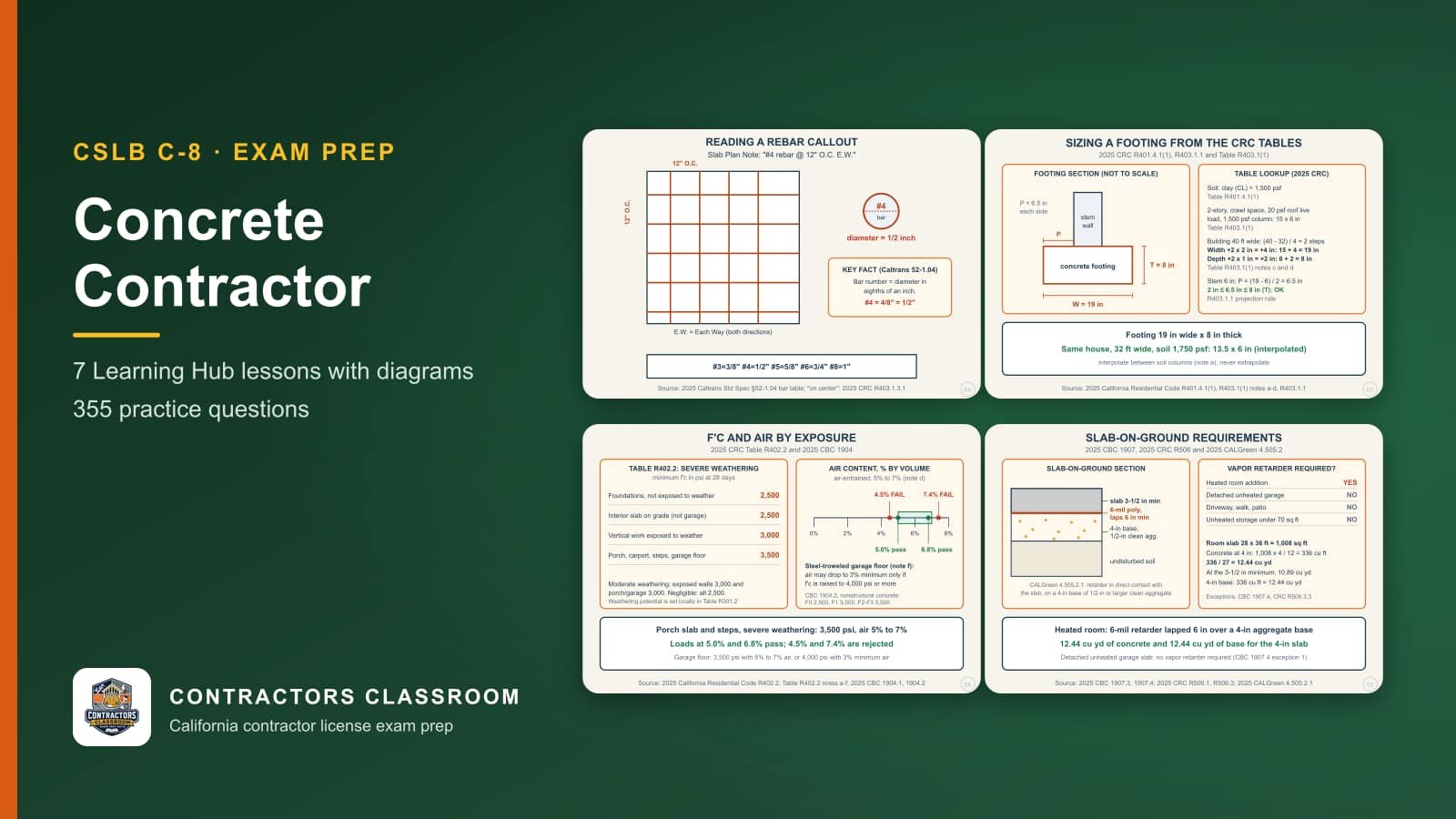
Diagrams from the C-8 concrete contractor lessons: Reading a Rebar Callout, Sizing a Footing from the CRC Tables, Specified Strength and Air Entrainment by Exposure and Slab-on-Ground: Thickness, Base, Vapor Retarder and Capillary Break
355practice questions
5categories
7Learning Hub lessons
$249Law & Business included

What the exam covers: Concrete (C-8)

The CSLB exam for the California concrete contractor license (C-8) is a closed-book, multiple-choice test. CSLB's official study guide divides it into five major sections and gives each an approximate weight: Planning and Estimating (about 28%), Pre-placement Preparation (about 27%), Placing and Finishing (about 17%), Post-placement Tasks (about 7%), and Safety (about 21%).

Planning and Estimating carries the most weight, about 28%, so it deserves roughly that share of your study time, with Pre-placement Preparation next at about 27%.

Contractors Classroom turns that outline into 355 practice questions in 5 categories (Planning and Estimating, Formwork and Reinforcement (Rebar), Concrete Placement, Finishing & Curing, Proportioning, Mixing, and Transporting Concrete, and Cal-OSHA Silica, Impalement & Formwork Safety), plus 7 Learning Hub lessons with diagrams (such as "Reading a Rebar Callout" and "Sizing a Footing from the CRC Tables"). Law and Business, which most applicants take alongside their trade exam, is included at no extra charge.

Exam sections and approximate weights

  • Planning and Estimating~28%
  • Pre-placement Preparation~27%
  • Placing and Finishing~17%
  • Post-placement Tasks~7%
  • Safety~21%

Practice question categories

  • Planning and Estimating47 practice questions
  • Formwork and Reinforcement (Rebar)117 practice questions
  • Concrete Placement, Finishing & Curing75 practice questions
  • Proportioning, Mixing, and Transporting Concrete36 practice questions
  • Cal-OSHA Silica, Impalement & Formwork Safety80 practice questions

What the Concrete Contractor exam covers, section by section

Planning and Estimating (~28%)

Concrete leaves little room for second chances, so the thinking happens before the first truck arrives. A planner weighs site access, structure design, mix needs, formwork, crew size, and weather, and schedules deliveries and finishing windows. Takeoffs of concrete, steel, and labor then become a bid that reflects the true cost of the job. Underestimating a pour or a crew can cost far more than any single material. Pump or crane access, haul distances, and the number of finishers available all feed into the schedule, because a late truck can ruin a placement that was otherwise well prepared.

  • Organizing site access, sequencing, forms, mix selection, and crew needs ahead of the pour
  • Calculating yardage, reinforcing steel, forming, and labor to price the work accurately

Pre-placement Preparation (~27%)

Most concrete problems trace back to what happens before placement. Old structures are broken out, the ground is excavated and graded to a stable base, and forms are set to line and elevation. Drains, vapor barriers, rebar, and cast-in hardware must all be located and secured, because none can be corrected once concrete covers them. Compacted subgrade, accurate form stakes, and chairs or dobies that hold steel at the right depth are the details that keep slabs from cracking or curling later.

  • Removing old material and shaping the subgrade to proper depth and slope
  • Setting and bracing forms accurately to lines, grades, and dimensions
  • Placing drainage lines and moisture barriers beneath slabs
  • Tying and supporting rebar, anchor bolts, and sleeves where plans call for them

Placing and Finishing (~17%)

Once the mix arrives, the crew works against the clock. Concrete is discharged, spread, consolidated, and leveled, then floated, troweled, or textured at the right moment as bleed water leaves the surface. Afterward it needs moisture and temperature protection while it gains strength, along with sampling and checks that confirm it meets requirements. Timing is everything, since a surface worked too early or too late is hard to rescue. Wet weather, high heat, or wind can speed or slow the set, so the crew adjusts with retarders, windbreaks, or earlier finishing.

  • Discharging, spreading, vibrating, and screeding the mix without segregation
  • Floating, troweling, edging, or brooming the surface to the specified texture
  • Protecting fresh slabs while they harden and sampling to verify quality

Post-placement Tasks (~7%)

After the concrete has hardened, the project is still not complete. Decorative color and protective coatings go on once the surface is ready, forms come off without damaging edges, and any honeycombing, cracks, or gaps are patched, grouted, or sealed so the finished work looks right and lasts under weather and traffic. Neglecting these last steps often shows up as stains, leaks, or early cracking. Pressure washing, proper cure time, and a clean dry surface let a penetrating or film-forming sealer bond instead of peeling.

  • Coloring and protecting hardened surfaces with stains and sealing products
  • Removing forms safely, then patching defects and filling joints and voids

Safety (~21%)

Concrete work combines heavy loads, caustic wet mix, noisy machinery, and open excavations. Safe crews protect their skin, eyes, backs, and lungs, and they follow rules for equipment around trenches, forms, and rebar. Job site safety also covers traffic, public protection, falling objects, and keeping the work area orderly. Training, planning, and clear communication keep minor slips from becoming serious injuries. Hot cement burns, falling form panels, and heavy truck traffic around the chute are everyday concerns, so spotters, eye wash, and clear walkways are part of the plan.

  • Guarding workers against wet-cement burns, silica dust, noise, and lifting strain
  • Controlling site hazards such as trenches, protruding rebar, vehicles, and unstable forms

Code books behind the Concrete Contractor exam

The exam outline published for this trade lists these references.

  • 2025 California Building CodeThe building code chapters on concrete, soils, foundations and special inspections set the minimums a concrete contractor builds to and the checks that follow. For this trade it governs slab thickness, base and moisture layers, reinforcement protection and durability exposures, so it feeds Planning and Estimating, Pre-placement Preparation and the testing portion of Placing and Finishing.
  • 2025 California Residential CodeThe residential code is the reference for houses and small buildings: footing sizes by soil and snow load, stem walls, slab-on-ground details, minimum concrete strength by exposure and the amount and placement of bars. A candidate uses it for the footing, slab and reinforcement questions in Pre-placement Preparation, and for quantity math in Planning and Estimating.
  • Concrete in PracticeThis series of short technical bulletins explains fresh and hardened concrete in plain terms: what slump, air content and temperature tell you, how bleeding, segregation and plastic cracking happen, and how to finish and cure properly. It is the practical reference behind Placing and Finishing and the mix-behavior questions that show up in planning.
  • Concrete Repair and Maintenance IllustratedAn illustrated guide to diagnosing and fixing damaged concrete: cracks, spalls, scaling, corrosion of embedded steel and failed joints, plus the patching materials, bonding methods and sealants used. It is the reference behind the Post-placement Tasks section, where repairing, grouting and caulking concrete are tested, and it helps you recognize what caused a defect.
  • Construction Best Management Practices HandbookThis stormwater handbook describes the controls a concrete crew uses to keep slurry, washout water, sediment and spilled material out of storm drains and waterways. Concrete washout areas, saw-cutting slurry and excavation runoff are the typical subjects, so it feeds the job site safety and environmental questions plus the demolition and excavation items of preparation.
  • The Contractor's Guide to Quality Concrete ConstructionWritten for the people who actually place concrete, this guide covers what a contractor should expect of a slab, wall or footing: tolerances, forming and joint layout, placing sequence, finishing timing, curing and common defects with their causes. It is the broad field reference behind Pre-placement Preparation and Placing and Finishing, and a good source for how-to-do-it reasoning.
  • Design and Control of Concrete Mixtures, 17th editionThe cement industry's main text on concrete materials: cement types, aggregates, water, admixtures, supplementary cementitious materials, mix proportioning, durability and testing. It explains why water-cement ratio, air content and strength relate the way they do, so it supports the mix, testing and material-behavior questions in Planning and Estimating and in the curing and testing part of Placing and Finishing.
  • State of California Construction & Electrical Safety Orders (Cal/OSHA)The construction safety orders carry the rules for concrete work: formwork and shoring, impalement hazards at exposed bars, trench and excavation protection, pump and mixer truck operation, and dust and silica exposure when cutting or grinding. Along with the General Industry volume named in the same title, they feed the entire Safety section, roughly a fifth of the exam.
  • Underground Service Alert GuidelinesThese guidelines explain the one-call notification for excavation: when a ticket is required, the waiting period, how the work area is marked, how to locate lines by hand where marks are, and what to do after striking a utility. Footing trenches and post holes count, so it supports the excavation items of preparation and the job site safety questions.

Key terms for the Concrete Contractor exam

Slump
A measure of how stiff or fluid fresh concrete is, taken by filling a cone, lifting it away and measuring how far the pile sags. Adding water raises slump but lowers strength, so reading slump results correctly matters for placement and acceptance decisions.
Air entrainment
Microscopic bubbles deliberately created in the paste by an admixture so the concrete can absorb freezing and thawing and deicing stress without scaling. Exposure conditions determine whether it is required, and too much air costs strength, so it is checked at delivery.
Water-cementitious materials ratio
The weight of mix water divided by the weight of cement plus any fly ash or slag. A lower ratio gives denser, stronger, more durable concrete, which is why extra water at the truck is a mistake even when it makes the pour easier.
Specified compressive strength
The minimum strength, in pounds per square inch at a stated age, that the plans demand for a concrete element. The mix is designed above it, the cylinders are tested against it, and the code sets floors that vary with exposure and structural use.
Test cylinders
Samples of fresh concrete cast into molds, cured under controlled conditions and later crushed in a testing machine to confirm strength. How they are filled, rodded, protected and transported affects the result, so careless handling can make good concrete appear weak.
Vapor retarder
A sheet of polyethylene laid under an interior slab to slow ground moisture from rising into floor finishes and the room. Lap the seams, patch punctures and keep it intact through steel placement; its location relative to the base course is a frequent exam point.
Capillary break
A layer of clean, coarse, free-draining stone beneath a slab that stops water from wicking upward through fine soil. When a vapor retarder is used, this layer works beside it, and the two together keep moisture away from the concrete and flooring.
Curing compound
A liquid membrane sprayed over finished concrete to hold in mixing water so cement keeps hydrating. It must go on evenly at the right moment and rate, and some types interfere with later coatings, so the compound must suit the finish planned for the slab.
Plastic shrinkage cracking
Short, random surface cracks that appear within hours when evaporation outruns bleed water, typical on hot, windy or dry days. Fog misting, windbreaks, evaporation retardants and polypropylene fibers reduce them, and recognizing the cause separates them from later structural cracks.
Control joint
A groove cut or tooled into a slab to create a weakened line where shrinkage cracking is meant to happen, hidden in the pattern instead of wandering across the surface. Spacing depends on thickness, and cutting too late lets random cracks form first.
Bleed water
The thin film of water that rises to a slab's surface after consolidation as heavier solids settle. Finishing while it is still present traps water and weakens the top, so troweling waits until the sheen disappears, a timing judgment that appears in finishing questions.
Cold joint
A plane of weakness left where fresh concrete is placed against concrete that has already begun to set, so the two layers do not blend. Planning delivery intervals, using retarders and vibrating into the previous lift help prevent it in walls and deep placements.
Bar chairs
Small plastic or wire supports that hold reinforcing bars at the right height within a slab so they end up inside the concrete, not lying on the base. Spacing, stability under foot traffic and moisture-barrier protection all matter for their use.
Drum revolution limit
A cap on how many turns a truck mixer drum may make, along with a time limit, between batching and discharge. Concrete that is mixed too long or sits too long stiffens and loses quality, so late loads can be rejected.
Special inspection
Independent verification by a qualified inspector, required by the building code for certain structural concrete work such as strength sampling, reinforcement placement and tendon stressing. Knowing which operations need someone watching continuously versus periodically avoids stalled pours.
Honeycombing
Voids and exposed stone left in a wall or column where mortar failed to fill the spaces between coarse aggregate, usually from poor consolidation, congested steel or leaking forms. It exposes reinforcement and demands evaluation and repair.
Respirable crystalline silica
Extremely fine dust released when concrete is cut, ground, drilled or chipped, which can lodge deep in the lungs. Wet methods, dust collection and respiratory protection are the controls; the hazard is a recurring topic for saw, grinder and demolition tasks.
Form stripping
Removing the molds from hardened concrete once it has gained enough strength to carry its own weight and construction loads. Stripping early risks sagging and damaged edges, so strength evidence, element type and any required reshoring decide the timing.
Presumptive bearing value
A conservative soil pressure, in pounds per square foot, that the residential code assigns by soil type when no engineering soil report exists. It sets how wide a footing must be so the load spreads out enough for the ground to carry it.
Polypropylene fiber
Short synthetic strands blended into the mix to hold fresh concrete together while it is most vulnerable. Their main role is limiting early shrinkage cracks; they do not replace structural reinforcement or the need for joints and proper curing.

Where to spend practice time for the Concrete Contractor exam

  • Volume and quantity mathPlanning and Estimating is about 28 percent of the exam, the largest block, and many of its questions need a calculator. Drill converting inches to feet, finding cubic feet for slabs, footings and walls, dividing by 27 for cubic yards, and then adding a sensible allowance. Practice working backward from a truck load to area covered, and from bar spacing to bar count.
  • Reading plans and rebar calloutsFormwork and reinforcement is the biggest practice category and straddles both planning and preparation. Learn to decode a callout like bar number, spacing, direction and cover, remembering that bar numbers count eighths of an inch. Sketch a footing or wall section from a written note, then count bars and ties from it, so symbols stop being abstract.
  • Pre-placement preparation (27 percent)This section covers demolition, grading, excavation, layout, forms, drains, moisture barriers, reinforcement and embedded items, so its sheer breadth justifies near-equal study time with planning. Practice ordering the steps in sequence, checking form bracing and elevations, positioning anchor bolts and sleeves before the pour, and deciding what must be inspected before any concrete arrives.
  • Base, moisture and slab detailsSlab-on-ground topics recur because they combine code minimums with practical sequencing. Compare the roles of base course, capillary break, vapor retarder and bar supports, and rehearse where each sits relative to the others. Review joint types and spacing, exposure-based strength and air requirements, and what the building code says about interior versus exterior slabs.
  • Placing, finishing, curing and testingPlacing and Finishing is about 17 percent and rests on timing judgment. Practice the sequence from consolidation through screeding, floating, edging, jointing and troweling, and tie each step to the bleed-water stage. Compare curing methods, memorize what slump, air and cylinder tests tell you, and recall the repair and sealing topics in the 7 percent post-placement section.
  • Safety: silica, impalement and formworkSafety is about 21 percent, and the practice questions concentrate on a few recurring hazards. Review respirable silica controls for cutting and grinding, protection for exposed bar ends, formwork and shoring stability, excavation and utility-marking rules, and pump or truck positioning. Ask for each hazard: what is the exposure, what is the control, and who is responsible for putting it in place.

Scenarios to talk through before the Concrete Contractor exam

  • Hot, windy slab afternoonA crew is finishing a large exterior slab on a hot, windy afternoon, and fine cracks start appearing before troweling. Which terms apply here, such as bleed water, plastic shrinkage cracking and curing compound? Think through what you would change about timing, wind protection and curing, and what you would check on the surface before the next pass.
  • Driver offers to add waterThe mixer driver says the load looks stiff and offers to add water at the chute so the crew can move faster. Reason through slump, the water-cementitious materials ratio, the drum revolution limit and the delivery ticket. What would you check, what would you refuse or document, and who else should know before the load is placed?
  • Torn barrier under an interior slabWalking an interior slab before the trucks are ordered, you find a torn vapor retarder, fine silty soil showing through and reinforcing bars lying flat. Which terms apply: capillary break, base course, bar chairs, lapped seams? Decide what order you would repair and recheck things, and what the inspector or owner would want to see.
  • Decoding a footing noteA footing detail carries a short bar note you must both price and place. Talk through how you read the bar number, the spacing and the direction, how you would count the bars along the run, and how you would hold the steel at the right height. What would you verify about cover before anyone calls for the pour?
  • Trench along a property lineFooting trenches are planned along a property line where buried utilities are likely. Work out what must happen before the first bucket of soil moves, how the marks are respected once you are digging, and what the crew does if it strikes a line. Which parts of this belong to planning, and which to job-site safety?
  • Saw cutting and grinding dustYour crew will saw-cut joints in a cured slab and grind a wall face the same week. Consider respirable crystalline silica, wet methods, dust collection, protective equipment and the slurry left behind. When should the control joints be cut, and what would you plan for washing out and disposing of the waste?
  • Pressure to strip forms earlyThe schedule is tight, and a foreman wants to strip wall forms the morning after the pour. Consider form stripping, test cylinders, special inspection, reshoring and the type of member involved. What evidence of strength would you want first, and who decides whether the forms can come off safely?
  • Pump breakdown mid-wallHalfway up a tall wall, the pump breaks down and the next truck is an hour away. Think about cold joints, retarders, consolidating into the previous lift and honeycombing. What would you do to the surface already placed, what would you tell the batch plant, and what would you look at once the forms come off?

Learning Hub lessons

Each lesson has guided steps, a diagram, a worked example and a quick check inside the classroom.

Preview the lesson diagrams

  1. Reading a Rebar CalloutSteps: A Callout Packs Three Facts Into One Line; Decode the Bar Number - Nominal Diameter in Eighths of an Inch; Decode the Spacing - O.C. Means Center to Center; Decode the Direction - E.W. Means Each Way; Use the Callout to Count How Many Bars You Need
  2. Sizing a Footing from the CRC TablesSteps: Start With the Soil: Presumptive Bearing Values; Know What the Footing Tables Are For; Read the Row and the Column; Adjust for Building Width and Between Soil Values; Check the Projection, Then Build It
  3. Specified Strength and Air Entrainment by ExposureSteps: The Plans Name the Strength, the Code Sets the Floor; Reading Table R402.2; Air Entrainment; Garage Floors, Deicers and Steel Troweling; The Commercial Side: CBC 1904
  4. Slab-on-Ground: Thickness, Base, Vapor Retarder and Capillary BreakSteps: Minimum Thickness and Strength; Site Preparation and Base Course; The Vapor Retarder and Where It Is Not Required; The Capillary Break; Keep the Steel Up Where It Works
  5. When Concrete Work Needs Special Inspection (CBC Table 1705.3)Steps: Where the Rule Lives; The Five Exceptions; Continuous Versus Periodic in Table 1705.3; Do Not Strip Early; Hospital-Type (OSHPD) Work Adds Rules
  6. Caltrans Concrete: Slump Limits, Free Water and Delivery TimeSteps: Where This Applies; Slump Limits by Type of Work; Free Water Cap; Delivery Time and Revolution Limits; Adding Water at the Delivery Point
  7. Caltrans Concrete Curing Methods and PeriodsSteps: Four Methods, One Rule: Never Let It Dry Early; Water Method; Curing Compound Method; Applying the Compound; Waterproof Membrane and Forms in Place

See the classroom in action

Frequently asked questions

How do I get a California concrete contractor license?

A concrete finisher or cement mason who wants to contract independently applies under C-8. CSLB generally requires documented journey-level experience, a bond, and passing scores on both the Law and Business exam and the C-8 exam. Rules change, so confirm them with CSLB.

What does the concrete contractor exam ask about planning and estimating?

Planning and Estimating is the heaviest part of the C-8 exam, at about 28%. Expect questions on organizing site access, sequencing, forms, mix selection, and crew needs ahead of the pour and calculating yardage, reinforcing steel, forming, and labor to price the work accurately. Next in weight come pre-placement preparation (about 27%) and safety (about 21%).

What kinds of questions are on the concrete contractor exam?

The three sample questions in CSLB's C-8 study guide ask about how many cubic yards of concrete a slab needs, why polypropylene fiber goes into a mix, and how to read a rebar callout on a wall-section drawing. Like every question on the exam, each has four choices and one best answer.

Which codes and books does the C-8 exam reference?

CSLB's C-8 study guide lists the 2025 California Building and Residential Codes (Title 24), the Cal/OSHA safety orders (Title 8), and trade references such as Concrete in Practice, Concrete Repair and Maintenance Illustrated, and Construction Best Management Practices Handbook. Use them to study; the exam itself is closed-book.

Is the concrete contractor exam open book?

No. The C-8 study guide says no reference materials may be used, even though it names Concrete in Practice and Concrete Repair and Maintenance Illustrated among the books to study from. A calculator is provided, and guessing is not penalized.

Can I take the concrete contractor exam outside California?

CSLB's exam FAQ says trade exams are given in California or Oregon only, so C-8 is not offered in other states, although Law and Business can be taken out of state. Check the current PSI list when you schedule.

How are the 355 C-8 practice questions organized?

They are split into 5 categories, largest first: Formwork and Reinforcement (Rebar) (117), Cal-OSHA Silica, Impalement & Formwork Safety (80), Concrete Placement, Finishing & Curing (75), Planning and Estimating (47), and 1 more. Formwork and Reinforcement (Rebar) holds about 33% of the questions. 7 Learning Hub lessons add diagrams and worked examples for the harder topics. The missed-question review collects every question you get wrong.

Is there a free trial for concrete contractor exam prep (C-8)?

Yes. The free C-8 preview opens the real classroom with no sign-up and gives you the first question from every C-8 category, including Formwork and Reinforcement (Rebar) and Cal-OSHA Silica, Impalement & Formwork Safety, plus Law and Business. The full course is a one-time $249 purchase.

Is concrete contractor exam prep available in Spanish?

The website and the eight demo videos are available in Spanish. The classroom and the 355 C-8 practice questions are in English for now; translating the questions is not part of the course yet.

Ready to practice for real?

Try the real classroom free, no sign-up, or get the full course for your trade.

Independent exam preparation. Contractors Classroom is not affiliated with the Contractors State License Board, and no course can guarantee a passing result.


