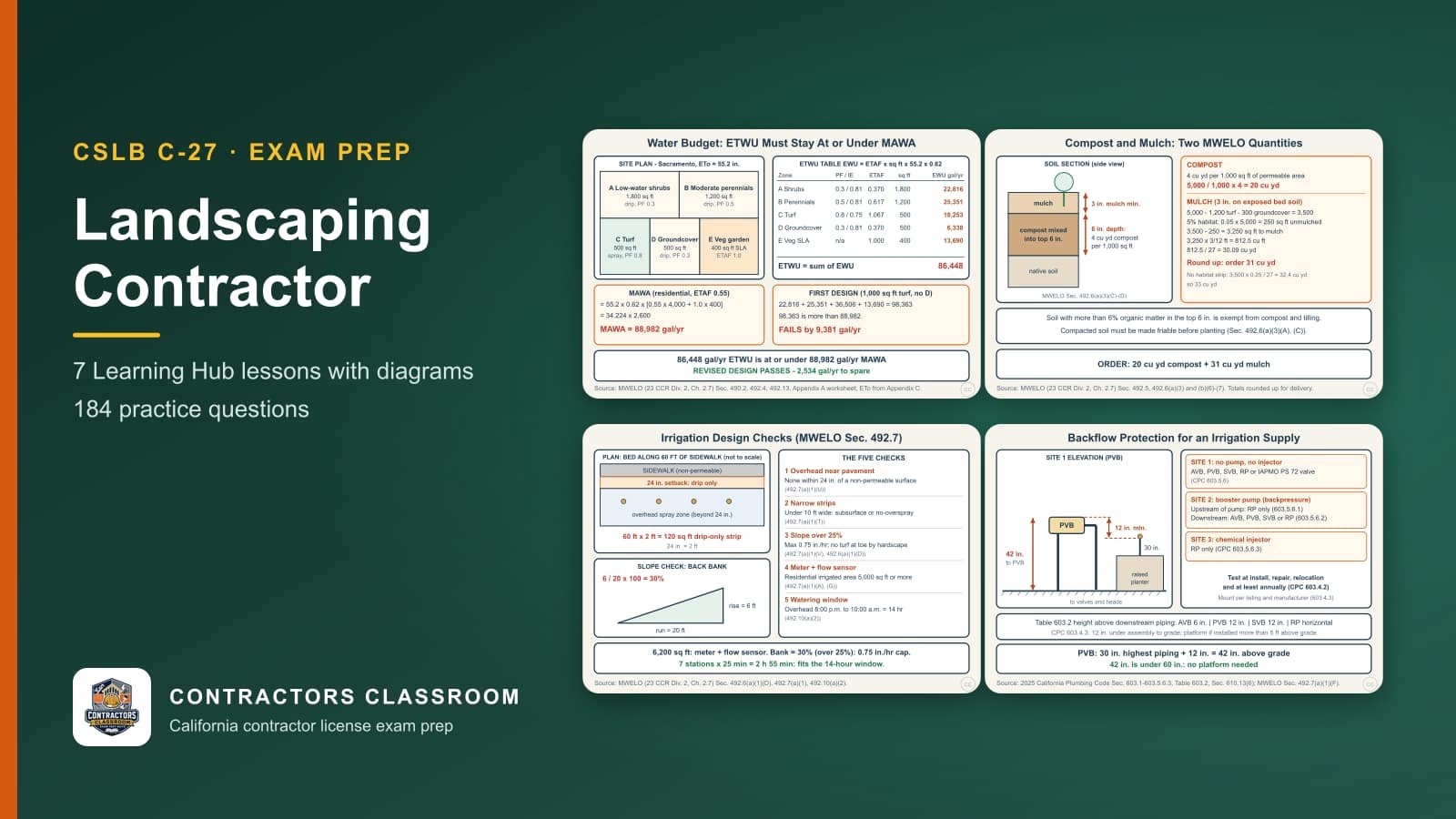
- Hydrozone
- A group of plants with similar water needs, sun exposure and soil, watered from the same valve. Mixing very thirsty and very drought-tolerant plants on one valve wastes water or kills plants, so the design plan shows each hydrozone separately.
- Maximum Applied Water Allowance
- The upper limit on a landscape's annual water use, calculated from local reference evapotranspiration, the allowed plant water-need factors and the size of the planted area. A design is acceptable only when its calculated total use does not exceed this ceiling.
- Reference evapotranspiration
- The water, in inches per year or per month, that a well-watered cool-season lawn would lose to soil evaporation and plant transpiration at a given location. Other plants' needs are expressed as a fraction of it, which makes it the base for every water budget and irrigation schedule.
- Plant factor
- A number between roughly zero and one that rates how much water a plant species needs relative to reference evapotranspiration. Lower values mean less irrigation, and the category assigned to a species controls how its hydrozone is counted in the water budget.
- Bioswale
- A shallow, planted channel shaped to slow, filter and soak up runoff from paved areas. It relies on gentle side slopes, amended soil and tolerant vegetation, and must be built with the right grade so water moves through it instead of ponding or eroding.
- Master valve
- A normally closed valve at the head of an irrigation system that opens only when the controller is running a program. If a zone valve sticks or a pipe breaks downstream, the master valve limits the loss.
- Weather-based controller
- An automatic irrigation clock that adjusts run times from evapotranspiration data or soil moisture readings instead of a fixed schedule. It keeps its settings in non-volatile memory so a power loss does not erase the program.
- Pressure vacuum breaker
- A backflow device with a spring-loaded check and an air inlet that must stand upright and well above the highest downstream outlet. It is common on sprinkler systems, cannot sit underground or in a flooded box, and needs yearly testing.
- Swing joint
- A flexible assembly of fittings that connects a sprinkler riser to the lateral pipe, letting the head absorb a bump from a mower or foot traffic without snapping the pipe. It is especially important beside walks and in busy turf.
- Drip emitter
- A low-volume device that delivers water in gallons per hour right at a plant's root zone, through tubing and fittings. It suits narrow strips, mulched beds and slopes because it avoids overspray and runoff when pressure is regulated and filtered.
- Precipitation rate
- How fast a sprinkler layout puts water on the ground, in inches per hour. Matching it to the soil's infiltration rate and the slope prevents runoff, and mixing heads with different rates on one valve causes dry and soggy spots.
- Compost incorporation
- Mixing a specified volume of compost per thousand square feet into the top layer of soil before planting, to rebuild structure and water-holding ability. Soils already rich in organic matter may be exempt, and compost is mixed in, not spread on top.
- Segmental retaining wall
- A wall built of dry-stacked, interlocking concrete units, often with layers of geogrid reaching back into the soil. It relies on gravity, setback and drainage behind it, and the units must meet the material standard that the code cites.
- Patio slab control joint
- A groove or saw cut in a concrete slab that makes the slab crack in a straight, planned line as it shrinks. Spacing is limited, and a patio laid out with joints too far apart will crack randomly.
- Landscape lighting transformer
- A box that steps household voltage down to low voltage for path and accent fixtures. Its wattage rating caps the total lamp load, and it normally includes a timer or photocell input, which is why load must be added up before choosing one.
- Voltage drop
- The loss of electrical pressure along a long or thin cable run, which makes the farthest fixtures dim. Landscape lighting designers fix it with heavier wire, shorter runs, splitting loads across circuits or using multiple transformer taps.
- Hinge
- The band of wood left intact when a tree is felled, sitting where the front notch and rear cut stop short of meeting. It steers the fall like a door hinge, and cutting through it carelessly leaves the tree uncontrolled.
- Humboldt notch
- A felling notch whose angled cut is made below the horizontal face cut. It is often used on large trees on steep slopes, and it limits how far the notch may reach into the trunk.
- Line-clearance tree trimmer
- A worker trained and qualified to prune near conductors carrying high voltage. Anyone else must stay outside the prescribed approach distance, and trimming near energized lines is never a general landscape crew task.