CSLB C-29

Masonry Contractor License Exam Prep (C-29)

Getting ready for the California masonry contractor license exam (CSLB C-29)? Study with 90 practice questions in 2 categories and 8 Learning Hub lessons, made for masons and bricklayers, with the Law and Business exam included.

One-time purchase, no subscription. Law & Business included.

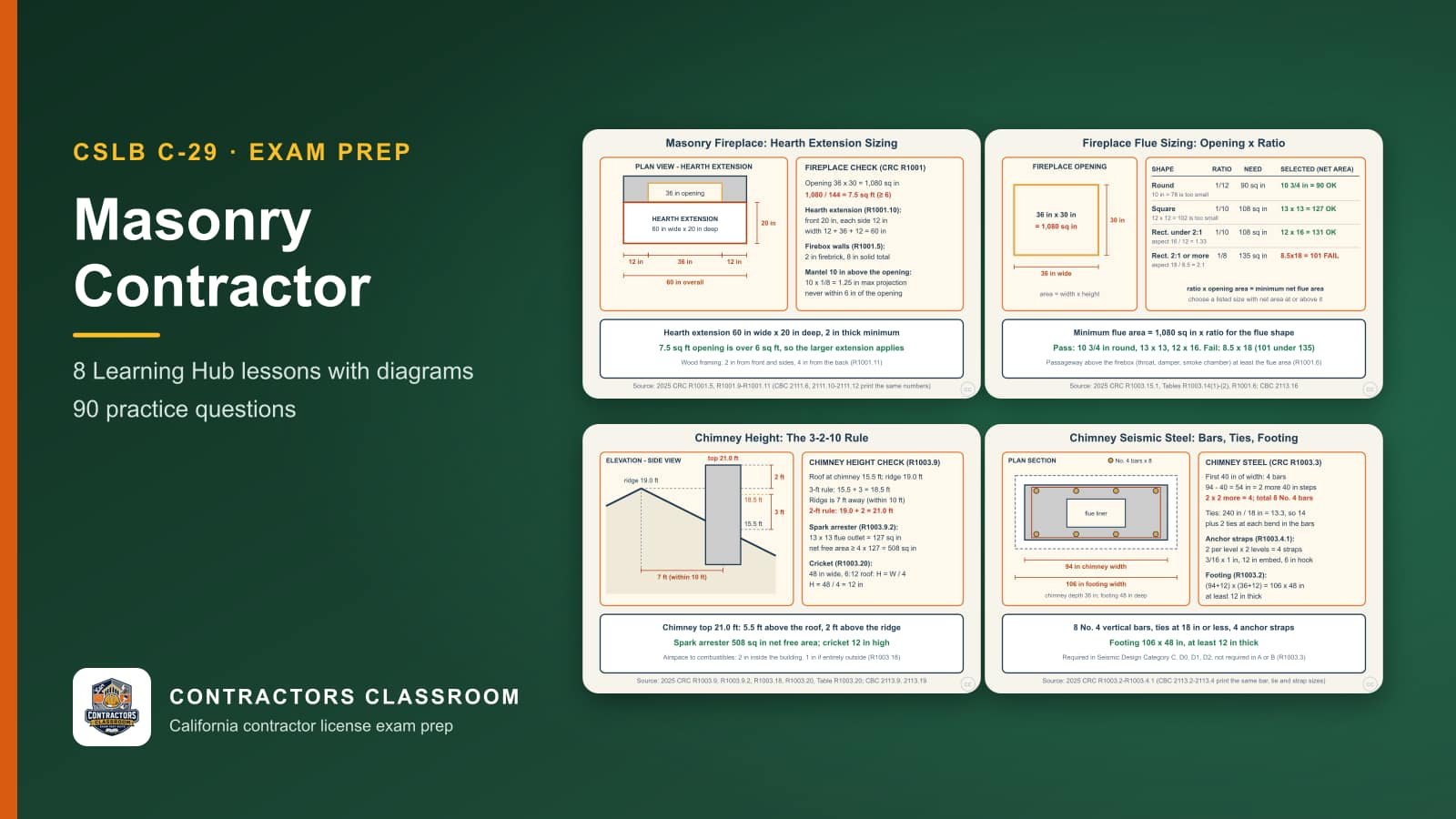
Diagrams from the C-29 masonry contractor lessons: Masonry Fireplace: Hearth, Firebox Walls and Clearances, Sizing the Flue for a Masonry Fireplace, Chimney Height, Cricket, Spark Arrester and Clearances and Chimney Seismic Steel, Ties and Strap Anchors
90practice questions
2categories
8Learning Hub lessons
$249Law & Business included

What the exam covers: Masonry (C-29)

The CSLB exam for the California masonry contractor license (C-29) is a closed-book, multiple-choice test. CSLB's official study guide divides it into seven major sections and gives each an approximate weight: Planning and Estimating (about 15%), Job Site Preparation (about 20%), Masonry Wall and Building Installation and Repair (about 16%), Decorative Masonry Installation and Repair (about 9%), Masonry Veneer and Stone Installation and Repair (about 11%), Fireplace, Chimney, and Outdoor Cooking Area Installation and Repair (about 9%), and Personnel and Job Site Safety (about 20%).

Job Site Preparation carries the most weight, about 20%, so it deserves roughly that share of your study time, with Personnel and Job Site Safety next at about 20%.

Contractors Classroom turns that outline into 90 practice questions in 2 categories (Planning and Estimating and Cal-OSHA Safety), plus 8 Learning Hub lessons with diagrams (such as "Masonry Fireplace: Hearth, Firebox Walls and Clearances" and "Sizing the Flue for a Masonry Fireplace"). Law and Business, which most applicants take alongside their trade exam, is included at no extra charge.

Exam sections and approximate weights

  • Planning and Estimating~15%
  • Job Site Preparation~20%
  • Masonry Wall and Building Installation and Repair~16%
  • Decorative Masonry Installation and Repair~9%
  • Masonry Veneer and Stone Installation and Repair~11%
  • Fireplace, Chimney, and Outdoor Cooking Area Installation and Repair~9%
  • Personnel and Job Site Safety~20%

Practice question categories

  • Planning and Estimating75 practice questions
  • Cal-OSHA Safety15 practice questions

What the Masonry Contractor exam covers, section by section

Planning and Estimating (~15%)

Masonry jobs are won on paper before the first unit is laid. The mason decides what is being built and in what stages, studies the drawings and written specifications, and converts them into counts of block, mortar, grout and steel, along with the crew hours and equipment needed to place them.

  • Break the job into stages with a clear scope
  • Pull wall sizes, openings and details from drawings
  • Take off block, mortar, grout and rebar quantities
  • Estimate crew hours plus scaffolding and mixer needs

Job Site Preparation (~20%)

A masonry site has to be ready before units go up. Permits, utility marking and deliveries are settled early, runoff is steered away from footings and stacked materials, and steel is positioned while fresh walls get bracing against wind until the mortar gains strength. Access and storage are then set up so crews keep working.

  • Handle permits, utility marks and deliveries before work begins
  • Divert runoff and groundwater from footings and stored units
  • Position steel and brace fresh walls until they cure
  • Set up staging, storage and clear access for the crew

Masonry Wall and Building Installation and Repair (~16%)

Laying up a block wall is the central craft here: courses kept level and plumb, cells filled with grout and steel, and the whole assembly tied together. Older buildings add the challenge of matching original mortar and units, and retaining walls must hold soil back and let water escape. Finished masonry is cleaned of smears and stains.

  • Lay concrete block courses level, plumb and aligned
  • Restore aging masonry with compatible mortar and matching units
  • Construct and fix walls that hold back soil
  • Remove mortar smears and stains without damaging faces

Decorative Masonry Installation and Repair (~9%)

Decorative work puts appearance first, so layout, finish and fit carry extra weight. Patios, walks and steps need a firm base and slope for water. Precast pieces arrive made and must be set carefully, while glass block panels need support and room to move. Chipped, cracked or stained pieces can be mended and cleaned.

  • Lay paved surfaces and steps over a stable, draining base
  • Set factory-made masonry pieces with correct anchoring
  • Build glass block panels with even joints and support
  • Fix chipped ornamental work and wash away stains

Masonry Veneer and Stone Installation and Repair (~11%)

Veneer gives a building the look of masonry without carrying its weight. Adhered types bond to a prepared backing with mortar, anchored types hang from ties fastened to the wall behind, and cut stone brings its own handling and fastening demands. Over time joints open, units crack and faces stain, so repair and gentle cleaning matter.

  • Bond thin units to a prepared backing with proper mortar
  • Tie brick or stone veneer to the wall with metal anchors
  • Set cut stone in a planned pattern with solid support
  • Repoint failed joints, replace damaged units and clean gently

Fireplace, Chimney, and Outdoor Cooking Area Installation and Repair (~9%)

Anything built to hold fire needs materials and clearances that tolerate heat and carry smoke safely out. A masonry fireplace relies on a firebox, throat, flue and chimney working together to draw well, while outdoor barbecues and fire pits face the same heat plus weather and nearby combustibles. Knowing why each part exists helps a mason build structures that perform and stay safe in use.

  • Build fireboxes, flues and chimneys from heat-tolerant materials with safe clearances
  • Construct outdoor grills and fire pits that contain fire and withstand heat

Personnel and Job Site Safety (~20%)

Masonry is heavy, dusty work, so protection is built into the routine. Crews follow California safety rules, guard against falls from scaffolds and walls, and use proper lifting methods for stone slabs that can crush or slip. Dust, slurry and cutting waste are contained and disposed of properly.

  • Follow California workplace safety rules for training and protective gear
  • Work safely on scaffolds and tall walls using fall protection
  • Move and cut heavy slabs with lifting aids and dust control
  • Contain and dispose of dust, slurry and hazardous waste

Code books behind the Masonry Contractor exam

The exam outline published for this trade lists these references.

  • 2022 California Building CodeThe building code chapter on masonry, together with its chapters on foundations, fire-resistance and glazing in walls, sets the rules for reinforced and unreinforced walls, mortar and grout, anchorage and veneer. For a mason it also covers site flatwork slopes, so it feeds Masonry Wall and Building Installation, Decorative Masonry and Job Site Preparation questions.
  • 2022 California Historical Building CodeThis code offers alternative, flexible provisions for qualified historical structures so that original brick, stone and mortar can be kept and repaired instead of replaced. A mason uses it to judge when a repair should match old materials and methods, which supports the historical masonry part of the wall installation and repair section.
  • 2022 California Residential CodeThe residential code is the source for houses and small structures: masonry fireplaces and chimneys, veneer limits and ties, mortar types, wall reinforcement and the footings beneath. Hearth sizes, flue rules and clearances are all found here, so it is central to the fireplace section and to the veneer and wall questions on the exam.
  • Building Code Requirements and Specification for Masonry StructuresThis pair of documents combines design requirements with a construction specification for masonry: unit and mortar quality, grouting, reinforcement placement, tolerances, cold and hot weather practice and quality assurance. It is the reference behind questions on how masonry is built correctly, mainly in Job Site Preparation and the wall installation section.
  • Dimension Stone Design ManualA reference on natural cut stone: stone types and properties, thickness, finishes, anchoring systems, joints and installation practice for facings, paving and veneer. It informs how stone slabs are selected, supported and fastened, so it feeds the dimensional stone part of Masonry Veneer and Stone Installation and Repair and the handling of heavy slabs in safety.
  • Informational Guide to Grouting Masonry, 3rd EditionThis guide explains grout mixes, low-lift and high-lift methods, cell cleanouts, consolidation and the timing and height limits for pours in reinforced block and brick walls. It is the specific reference behind reinforcement-and-grouting questions in Job Site Preparation and in Masonry Wall and Building Installation, where sequencing and inspection are tested.
  • Masonry Design ManualA design-oriented companion that shows typical reinforced wall sections, bar sizes and locations, lintels, bond beams, wall types and detailing. Even for a contractor who does not design, it clarifies what the engineer's drawings mean, so it supports plan reading and material calculations in Planning and Estimating and wall construction in the installation section.
  • Masonry Fireplace and Chimney HandbookA construction handbook for masonry fireplaces and chimneys: footing and hearth, firebox proportions, damper, smoke chamber, flue liner, termination height, clearances and seismic reinforcement. Every topic of the fireplace section of the exam, including barbecue and fire pit construction, can be linked to the details described here.
  • Masonry VeneerA technical guide to both anchored and adhered veneer: unit types, tie and anchor spacing, air space, flashing, weep holes, lath and scratch coat for adhered systems, movement joints and wall movement. It is the reference behind the veneer section of the exam, about eleven percent, and a common source of water-management questions.
  • State of California Construction & Electrical Safety Orders (Cal/OSHA)The construction safety orders govern masonry work: bracing of freestanding walls, restricted zones beside walls under construction, scaffold and elevated work, material stacking, silica dust from cutting, and handling heavy stone slabs. They feed the Personnel and Job Site Safety section, about a fifth of the exam, including disposal of contaminated materials.
  • Vocational Skills Training for Segmental Paver InstallationA training manual for interlocking paver work: excavation, compacted aggregate base, bedding layer, edge restraints, laying patterns, cutting, compaction and joint sand, along with drainage. It is the specific source behind patio and driveway paver questions in Decorative Masonry Installation and Repair and the base-preparation items in Job Site Preparation.

Key terms for the Masonry Contractor exam

Concrete masonry unit
A precast hollow block, usually eight inches deep, used to build reinforced walls with grout-filled cells. Its nominal size includes the mortar joint, so counting units and square footage depends on knowing nominal against actual dimensions.
Bed joint
The horizontal layer of mortar that a unit rests on, as opposed to the vertical head joint at its end. Full, even bed joints affect wall strength, water resistance and appearance, so mortar coverage and thickness are common quality checks.
Running bond
A pattern where each course is shifted half a unit from the one below so vertical joints never line up. It spreads loads, resists cracking along joints and sets how reinforcing steel and cells align in block walls.
Bond beam
A horizontal course of special U-shaped or notched block, filled with grout and reinforcing bars, that ties a wall together at the top or at intervals. It also supports roof or floor connections, so its steel must be positioned before grouting.
Grout lift
One stage of filling wall cells with grout, limited in height so the fluid pressure does not blow out units and the mix can be consolidated. Waiting for earlier lifts to stiffen before adding the next is part of the method.
Cleanout
An opening left at the base of a tall grouted cell so mortar droppings and debris can be washed or blown out and the steel inspected before closing. Leaving fins and fallen mortar behind blocks grout flow and bond.
Type S mortar
A mix classification with high compressive and flexural bond strength, commonly specified for below-grade work, retaining walls and reinforced walls under lateral load. Choosing the right type for exposure and loading, and batching by volume, are routine exam topics.
Weep holes
Openings left at the base of veneer, above flashing, that let moisture trapped behind the facing drain out. Plugging them with mortar, or omitting the flashing above them, turns a drainage plane into a water trap.
Veneer tie
A corrosion-resistant metal anchor fastened to the backing wall and set in the mortar joint to hold anchored brick or stone to the structure. Size, spacing and extra ties around openings are checked, and the tie must keep the air space open.
Adhered veneer
Thin stone or masonry units bonded directly to a backing with mortar, usually over lath and a scratch coat, with no air space or ties. Surface preparation and bond are critical because the facing relies on adhesion, not mechanical anchors.
Hearth extension
The noncombustible floor surface in front of a fireplace opening that protects framing and finishes from sparks and rolling embers. Its depth and width beyond the opening, and its thickness, are set by code and appear in fireplace questions.
Smoke chamber
The sloped masonry transition between the firebox throat and the flue that funnels smoke upward. Its smoothly parged interior walls and inward slope reduce turbulence and keep the draft working, and its construction is a distinct checkpoint.
Flue liner
A fire-clay or code-accepted equivalent tile lining that contains hot gases and protects surrounding masonry. Its cross-sectional area is tied to the fireplace opening, and sections must be joined and supported correctly all the way up.
Chimney cricket
A small peaked saddle built on the high side of a wide chimney where it meets a sloped roof, to shed water around the stack instead of letting it pool behind. It is flashed like a roof detail.
Spark arrester
A screened cap at the top of a flue that keeps burning fragments from escaping and starting roof or brush fires. Mesh size and material limits apply, and it must stay clear enough not to choke the draft.
Limited access zone
A marked strip beside a wall that is being built, which only the crew actually working on it may enter, because an unbraced wall could fall. Its width tracks wall height, and the marking remains until bracing or completion makes the wall stable.
Efflorescence
A white, powdery salt deposit left on masonry surface when water moving through the wall evaporates. It signals moisture entering or passing through the assembly, and the cleaning and repair step is to find the source of that water.
Repointing
Raking out deteriorated mortar joints to a safe depth and refilling them with fresh mortar, ideally matched in strength and color to historic work. A mix harder than the old brick can damage the units, so matching matters.
Edge restraint
A rigid border of concrete, steel or plastic that locks interlocking pavers in place and stops the sand bed from spreading outward under traffic. Without it, rows shift and joints open, so it goes in before the pavers are fully set.

Where to spend practice time for the Masonry Contractor exam

  • Job site preparation (20 percent)This section covers pre-construction, water management, reinforcement and bracing, and site setup, and it shares top weight with safety. Drill the order of operations before any wall goes up: footing and dowels, moisture protection, steel placement and spacers, cleanouts, bracing and drainage. Sketch a wall section and mark where each item belongs.
  • Safety around walls and stonePersonnel and Job Site Safety is also about 20 percent. Concentrate on the masonry-specific items: restricted zones and bracing for freestanding walls, scaffold and elevated work, stacking of heavy units, silica dust from cutting, lifting stone slabs, and disposing of contaminated materials. For each, learn the trigger, the control, and who may be where.
  • Planning, quantities and unit mathPlanning and Estimating is about 15 percent but needs a calculator. Practice nominal versus actual unit sizes, converting a count of block or brick into wall area and back, mortar and grout volumes, bar counts from spacing, and the square footage of paving or veneer. Work a few problems backward to confirm the units.
  • Wall construction, repair and groutingThe wall construction section is about 16 percent and spans CMU walls, historical repair, retaining walls and cleaning. Compare mortar types and where each fits, review grout lift sequencing and cleanouts, and learn what reinforcement and drainage a retaining wall needs. Add the methods used for repointing and cleaning without harming old masonry.
  • Veneer and stone systemsVeneer and stone installation is about 11 percent of the exam and has two systems to keep apart. Compare anchored and adhered veneer: ties, air space, flashing and weep holes against lath, scratch coat and bond. Practice drawing a base-of-wall detail that shows where water enters and where it leaves, then repeat for dimension stone with its own anchors.
  • Fireplaces, chimneys and outdoor cookingFireplace, chimney and outdoor cooking work is about 9 percent, but it is rule-heavy and answers are specific. Practice the sequence from footing to hearth, firebox, throat, smoke chamber, flue and termination, the clearance and flue-sizing relationships, and the seismic steel. Compare how barbecues and fire pits differ from a house fireplace.

Scenarios to talk through before the Masonry Contractor exam

  • Fireplace with a tall mantelA homeowner wants a masonry fireplace with a wooden mantel set close to the opening. Reason through the hearth extension, the firebox, the smoke chamber, the flue liner and clearance to combustibles. Which items would you check before the framing is closed in, and which are only visible if you inspect at the right stage?
  • Tall grouted block wallYou are about to grout a tall reinforced block wall. Walk through the grout lift, the bond beam, the cleanouts and the placement of vertical steel. In what sequence do you clean, inspect, close and fill, and what mistakes in the earlier courses would make the pour fail or the cells stay empty?
  • Freestanding wall near a drivewayYour crew is raising a tall masonry wall beside a driveway where deliveries will pass. Consider the limited access zone, temporary bracing, stacked units and scaffold work. Who may be inside the marked area, how long does it remain, and what changes about the plan if the wind picks up?
  • Damp stains on new veneerA white deposit and damp patches appear low on a new brick veneer wall. Trace the possible causes using efflorescence, weep holes, flashing, mortar droppings, veneer ties and the air space. What would you inspect first, what could be repaired from the outside, and what would require opening the wall?
  • Repointing a century-old wallAn old brick wall has crumbling joints, and the owner wants it repaired without damaging the building's character. Discuss repointing, mortar strength compared with the old brick, the historical building code, and cleaning methods. How deep do you rake, what do you test first, and why can a harder mix cause new damage?
  • Paver patio beside the houseA client wants a paver patio against the back of the house that sheds rain away from the wall. Think through excavation, compacted base, bedding layer, edge restraint, slope and joint sand. What would you check in the base before laying the first paver, and which defect would show up first if the edge restraint were left out?
  • Delivering large stone slabsLarge natural stone slabs are arriving for a veneer and countertop job. Consider how they are unloaded, stored and carried, what lifting aids suit them, and what dust arises when you cut. How would you protect people, keep the slabs from cracking, and dispose of the slurry and offcuts?
  • Chimney through the roofA new masonry chimney will pass through a pitched roof. Reason through the termination height, the cricket, the spark arrester, flashing and the seismic steel with its ties and strap anchors. Which of these are set while building, which at the end, and how do they all connect back to the fireplace opening?

Learning Hub lessons

Each lesson has guided steps, a diagram, a worked example and a quick check inside the classroom.

Preview the lesson diagrams

  1. Masonry Fireplace: Hearth, Firebox Walls and ClearancesSteps: What the Code Controls on a Masonry Fireplace; Hearth and Hearth Extension: Thickness and Size; Firebox Walls, Depth, Throat and Lintel; Clearance to Combustibles and Mantels; Footing, Cleanout and the Order of Checks
  2. Sizing the Flue for a Masonry FireplaceSteps: Why the Flue Is Tied to the Opening; Get the Opening Area; Pick the Ratio for the Flue Shape; Read the Net Area from the Tables; Check the Passageway and Install the Liner
  3. Chimney Height, Cricket, Spark Arrester and ClearancesSteps: The 3-2-10 Termination Rule; Chimney Cap and Cricket; Spark Arrester and Rain Cap; Clearance to Combustibles and Fireblocking; Walls, Cleanout and Flue Changes
  4. Chimney Seismic Steel, Ties and Strap AnchorsSteps: When the Seismic Rules Apply; Vertical Bars: Count by Width; Horizontal Ties; Strap Anchors at Floors, Ceilings and Roof; Footing and Corbeling
  5. Grouting Reinforced Masonry: Lifts, Pours and CleanoutsSteps: The Grout Itself and the Time Limit; Lift Height and Pour Height; Build the Cells So the Grout Can Flow; Hold the Steel in Place and Keep It Covered; Cleanouts, Barriers and the Inspection Window
  6. Mortar Types and Batching by VolumeSteps: Which Mortar Goes Where; Read the Cement-Lime Rows of Table R606.2.8; Why the Type Matters; Batch by Volume Using the Code Weights; Joints and Placement Once the Mortar Is Mixed
  7. Anchored Masonry Veneer: Ties, Flashing and Weep HolesSteps: Where Anchored Veneer Is Allowed; Tie Size, Embedment and Spacing; Extra Ties Around Openings; Airspace and Table R703.8.4(1); Flashing, Weep Holes and Angle Support
  8. Masonry Wall Safety: Limited Access Zone, Bracing and StackingSteps: When a Limited Access Zone Is Required; How Wide the Zone Is; Who May Enter and How Long It Stays; Bracing Walls Over 8 Feet; Stacking Brick and Block; Dust Control When You Cut Masonry

See the classroom in action

Frequently asked questions

How do I get a California masonry contractor license?

A mason or bricklayer who wants to contract independently applies under C-29. CSLB generally requires documented journey-level experience, a bond, and passing scores on both the Law and Business exam and the C-29 exam. Rules change, so confirm them with CSLB.

What does the masonry contractor exam ask about job site preparation?

Job Site Preparation is the heaviest part of the C-29 exam, at about 20%. Expect questions on handle permits, utility marks and deliveries before work begins, divert runoff and groundwater from footings and stored units, and position steel and brace fresh walls until they cure. Next in weight come personnel and job site safety (about 20%) and masonry wall and building installation and repair (about 16%).

What kinds of questions are on the masonry contractor exam?

The three sample questions in CSLB's C-29 study guide ask about what to do with surplus concrete, how much wall area a pile of concrete blocks covers, and the minimum slope of a brick patio near a building. Like every question on the exam, each has four choices and one best answer.

Which codes and books does the C-29 exam reference?

CSLB's C-29 study guide lists the 2022 California Building, Historical Building, and Residential Codes (Title 24), the Cal/OSHA safety orders (Title 8), and trade references such as Building Code Requirements and Specification for Masonry Structures, Dimension Stone Design Manual, and Informational Guide to Grouting Masonry, 3rd Edition. Use them to study; the exam itself is closed-book.

Is the masonry contractor exam open book?

No. The C-29 study guide says no reference materials may be used, even though it names Building Code Requirements and Specification for Masonry Structures and Dimension Stone Design Manual among the books to study from. A calculator is provided, and guessing is not penalized.

Can I take the masonry contractor exam outside California?

CSLB's exam FAQ says trade exams are given in California or Oregon only, so C-29 is not offered in other states, although Law and Business can be taken out of state. Check the current PSI list when you schedule.

How are the 90 C-29 practice questions organized?

They are split into 2 categories, largest first: Planning and Estimating (75) and Cal-OSHA Safety (15). Planning and Estimating holds about 83% of the questions. 8 Learning Hub lessons add diagrams and worked examples for the harder topics. The missed-question review collects every question you get wrong.

Is there a free trial for masonry contractor exam prep (C-29)?

Yes. The free C-29 preview opens the real classroom with no sign-up and gives you the first question from every C-29 category, including Planning and Estimating and Cal-OSHA Safety, plus Law and Business. The full course is a one-time $249 purchase.

Is masonry contractor exam prep available in Spanish?

The website and the eight demo videos are available in Spanish. The classroom and the 90 C-29 practice questions are in English for now; translating the questions is not part of the course yet.

Ready to practice for real?

Try the real classroom free, no sign-up, or get the full course for your trade.

Independent exam preparation. Contractors Classroom is not affiliated with the Contractors State License Board, and no course can guarantee a passing result.


