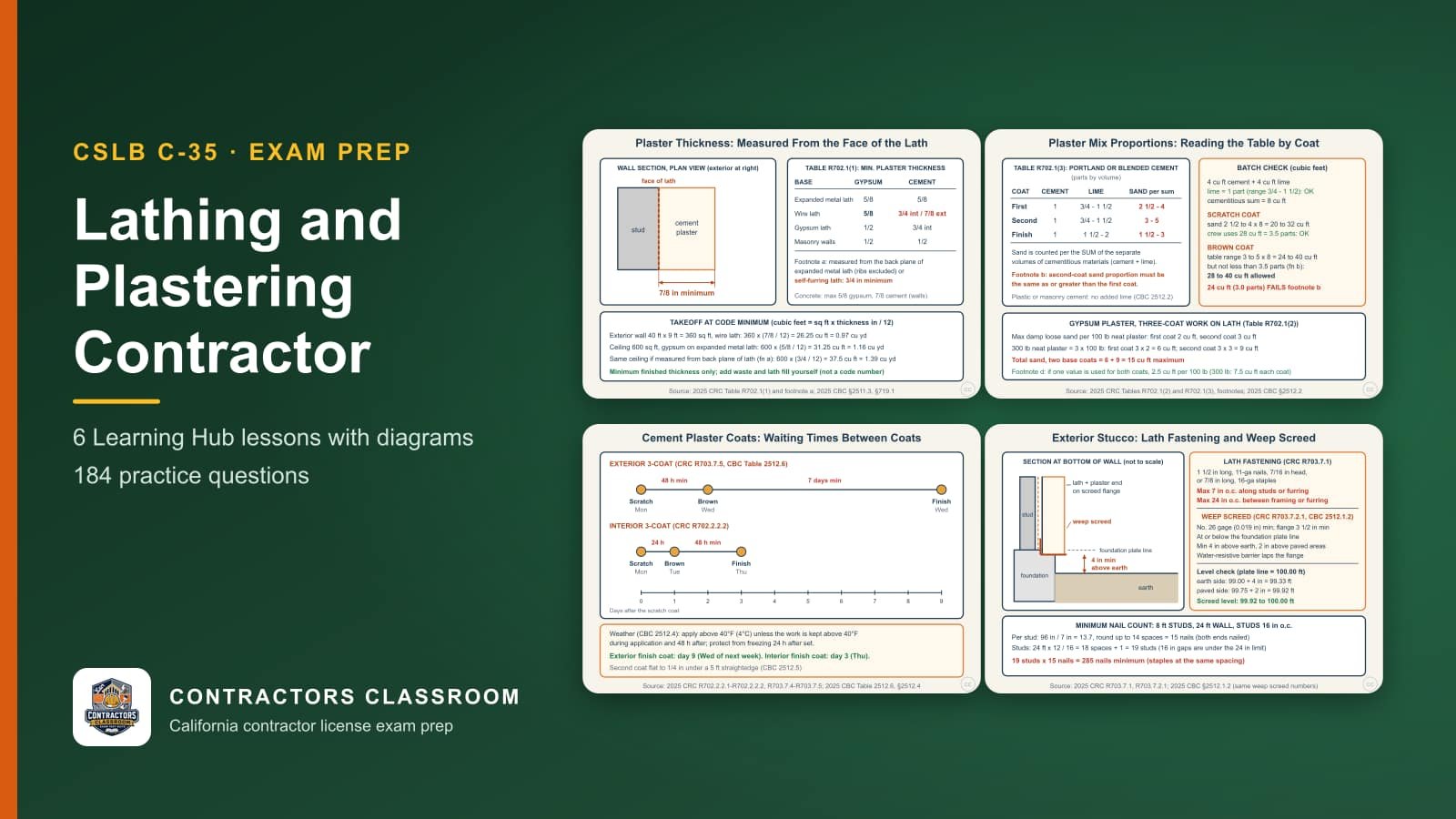
- Scratch coat
- The first plaster coat, pressed hard enough to push through the lath and then raked to leave grooves. The grooves give the next coat something to grip, so the surface is intentionally rough.
- Brown coat
- The second, leveling coat laid over a scratch coat that has set. It is floated flat and true, since the thin finish coat cannot hide waves or hollows left behind in this layer.
- Finish coat
- The thin final layer that supplies color and texture, whether smooth trowel, sand float or dash. It is applied over a brown coat that has cured, and its mix and timing influence how even the color appears.
- Expanded metal lath
- Steel sheet slit and stretched into a diamond mesh that holds plaster mechanically. It is galvanized for corrosion resistance, must be backed rigidly, and laps are fastened so the mesh does not flex under the plaster.
- Weep screed
- A metal accessory at the base of a stucco wall that lets trapped water escape and air move behind the cladding. It must stay above the ground or paving by the required distance and be integrated with the weather barrier.
- Furring
- Spacing lath slightly off the sheathing so plaster can wrap around the mesh from behind. Self-furring lath has dimples or ribs that do this, while other methods use nails, strips or special fasteners.
- Plaster ground
- A strip of wood or metal fixed around openings and at edges to gauge the plaster thickness. Plasterers run their screed or darby against the grounds, so they define the flatness and thickness of the wall.
- Casing bead
- A metal trim that finishes a plaster edge where it stops against another material or at a window or door. It protects the edge, provides a straight line and serves as a ground for thickness.
- Keying
- The plaster pushed through the openings in lath and mushrooming out behind it. These keys lock the coat to the lath mechanically, so a thin or starved scratch coat produces weak bond.
- Damp curing
- Keeping cement plaster moist for a set period, often by misting, so it can gain strength rather than dry out too fast. Hot, dry or windy conditions make curing more important and sometimes change the schedule.
- Mix proportions by volume
- A recipe that gives cement, lime and sand as parts measured by volume, such as one part cement to a stated range of sand. Later coats may not be leaner than earlier ones, so the base coats carry the richest mix.
- Neat gypsum plaster
- Gypsum plaster as sold in the bag before any sand is added. Sand is measured in relation to a hundred-pound unit of neat plaster, so the batch size follows the plaster rather than the sand.
- Plaster equivalent thickness
- A fire-test credit that lets a stated thickness of plaster count as protection normally supplied by another material. Its depth is counted starting at the lath surface, not at the framing behind it.
- Crazing
- A network of fine hairline cracks on the surface of cement plaster. It usually follows drying too quickly, an overly wet or rich mix or over-troweling, and good curing practice helps prevent it.
- Control joint
- A metal accessory that divides a large stucco wall into panels so shrinkage and building movement crack along the joint rather than across the surface. Panel size limits and joint locations are set by code.
- Hawk
- A flat, square board held with a handle underneath that carries a supply of plaster. The plasterer scoops material onto the trowel from it, keeping it close to the wall and the working height.
- Plaster mixer guard
- A cover over the paddles, hopper opening and drive parts of a plaster mixer. It keeps hands and clothing out of moving machinery, so the mixer must not run with the guard removed.
- Cold joint
- A visible seam where fresh plaster meets plaster that has already begun to set in the same wall plane. Crews plan their work in continuous sections, stopping at corners or joints, to avoid this blemish.
- Cement hydration
- The chemical reaction between portland cement and water that hardens plaster and builds strength. Because it needs moisture, drying is not the same as curing, and plaster that dries too soon stays weak.
- Water-resistive barrier
- The asphalt-saturated paper or similar membrane installed behind lath to drain water that penetrates the stucco. Layers are lapped like shingles and tied into flashing and the weep screed.