CSLB C-7

Low Voltage Systems Contractor License Exam Prep (C-7)

Getting ready for the California low voltage systems contractor license exam (CSLB C-7)? Study with 460 practice questions in 4 categories and 4 Learning Hub lessons, made for low voltage and alarm technicians, with the Law and Business exam included.

One-time purchase, no subscription. Law & Business included.

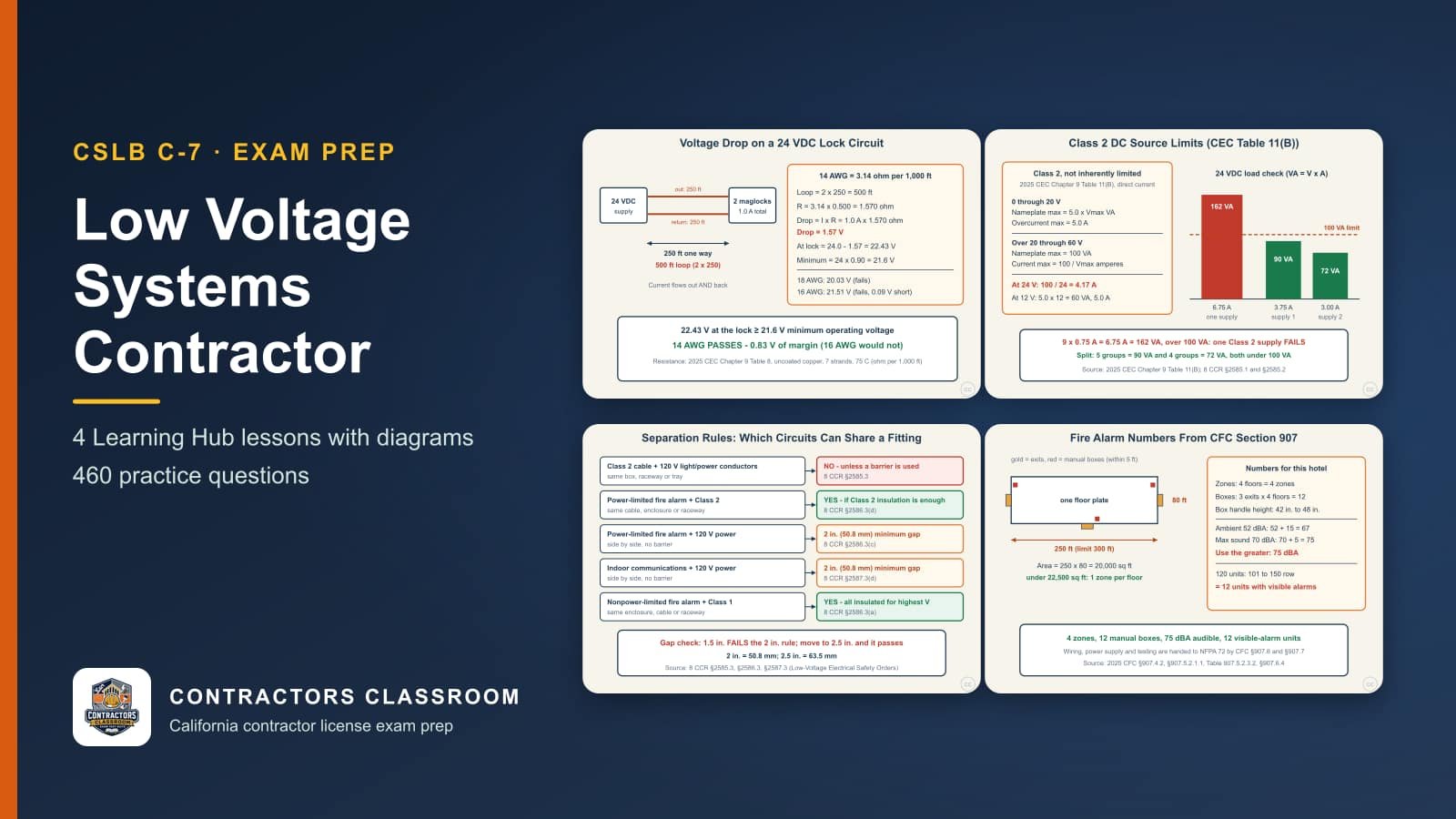
Diagrams from the C-7 low voltage systems contractor lessons: Voltage Drop on Low-Voltage DC Runs (Locks, Cameras, Sounders), Class 2 Power Source Limits: How Big a Supply Can One Circuit Use, Keeping Low-Voltage, Fire Alarm and Communications Wiring Apart and Fire Alarm Layout Numbers Printed in CFC Section 907
460practice questions
4categories
4Learning Hub lessons
$249Law & Business included

What the exam covers: Low Voltage Systems (C-7)

The CSLB exam for the California low voltage systems contractor license (C-7) is a closed-book, multiple-choice test. CSLB's official study guide divides it into seven major sections and gives each an approximate weight: Job Planning and Design (about 18%), Material Selection and Estimation (about 15%), Wire/Cable Installation and Termination (about 12%), Systems Configuration and Installation (about 16%), Testing and Project Closeout (about 17%), System Troubleshooting, Repairs, or Replacements (about 7%), and Safety (about 15%).

Job Planning and Design carries the most weight, about 18%, so it deserves roughly that share of your study time, with Testing and Project Closeout next at about 17%.

Contractors Classroom turns that outline into 460 practice questions in 4 categories (Planning and Estimating, Structured Cabling & Telecommunications, Life Safety, Access Control & Alarm Systems, and Electrical Safety & Cal-OSHA), plus 4 Learning Hub lessons with diagrams (such as "Voltage Drop on Low-Voltage DC Runs (Locks, Cameras, Sounders)" and "Class 2 Power Source Limits: How Big a Supply Can One Circuit Use"). Law and Business, which most applicants take alongside their trade exam, is included at no extra charge.

Exam sections and approximate weights

  • Job Planning and Design~18%
  • Material Selection and Estimation~15%
  • Wire/Cable Installation and Termination~12%
  • Systems Configuration and Installation~16%
  • Testing and Project Closeout~17%
  • System Troubleshooting, Repairs, or Replacements~7%
  • Safety~15%

Practice question categories

  • Planning and Estimating78 practice questions
  • Structured Cabling & Telecommunications155 practice questions
  • Life Safety, Access Control & Alarm Systems127 practice questions
  • Electrical Safety & Cal-OSHA100 practice questions

What the Low Voltage Systems Contractor exam covers, section by section

Job Planning and Design (~18%)

Before any cable is pulled, the installer studies drawings and written specifications to understand what the low voltage system must do and where it will live. Good planning means choosing wire routes and equipment spots that respect code, avoid conflicts with plumbing, framing, and power work, and tie cleanly into the cabling and gear a building already has.

  • Reading drawings and specs to understand scope, symbols, and system requirements
  • Deciding where cable runs, racks, panels, and devices will be placed
  • Meeting code and accepted industry practice in every design choice
  • Anticipating how your work affects framers, electricians, and other trades
  • Connecting new systems to existing cabling, equipment, and network backbones

Material Selection and Estimation (~15%)

Choosing the right cable, connectors, enclosures, and hardware for each application keeps a system dependable and easy to service. This area also looks at the hand and power tools used to install it, plus the arithmetic of quantities, labor, and markup that turns a scope of work into a priced proposal a customer can approve.

  • Matching cable types and hardware to the application and the surrounding environment
  • Choosing tools and test gear suited to each installation task
  • Pricing materials and labor into a clear written proposal for the customer

Wire/Cable Installation and Termination (~12%)

Pulling cable well starts with the pathway: conduit, trays, hangers, and supports that protect conductors and keep them organized. From there the work moves to terminating each conductor properly at jacks, panels, and connectors, and identifying every run so the next technician can trace it quickly without guesswork or opening ceilings.

  • Laying out and fastening raceways, trays, and cable supports along the route
  • Choosing termination tools and techniques that fit each connector type
  • Seating and terminating conductors cleanly at jacks, blocks, and patch panels
  • Using consistent labels so every cable can be identified later

Systems Configuration and Installation (~16%)

This is the hands-on core of the trade: mounting racks and equipment-room gear, then installing the end devices and head-end hardware for each system type. A candidate also needs working knowledge of how building controls are integrated and how networked and voice-over-IP equipment receives addresses, settings, and connections so everything works together.

  • Mounting racks, power supplies, and patch hardware inside the equipment room
  • Installing cameras, phones, data outlets, speakers, antennas, and fiber links
  • Placing controllers and sensors that automate building functions
  • Assigning addresses and settings so networked and voice devices communicate

Testing and Project Closeout (~17%)

A system is not finished when the last device is mounted. Technicians verify continuity, signal quality, and operation with appropriate meters and analyzers, then assemble as-built drawings and test records. The job ends with a walkthrough where the owner's staff learn how to operate the system and where to find its documentation.

  • Selecting meters and analyzers that confirm equipment performs as designed
  • Delivering records, as-built drawings, and hands-on instruction to the owner

System Troubleshooting, Repairs, or Replacements (~7%)

When a low voltage system misbehaves, the fix begins with a methodical look at symptoms, power, connections, and recent changes rather than random part swapping. Isolating the faulty cable, device, or setting, then repairing or replacing it and confirming normal operation, keeps downtime short and callbacks rare for the customer.

  • Isolating faults step by step, then repairing or replacing failed cables and devices

Safety (~15%)

Low voltage crews work in ceilings, attics, trenches, and on ladders and rooftops, so hazard awareness matters as much as technique. A solid grounding in California workplace safety rules, a habit of spotting dangers before starting, and consistent safe routines protect both the crew and other people in the building.

  • Following the Cal/OSHA rules that apply to cabling and installation work
  • Recognizing overhead, electrical, and confined-space dangers before starting
  • Using ladders, tools, and protective gear correctly every day

Code books behind the Low Voltage Systems Contractor exam

The exam outline published for this trade lists these references.

  • 2022 California Building CodeFor low voltage work the building code matters wherever cable leaves its pathway: penetrations through rated walls and floors that need firestopping, equipment room construction, accessible mounting of devices, and the effect of your routes on structure and finishes. It feeds the code-compliance and impact-on-other-trades topics in Job Planning and Design.
  • 2022 California Electrical CodeThe electrical code supplies the articles for Class 2 and Class 3 circuits, power-limited fire alarm, communications and optical fiber cables, including marking, separation from power conductors and grounding. It is the reference behind pathway and termination rules in Wire/Cable Installation and the compliance and safety topics throughout the exam.
  • 2022 California Fire CodeThe fire code is where fire alarm and detection layout lives for this trade: manual pull stations, how a building is divided into zones, sound levels for horns, visible strobes, and spare capacity. It feeds the life safety portions of Systems Configuration and Installation and the code compliance topics in Job Planning and Design.
  • ANSI/CEA/CEDIA/InfoComm Standard: Audio, Video and Control Architectural Drawing Symbols StandardA drawing-symbol standard for audio, video and control systems. It lets a contractor read a room plan, identify speakers, displays, cameras, touch panels and rack equipment, and tell what a designer intends. It supports the plan interpretation bullet in Job Planning and Design and the audio and video portions of Systems Configuration.
  • BICSI: Telecommunications Distribution Methods Manual (TDMM)A design and installation manual for telecommunications spaces and pathways: entrance facilities, equipment rooms, backbone and horizontal cabling, grounding and bonding for communications, firestopping and cabling support. It is a main source for planning wire routes and equipment locations and for the installation topics in Wire/Cable Installation and Termination.
  • State of California General Industry & Electrical Safety Orders (Cal/OSHA)Together with the Construction Safety Orders, this Title 8 set covers the hazards a low voltage crew meets: working at heights in ceilings and on lifts, electrical contact, tools, laser and fiber handling, and job site conditions. It is the reference behind the Safety section, which is about 15 percent of the exam.
  • TIA Wiring StandardsThese standards define cabling performance categories, topology, maximum link lengths, pathway and space design, and labeling and records. They are the basis for choosing Cat 6 versus fiber, for termination practice and for acceptance testing, so they feed Material Selection, Wire/Cable Installation and Testing and Project Closeout.
  • Ugly's Electrical ReferencesA compact reference of Ohm's law, voltage drop formulas, wire properties, conduit and box data and common electrical symbols. Low voltage candidates lean on it for the resistance and loop math behind powering locks, cameras and alarm devices, which supports Material Selection, Testing and the troubleshooting section.

Key terms for the Low Voltage Systems Contractor exam

Horizontal cabling
The twisted-pair or fiber run from a telecommunications room to the outlet at each work area. It is the part of structured cabling with a firm length limit, which is why office layouts and box counts depend on measuring real routes, not straight lines.
Telecommunications room
The closet or room on a floor where horizontal cables end on patch panels and connect to switches. Sizing it, powering it and keeping it cool and organized are planning duties that affect every cable that terminates there.
Demarcation point
The spot where the service provider's wiring ends and the building owner's wiring begins. Knowing it tells a contractor which side of the line to install, test and take responsibility for when a service problem appears.
Patch panel
A rack-mounted block of jacks where permanent horizontal cables end, letting short patch cords connect each run to switch ports. It keeps changes at the panel and spares the permanent cable from repeated handling.
Punch-down block
A termination field where each conductor is pressed between metal contacts with an impact tool, which seats the wire and trims the end. Voice and legacy circuits commonly end on these, and wiring order must follow the color code.
Near-end crosstalk
Signal that leaks from one pair into a neighboring pair at the same end of a cable. Untwisting too much wire at a termination raises it, so careful jack work and a certification test both aim to keep it low.
Insertion loss
The amount a signal weakens as it travels along a cable and through connectors, also called attenuation. Longer runs, poor terminations and higher frequencies all add loss, so testers compare the measured figure against the category's limit.
Wire map test
A basic cable check that confirms each of the eight conductors lands on the correct pin at both ends and reveals opens, shorts, crossed pairs and split pairs. It is usually the first test run after terminating a jack.
Optical time-domain reflectometer
A fiber tester that sends light pulses and graphs the reflections, showing distance to splices, connectors, bends and breaks. It lets a technician find a fault location along the strand instead of guessing.
Index of refraction
A number describing how much slower light travels in the glass than in air. A fiber tester needs this value entered correctly to convert timing into distance, so a wrong setting makes length readings wrong.
Single-mode fiber
Glass fiber with a very small core that carries one light path, suited to long backbone distances and high bandwidth. Compared with multimode, it uses different transceivers and has a different connector color convention.
Plenum-rated cable
Cable with jacket and insulation that resist flame spread and smoke production, required in air-handling spaces such as above-ceiling return air areas. Using a cheaper general-purpose jacket there is a classic wrong answer.
Firestop system
A listed combination of sealant, putty, pillows or collars that restores the fire rating of a wall or floor after cables pass through it. Each opening needs the tested assembly that matches the cable type and the barrier.
J-hook cable support
A hook-shaped hanger that holds cable bundles above a ceiling at set spacing without crushing them. It stands in for conduit in many offices, and the cable must not rest on ceiling tiles, grid wires or other trades' systems.
Class 2 power source
A supply whose voltage and current are limited so shock and fire risk stay low, shown by marking on the unit. Choosing one means checking the table limits and the device load, not just matching volts.
Power-limited fire alarm circuit
A fire alarm circuit fed from a source with restricted output, allowing lighter wiring methods than power circuits. Its cables have spacing and barrier rules where they share space with other circuit families.
Visible notification appliance
A strobe or similar light that alerts occupants who cannot hear a horn. Layout depends on room size and ceiling height, and its candela rating matters when choosing and spacing devices.
Power over Ethernet
A method of sending DC power to cameras, access points and phones over the same twisted pair that carries data. Planners must check the switch's power budget and the cable run length against what each device draws.
Loop resistance
The combined resistance of the out and return conductors feeding a low-voltage device. Voltage lost in that loop can leave a lock, camera or sounder starved, so you measure the full round-trip run and not one leg.

Where to spend practice time for the Low Voltage Systems Contractor exam

  • Planning, design and plan readingJob Planning and Design is about 18 percent, the largest block. It covers reading drawings, routing wire, locating equipment, code and standards compliance, effects on other trades and tying new systems to existing infrastructure. Practice tracing a route on a floor plan, spotting rated barriers and ceilings, and deciding where a rack, panel or headend must go.
  • Testing and project closeoutAt about 17 percent, Testing and Project Closeout is nearly as large as design. Review the instruments for copper and fiber, what each test proves, and the records and training you hand over at the end. Practice choosing a tester for a symptom and reading results such as length, loss and wire map faults.
  • Systems configuration and installationThis section is about 16 percent and spans equipment rooms and a long list of systems: satellite reception, CCTV, telephone and data, instrumentation, battery power, audio and video, fiber, building automation, plus IP networking and VoIP. Create a one-page comparison of each system's typical cable, power source and test, and review basic IP addressing and VLAN ideas.
  • Materials and cable quantity mathMaterial Selection and Estimation is about 15 percent. Beyond knowing which cable, connector and tool fits each job, expect arithmetic: how many boxes of cable a set of runs needs, rounded up to whole boxes, plus waste, labor and proposals. Drill unit conversions and always round to purchasable quantities.
  • Safety and circuit separationSafety is about 15 percent and mixes Cal/OSHA rules, hazard spotting and safe work practices with the code rules that keep Class 2, fire alarm, communications and power circuits apart. Practice recalling when a barrier or separate enclosure is needed and what ladders, lifts and ceiling work require.
  • Termination, labeling and troubleshootingWire and Cable Installation is about 12 percent and Troubleshooting about 7 percent, so together they are a modest but practical block. Review pathway support, termination methods, color codes, labeling schemes and common faults like opens, shorts and split pairs. Match each fault to its likely cause on a worksheet.

Scenarios to talk through before the Low Voltage Systems Contractor exam

  • A camera that drops at nightAn IP camera at the far end of a long cable run goes offline each night when its infrared lights switch on. Consider the switch power budget, loop resistance and the length of the run. Which tests would you perform, and what would you change if the cable is the cause? Say what you would document for the owner.
  • Locks and a sounder on one supplySeveral electromagnetic locks and an alarm sounder share one Class 2 power supply and the last device is dim and weak. Work through how you would check the supply marking, total load and voltage at the end of the circuit, and what options you have to fix it. State how you would prove the fix under full load.
  • Cable above a return-air ceilingYou must pull new data cable above a ceiling used as return air, crossing a rated corridor wall. Which jacket rating applies, how will you support the bundles, and what do you do at the wall penetration before the ceiling tiles are closed? Explain why shortcuts here are risky. Name the rating.
  • Fiber length looks wrongA fiber backbone test reports a length much shorter than the route you walked. Which instrument setting should you check first, what does it have to do with the index of refraction, and how would you confirm whether the problem is the setting, a break or a bad connector? Note which results you would save as records.
  • A split pair at the jackA newly terminated Cat 6 outlet passes a continuity check but a certifier reports poor near-end crosstalk. Describe what a wire map can miss, what termination habits create the problem, and how you would retest after redoing the jack. Say which result tells you the problem is solved, and what you would label afterward.
  • Fire alarm and data in one pathwayThe only available pathway carries data cable, a Class 2 camera circuit and power-limited fire alarm wiring. Which circuits may share a space, where would a barrier or separate enclosure be needed, and how do you mark and document the routing? Explain why a mistake here could matter during a real emergency.
  • Laying out a small officePlans for a tenant office show outlets, phones and a camera, but no telecommunications room. Where would you propose the room, how do the demarcation point and horizontal cabling limits shape your routes, and which other trades must you coordinate with? Explain how the layout would change if the tenant adds more workstations later.
  • Closing out a VoIP installationAt turnover of a VoIP phone and camera installation, the owner asks what you are leaving behind. List the labels, patch panel records, test results and training you would provide, and explain why power over Ethernet affects what you document. Say how you would present these records so the owner can find them in a year.

Learning Hub lessons

Each lesson has guided steps, a diagram, a worked example and a quick check inside the classroom.

Preview the lesson diagrams

  1. Voltage Drop on Low-Voltage DC Runs (Locks, Cameras, Sounders)Steps: Why Low Voltage Has So Little Room to Lose; Measure the Whole Loop, Not One Way; Look Up the Resistance in CEC Chapter 9 Table 8; Apply Ohm's Law to the Full Load on That Pair; Compare to the Device Minimum, Then Fix What Fails
  2. Class 2 Power Source Limits: How Big a Supply Can One Circuit UseSteps: What the Classes Mean; Marking You Must Be Able to Read; Read Table 11(B) for Direct-Current Sources; Turn the Table Into a Supply Check; Alternating Current and Fire Alarm Sources Follow the Same Pattern
  3. Keeping Low-Voltage, Fire Alarm and Communications Wiring ApartSteps: Know Which Circuit Family You Are Pulling; Class 2 and Class 3: Barrier or Separate Enclosures; Power-Limited Fire Alarm: 2 Inches and the Class 2 Exception; Communications Cable: Indoors and on the Building; Nonpower-Limited Fire Alarm and Class 1 May Share, With Rules
  4. Fire Alarm Layout Numbers Printed in CFC Section 907Steps: Where the California Fire Code Stops and NFPA 72 Starts; Manual Fire Alarm Boxes; Zones; Audible Appliance Sound Levels; Visible Appliances and Spare Capacity

See the classroom in action

Frequently asked questions

How do I get a California low voltage systems contractor license?

A low voltage technician or alarm installer who wants to contract independently applies under C-7. CSLB generally requires documented journey-level experience, a bond, and passing scores on both the Law and Business exam and the C-7 exam. Rules change, so confirm them with CSLB.

What does the low voltage systems contractor exam ask about job planning and design?

Job Planning and Design is the heaviest part of the C-7 exam, at about 18%. Expect questions on reading drawings and specs to understand scope, symbols, and system requirements, deciding where cable runs, racks, panels, and devices will be placed, and meeting code and accepted industry practice in every design choice. Next in weight come testing and project closeout (about 17%) and systems configuration and installation (about 16%).

What kinds of questions are on the low voltage systems contractor exam?

The three sample questions in CSLB's C-7 study guide ask about how many boxes of Cat 6 cable an office wiring job needs, what must be known to calibrate a fiber-optic test, and which jack suits Cat 6. Like every question on the exam, each has four choices and one best answer.

Which codes and books does the C-7 exam reference?

CSLB's C-7 study guide lists the 2022 California Building, Electrical, and Fire Codes (Title 24), the Cal/OSHA safety orders (Title 8), and trade references such as ANSI/CEA/CEDIA/InfoComm Standard, BICSI: Telecommunications Distribution Methods Manual (TDMM), and TIA Wiring Standards. Use them to study; the exam itself is closed-book.

Is the low voltage systems contractor exam open book?

No. The C-7 study guide says no reference materials may be used, even though it names ANSI/CEA/CEDIA/InfoComm Standard and BICSI: Telecommunications Distribution Methods Manual (TDMM) among the books to study from. A calculator is provided, and guessing is not penalized.

Can I take the low voltage systems contractor exam outside California?

CSLB's exam FAQ says trade exams are given in California or Oregon only, so C-7 is not offered in other states, although Law and Business can be taken out of state. Check the current PSI list when you schedule.

How are the 460 C-7 practice questions organized?

They are split into 4 categories, largest first: Structured Cabling & Telecommunications (155), Life Safety, Access Control & Alarm Systems (127), Electrical Safety & Cal-OSHA (100), and Planning and Estimating (78). Structured Cabling & Telecommunications holds about 34% of the questions. 4 Learning Hub lessons add diagrams and worked examples for the harder topics. The missed-question review collects every question you get wrong.

Is there a free trial for low voltage systems contractor exam prep (C-7)?

Yes. The free C-7 preview opens the real classroom with no sign-up and gives you the first question from every C-7 category, including Structured Cabling & Telecommunications and Life Safety, Access Control & Alarm Systems, plus Law and Business. The full course is a one-time $249 purchase.

Is low voltage systems contractor exam prep available in Spanish?

The website and the eight demo videos are available in Spanish. The classroom and the 460 C-7 practice questions are in English for now; translating the questions is not part of the course yet.

Ready to practice for real?

Try the real classroom free, no sign-up, or get the full course for your trade.

Independent exam preparation. Contractors Classroom is not affiliated with the Contractors State License Board, and no course can guarantee a passing result.


