- Pin tumbler cylinder
- The most common lock cylinder, in which spring-loaded stacks of pins block rotation until the cuts on the correct key lift each stack to the same line. Most keying, bypass and rekeying questions assume this design.
- Key bitting
- The pattern of cut depths along a key blade that matches the pin stacks. A bitting code records those depths, and keying schedules use codes to cut new keys without having the original in hand.
- Master key system
- A keying plan where each lock has its own change key, while a higher-level master key opens a group. Extra pins or wafers make this possible, and the layers of grand masters add risk of unintended key interchange.
- Lock bypass
- Defeating a lock without the correct key or combination, by working the latch or an overlooked feature of the design. Understanding bypass helps a technician choose hardware that resists it, such as deadlatching and shrouded strikes.
- Panic hardware
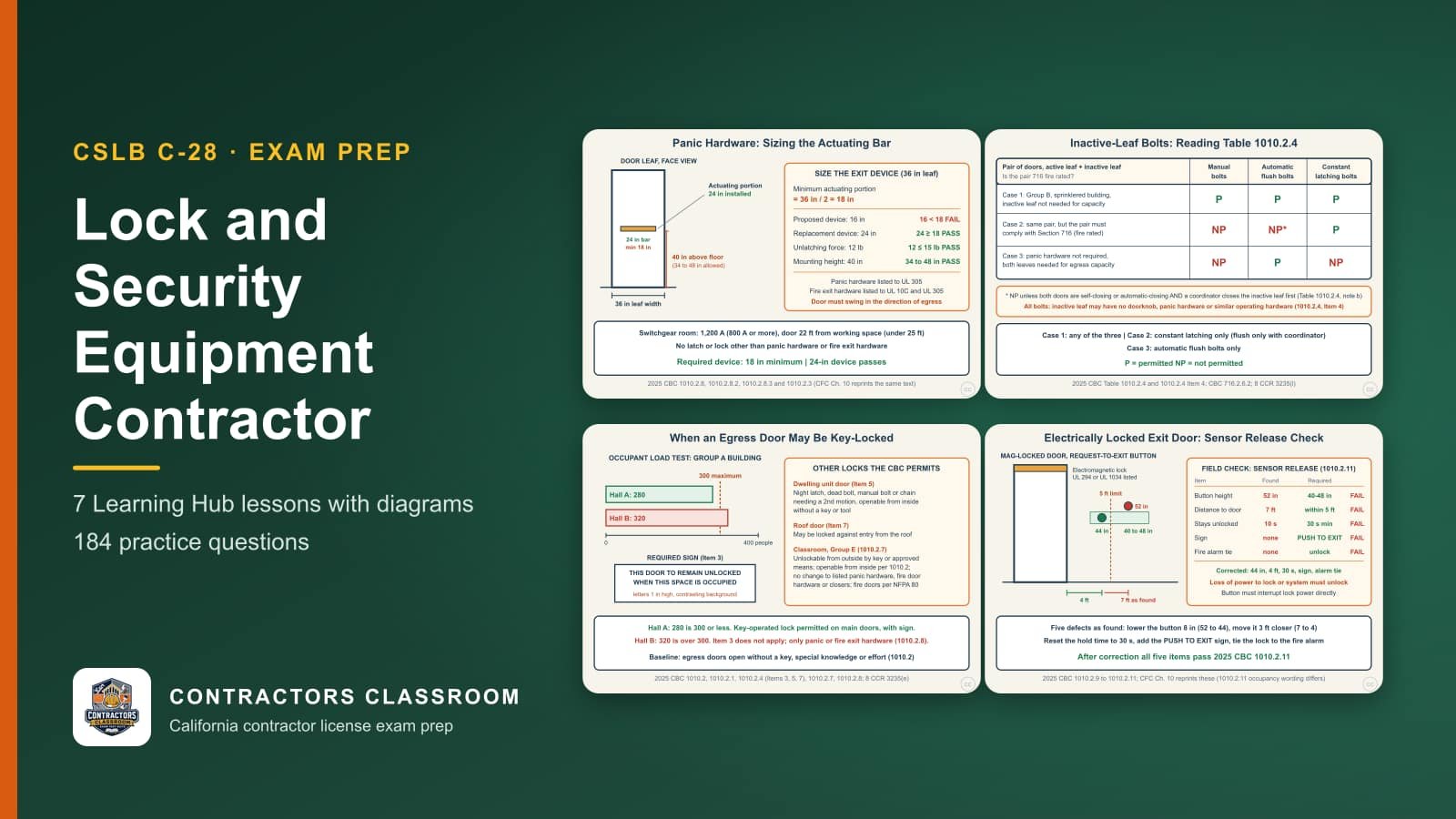
- A push bar or touch pad that releases a door latch under pressure from anyone leaving. Certain occupancies and rooms require it, and fire exit hardware is the version listed for use on fire-rated doors.
- Delayed egress lock
- A lock that, once someone pushes on the door, starts a short fixed delay before it releases, sounding an alarm in the meantime. Codes allow it only in certain buildings and require signs, a fire alarm release and limits on how many such doors are on a path.
- Electromagnetic lock
- A magnet on the frame that holds a steel plate on the door while energized. It has no moving parts and releases when power is cut, so its power supply must carry the combined current of all the magnets on it.
- Electric strike
- A frame-mounted strike plate that releases electrically so a latched door can be pulled open without turning the knob. Depending on its type it may stay locked or unlocked when power fails.
- Fail-safe and fail-secure
- Two behaviors of electrified locks on power loss. Fail-safe devices unlock and fail-secure devices stay locked, and the choice depends on the door's egress, fire alarm and security role.
- Request-to-exit sensor
- A motion detector or push button on the secure side that tells the access system a person is legitimately leaving, so no forced-door alarm sounds. On some doors it also releases the lock.
- Automatic flush bolts
- Bolts set into the edge of the fixed door leaf in a double-door opening that extend into the floor and head when the leaves close. They keep that leaf fixed without a visible bolt operated by hand.
- Door closer
- A spring and hydraulic mechanism that shuts a door under control, with adjustable valves for sweep and latch speeds. Fire doors need closers so they latch every time, and accessibility rules limit closing time and opening force.
- Hardware finish designation
- A short code naming a hardware finish, such as satin chrome, in two numbering systems that often map to the same finish. Reading these correctly on a schedule prevents ordering mismatched hardware.
- Mortise lock
- A heavy-duty lock body fitted into a pocket cut in the door edge, accepting trim, cylinders and many functions. Its installation needs accurate door preparation and compatible strikes.
- Backset
- The distance from the door edge to the center of the lock or latch bore. It must match the hardware and the frame preparation, or the latch will not meet the strike.
- Relocker
- A secondary locking device inside a safe that fires when someone attacks the door, blocking the bolt work even if the main lock is defeated. Drilling plans must avoid triggering it.
- Safe deposit lock
- A box lock in a bank vault that needs two different keys, the renter's key and the guard key, turned together. The arrangement keeps any one person from opening a box alone.
- Door coordinator
- A device above a pair of doors with overlapping edges that holds the active leaf back until the inactive leaf has closed. Without it, the leaves can jam and fail to latch.