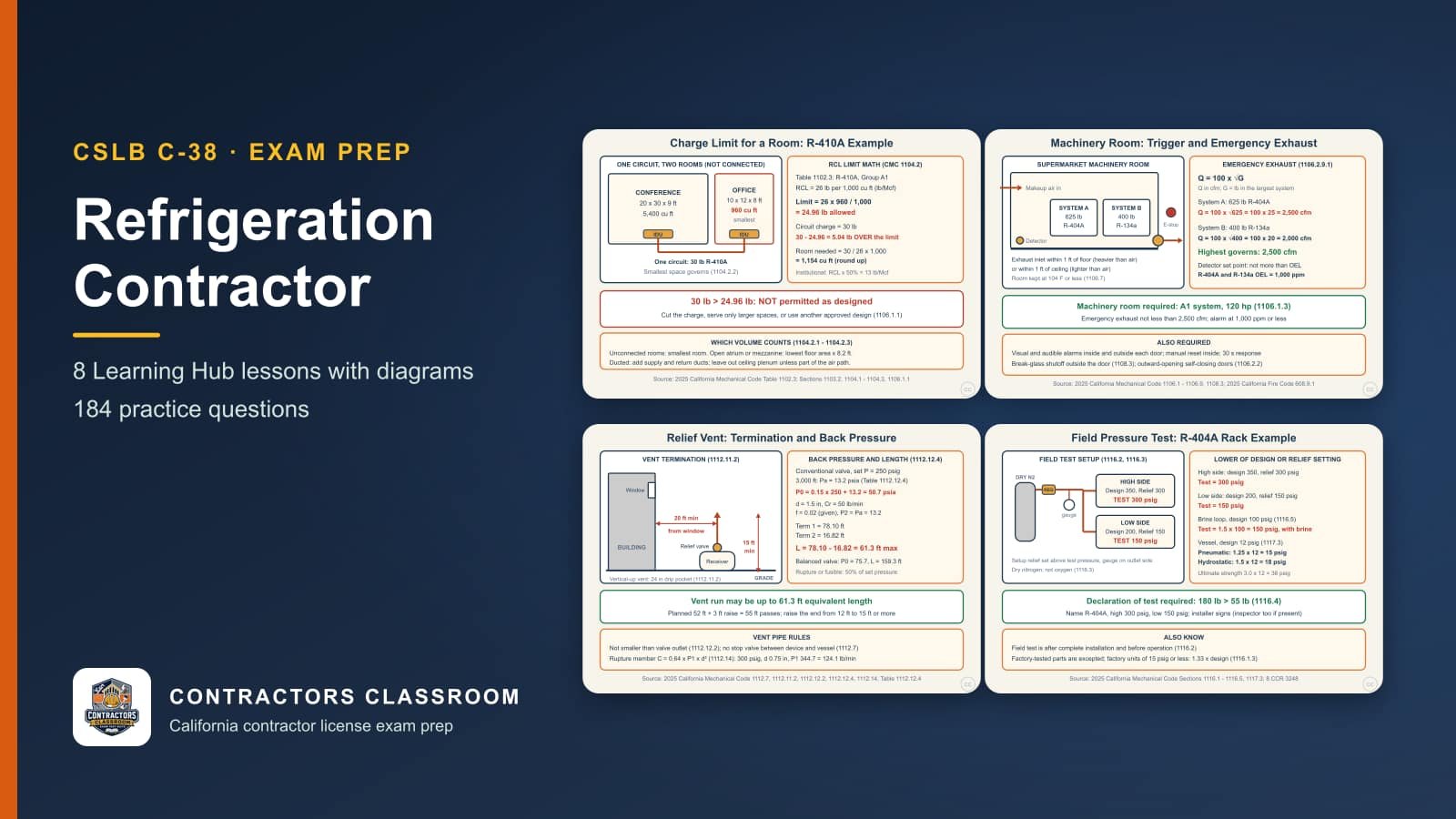
- Refrigerant concentration limit
- The most refrigerant, in pounds per thousand cubic feet, that room air may hold after one circuit leaks completely. Codes use it to cap the charge in systems serving occupied spaces, so the smallest room served usually decides the allowed amount.
- Machinery room
- A separate, ventilated room built to house refrigeration equipment when the charge or system type passes certain thresholds. It brings tight self-closing doors, detectors, alarms, emergency shutoff and exhaust requirements that ordinary equipment spaces do not have.
- Emergency exhaust
- Power-driven ventilation in a machinery room sized from the charge of the largest system, ready to clear a rupture. Air inlets sit low for refrigerant vapors that sink and high for vapors that rise, and makeup air must replace what is removed.
- Refrigerant detector
- A sensor in or near a machinery room that alarms when refrigerant reaches a set concentration, often tied to ventilation or shutoff. Its alarm level, self-test behavior and placement where a leak would collect are typical exam points.
- Relief valve vent line
- The discharge pipe that carries relieved refrigerant to a safe place outdoors. Its length, bends and size create back pressure that can reduce the valve's capacity, so the pipe cannot be smaller than the valve outlet and cannot contain a shutoff.
- Rupture disc
- A thin metal membrane built to burst at a set pressure and relieve a vessel. It is often installed ahead of a relief valve to prevent weeping, with a gauge between them that reveals a rupture.
- Fusible plug
- A plug made of low-melting alloy that softens at a set temperature, opening the vessel to relieve pressure during a fire. Unlike a relief valve it cannot reseal, and the vent pipe attached to it must be handled accordingly.
- Dry nitrogen pressure test
- A leak and strength test of refrigerant-containing parts using regulated, dry nitrogen. Oxygen and compressed air are not used, and the test setup needs a pressure regulator with an outlet gauge and a relief device.
- Declaration of test
- A dated, signed statement recording the refrigerant and the pressure applied to each side of the circuit during a field test of a larger system. It is paperwork, but it also proves the test was done, and it is one of the code compliance records a contractor keeps.
- Micron gauge
- An electronic vacuum gauge that reads very low absolute pressure. Evacuation is judged by how low the reading falls and whether it rises when the pump is isolated, because a rising reading signals moisture or a leak.
- Standing pressure test
- A hold period after pressurizing a system, during which the gauge must show no meaningful drop. Because temperature shifts change pressure, a small movement may be explained by the weather, so judging the result takes care.
- Tracer gas
- A small amount of detectable gas blended into the nitrogen used for a pressure test so a leak detector can find tiny leaks. It is added in a limited proportion, and the mix must remain nonflammable and nonreactive.
- Global warming potential
- A number comparing how strongly a refrigerant traps heat against carbon dioxide. High-potential refrigerants bring stricter leak-tightness rules in new store systems and drive the move toward lower-impact alternatives.
- Floating suction pressure
- A control approach that raises the target suction pressure when cooling demand is light. A warmer suction setting makes the compressors work less, which lowers energy use without hurting product temperatures.
- Liquid subcooling
- Cooling liquid refrigerant below its condensing temperature before it reaches the expansion device. It adds refrigerating capacity per pound of refrigerant and helps prevent flash gas, which is why low-temperature store systems are expected to use it.
- Saturated condensing temperature
- The temperature at which refrigerant condenses at the pressure inside the condenser. Designs hold it only a set number of degrees above outdoor air or wet-bulb temperature, because each extra degree raises compressor power.
- Heat recovery from refrigeration
- Capturing the heat that refrigeration systems reject and using it to warm space or water instead of releasing it outdoors. Retail food stores are expected to recover a share of that heat for heating, which links refrigeration to the building's energy design.
- Compressor overload protector
- A thermal or current-sensing device that opens the motor circuit when heat or amperage gets too high. It can be built into the motor or mounted outside, and line-duty and pilot-duty types connect differently, a distinction that appears in motor protection questions.
- Diaphragm element
- A flexible membrane that moves as pressure changes, operating a switch, valve or gauge. It is the standard pressure-sensing element, in contrast to a bimetal strip that responds to temperature, a float that tracks liquid level or a vane that senses airflow.
- Refrigerant recovery
- Removing refrigerant from a system into a listed recovery cylinder rather than venting it. Federal certification rules cover who may handle refrigerant, and the practice questions on this topic blend those rules with California safety requirements.